


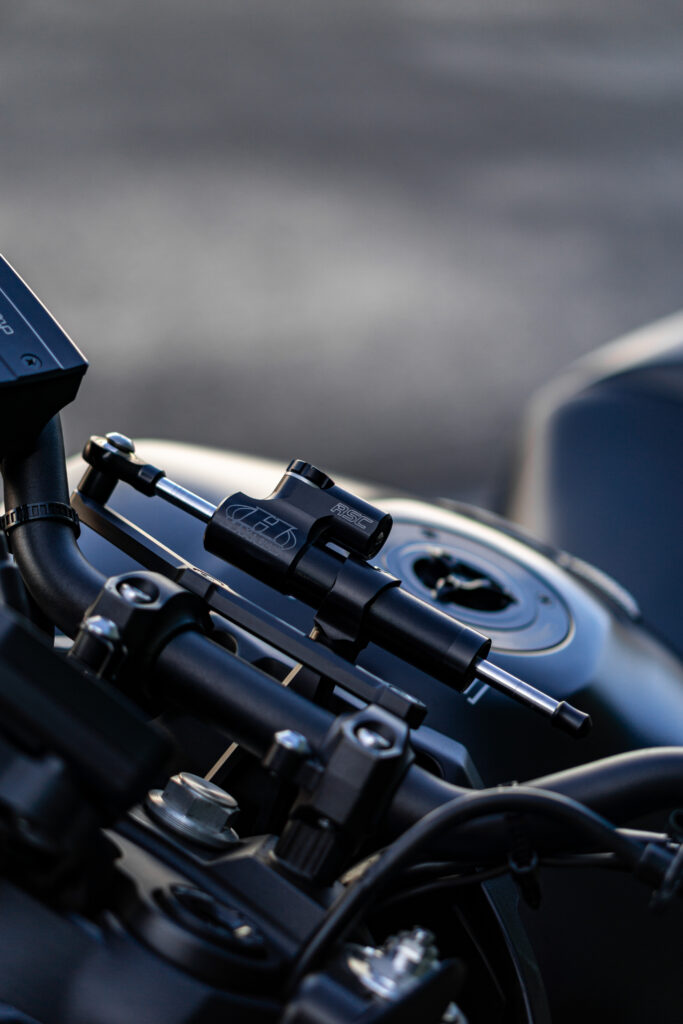
Superbikes use steering dampers to prevent tank-slappers and high-speed wobbles that can cause a rider to lose control. At the extreme speeds and lean angles these machines operate at, even small steering disturbances can amplify rapidly into dangerous oscillations. A steering damper absorbs those impulses before they escalate, keeping the front end stable and predictable.
The faster you ride, the more vulnerable your steering becomes to instability caused by road imperfections, braking forces, and aerodynamic turbulence. Superbikes are especially susceptible because their geometry, power output, and lightweight construction are tuned for performance rather than passive stability. The sections below break down exactly how steering dampers work, what types exist, and when you might need one on your own bike.
What happens to a superbike’s steering without a damper?
Without a steering damper, a superbike’s front wheel can enter a rapid, self-reinforcing oscillation known as a tank-slapper or speed wobble. This happens when a disturbance, such as a bump, a braking input, or a wheel leaving the ground briefly, causes the front wheel to deflect sideways. Without resistance, that deflection bounces back and forth with increasing violence, making the handlebars shake violently from side to side.
At low speeds, a rider’s grip and body weight are usually enough to dampen minor wobbles naturally. But at the speeds superbikes operate at, the physics change dramatically. The energy in the oscillation builds faster than a rider can physically counteract it. In racing and high-performance road riding, a tank-slapper can develop from a minor wobble to a crash-level event in under a second.
The problem is especially pronounced on superbikes because their geometry is optimized for cornering agility rather than straight-line stability. Short wheelbases, steep rake angles, and stiff suspension setups all reduce the natural self-correcting behavior that makes a touring bike feel planted. That is exactly why steering dampers became standard equipment on performance machines long before they appeared on everyday motorcycles.
Hyperpro
Ride with confidence
Find the nearest Hyperpro dealer and start your motorcycle upgrade.
How does a steering damper actually work?
A steering damper works by applying hydraulic resistance to the rotational movement of the steering head. It connects the front fork or triple clamp to the frame and uses a piston moving through oil to generate resistance. The faster the steering tries to move, the more resistance the damper produces, which suppresses rapid oscillations while still allowing normal, deliberate steering inputs to pass through unimpeded.
This speed-sensitive behavior is what makes a steering damper effective without making the bike feel heavy or unresponsive in corners. When you turn the handlebars intentionally at low speed, the movement is slow enough that the damper offers very little resistance. When a tank-slapper begins and the bars start whipping back and forth rapidly, the damper stiffens and absorbs the energy before it can build.
Most steering dampers are adjustable, allowing you to tune the level of damping to match your riding style, speed range, and the specific behavior of your motorcycle. Too little damping and the damper has minimal effect at speed. Too much and the steering feels heavy and unresponsive, which creates its own safety concerns. Finding the right setting is part of the setup process, and it often varies between track and road use.
What’s the difference between a rotary and a linear steering damper?
The key difference between a rotary and a linear steering damper is their physical orientation and how they convert steering movement into hydraulic resistance. A rotary damper mounts centrally at the steering head and rotates with it, while a linear damper uses a telescoping rod that extends and compresses as the bars move side to side. Both achieve the same goal through different mechanical approaches.
Rotary steering dampers
A rotary damper sits directly on top of the steering head, making it compact and clean in appearance. As the steering rotates, the internal mechanism turns with it and pushes oil through a valving system. This design works well on bikes where space is limited and a tidy installation matters, which is why it became popular on sportbikes and superbikes, where aesthetics and packaging are both priorities.
Linear steering dampers
A linear damper mounts between a fixed point on the frame and a moving point on the triple clamp or fork. As the bars turn, the rod extends or compresses, and the oil inside resists that movement. Linear dampers can offer more progressive damping characteristics across a wider range of movement, which makes them a strong choice for bikes where the steering arc is large or where the rider wants finer control over the damping curve.
Our steering damper range covers both approaches. The CSC model delivers constant linear damping across all steering speeds, while the RSC model uses a progressive damping curve that increases resistance as steering speed rises, providing more nuanced control without sacrificing normal handling feel.
Do all motorcycles need a steering damper?
Not all motorcycles need a steering damper, but many benefit from one. Bikes with long wheelbases, relaxed geometry, and lower top speeds, such as cruisers and standard commuters, are naturally more stable and rarely experience the kind of high-speed oscillations that make a damper necessary. Performance-oriented motorcycles, however, especially those ridden at high speeds or on track, are much more likely to benefit from one.
Several factors increase the likelihood that a bike will benefit from a steering damper:
- High power-to-weight ratio: More power means more potential for the front wheel to unload under acceleration, which is a common trigger for wobbles.
- Aggressive geometry: Short wheelbases and steep rake angles reduce natural steering stability.
- Lightweight construction: Less mass means less inertia to resist oscillation once it starts.
- Track or high-speed road use: The faster you ride, the less time you have to react and the more energy is involved in any instability.
- Aftermarket modifications: Changes to suspension, tires, or ergonomics can shift a bike’s handling balance in ways that increase instability.
Even on bikes where a tank-slapper has never occurred, a steering damper adds a layer of safety that becomes relevant in unexpected situations, such as hitting a pothole at speed or recovering from a sudden swerve.
When should you upgrade to an aftermarket steering damper?
You should upgrade to an aftermarket steering damper when your current setup, whether factory-fitted or absent entirely, no longer matches the demands of how you ride. This applies most directly if you have increased your bike’s power, changed your suspension, started riding on track, or if you have experienced any steering instability at speed. An aftermarket damper gives you adjustability that most stock units simply do not offer.
Factory steering dampers, when fitted, are calibrated for a specific range of riding conditions and a broad audience. They are a compromise. An aftermarket unit lets you dial in the damping level to suit your weight, your riding style, your tire choice, and the specific tracks or roads you ride. That level of control matters when you are pushing harder or riding in conditions where stability margins are tighter.
Beyond performance, there is also a fitment consideration. Many motorcycles leave the factory without any steering damper at all, even models that are clearly capable of speeds where instability becomes a real risk. Adding a damper to these bikes is a straightforward upgrade that significantly raises the safety ceiling. Explore the full range of Hyperpro suspension products to see what is available for your specific model.
How Hyperpro helps you ride with more control
We design our steering dampers specifically to address the instability problems described throughout this article, with two models built for different riding demands and a full range of model-specific mounting kits to make installation straightforward.
- CSC (Constant Safety Control): A linear damping model with 22 adjustable positions, delivering consistent resistance across all steering speeds for predictable, reliable control.
- RSC (Reactive Safety Control): A progressive damping model that increases resistance as steering speed rises, offering more nuanced performance for riders who want finer control at higher speeds.
- CNC-milled mounting kits: Model-specific brackets machined in Hyperpro Gold or Black, designed as plug-and-play fitments that require no drilling or cutting in 98% of applications.
- Broad model coverage: Kits are available for a wide range of street, sport, and adventure motorcycles, so you get a clean, engineered fit rather than a generic solution.
If you have questions about which damper suits your bike and riding style, get in touch with us directly. To purchase, find your nearest authorized dealer through our dealer locator and get the right setup for your motorcycle.