


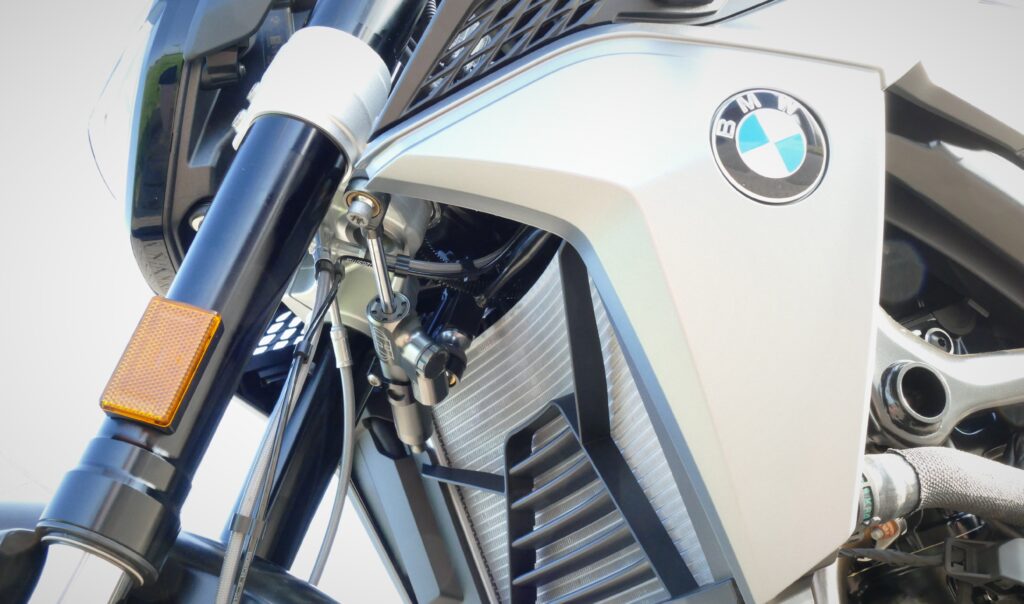
An inline steering damper is a hydraulic device mounted in a straight line between the steering head and the frame of a motorcycle, designed to resist sudden, uncontrolled handlebar movements. It works by using fluid resistance to absorb the energy of wobbles and tank-slappers before they escalate into a loss of control. The sections below cover how it works, how it compares to other damper types, and how to get the most from one on your bike.
How does an inline steering damper work?
An inline steering damper works by connecting a hydraulic cylinder between two fixed points on the motorcycle, typically the frame and a bracket near the steering head. As the handlebars turn, the cylinder extends or compresses, forcing fluid through internal valves. That fluid resistance absorbs sudden, high-speed steering inputs while allowing normal, deliberate steering to pass through unhindered.
The key mechanism is damping force. When the front wheel hits a bump or loses traction momentarily, the handlebars try to snap left or right with significant force. The damper’s internal valves restrict how quickly fluid can move through the cylinder, which slows that snap down to a manageable movement. The rider still steers the bike normally because low-speed, intentional inputs generate far less force than a wobble or tank-slapper.
Most inline dampers are adjustable, meaning you can increase or decrease the resistance to suit your riding style, road conditions, or speed range. A stiffer setting suits high-speed track use, while a softer setting keeps steering light and responsive on winding roads. The damper operates passively, requiring no electronics or power source to function.
Hyperpro
Ride with confidence
Find the nearest Hyperpro dealer and start your motorcycle upgrade.
What’s the difference between an inline and a rotary steering damper?
The main difference between an inline and a rotary steering damper is their physical configuration and mounting position. An inline damper is a linear hydraulic cylinder that mounts horizontally between the frame and steering head. A rotary damper is a compact disc-shaped unit that mounts directly on top of the steering stem, rotating as the bars turn. Both resist unwanted steering movement, but they do so through different mechanical principles.
An inline damper uses the extension and compression of a cylinder to generate resistance. Because it mounts along the side of the bike, it requires a pair of mounting brackets and a small amount of clearance along the frame. This makes it highly adjustable and easy to service, and the longer cylinder body allows for a greater range of damping force.
A rotary damper uses a vane or rotor mechanism inside a sealed housing. Its compact profile sits neatly at the top of the forks, which makes it popular on sport bikes where space around the steering head is limited. However, the rotary design can be more sensitive to mounting precision, and the damping curve behaves differently at extreme lock angles.
For riders who want straightforward adjustability and a proven, serviceable design, the inline format is often the more practical choice. For bikes where packaging space is tight or a low-profile look matters, a rotary unit may be preferable. The right choice depends on your specific bike model and how you intend to use the damper.
What causes handlebar wobble that a steering damper fixes?
Handlebar wobble, often called a tank-slapper or speed wobble, is caused by a rapid, self-reinforcing oscillation of the front wheel and steering assembly. It typically starts when the front tyre loses and regains traction quickly, for example after a bump, a patch of gravel, or a moment of front-wheel lift. Without sufficient damping, the steering geometry can amplify rather than absorb that initial disturbance.
Several factors make wobble more likely to occur:
- High speed: At greater speeds, the gyroscopic forces acting on the front wheel become harder to manage, and a small disturbance can escalate faster than a rider can react.
- Worn or under-inflated tyres: Tyres that are not in optimal condition respond inconsistently to road surfaces, increasing the chance of a traction interruption.
- Loose or worn steering head bearings: Any play in the steering head allows the fork assembly to move more freely than the geometry was designed to permit.
- Soft or incorrectly set suspension: Front suspension that is too soft or incorrectly set up allows the front end to dive and recover in ways that can trigger oscillation.
- Uneven weight distribution: A heavily loaded rear with a light front end reduces front tyre contact pressure, making the wheel more susceptible to lifting and losing grip momentarily.
A steering damper addresses the oscillation itself rather than its root cause. By resisting the rapid left-right movement of the handlebars, it interrupts the feedback loop that would otherwise allow a small wobble to grow into a full tank-slapper. It is a safety layer that works alongside, not instead of, properly maintained steering and suspension components.
What motorcycles benefit most from an inline steering damper?
Motorcycles that benefit most from an inline steering damper are those ridden at higher speeds, those with a geometry that makes them more sensitive to front-end disturbances, or those used on surfaces where traction is unpredictable. Sport bikes, naked bikes, and adventure motorcycles are the categories where a steering damper delivers the most noticeable improvement in confidence and control.
Sport and superbike riders operate at speeds where a tank-slapper can develop in a fraction of a second. The aggressive geometry of these bikes, with short wheelbases and steep rake angles, makes them responsive and fast-turning but also more reactive to disturbances. A damper gives the rider a meaningful safety margin at track days and fast road riding.
Adventure and dual-sport riders face a different challenge. Off-road surfaces, gravel roads, and rutted tracks regularly cause the front wheel to skip and deflect. Without a damper, these deflections transfer directly to the handlebars and can pull the bike off line or cause a wobble on the return to tarmac. An inline damper smooths out those inputs and keeps steering controllable across mixed terrain.
Naked and street bikes also benefit, particularly at motorway speeds where a sudden gust of wind or a mid-corner bump can unsettle the front end. Even riders who never push their bike hard notice the added stability a damper provides during everyday riding.
Bikes that are less likely to need a damper include low-speed urban commuters, cruisers with long wheelbases and relaxed geometry, and any motorcycle already equipped with an effective factory-fitted damping system. That said, any rider who has experienced front-end instability on their bike, regardless of category, has good reason to consider adding one. You can browse motorcycle suspension products to find fitment-specific options for your model.
How do you adjust an inline steering damper?
You adjust an inline steering damper by turning the adjustment knob or dial, typically located at one end of the cylinder, to increase or decrease the damping resistance. Most dampers use a numbered click system so you can track your setting and return to it easily. Start with a softer setting for normal road riding and increase resistance incrementally if you notice instability at higher speeds or on rough surfaces.
A practical approach to finding your ideal setting follows a simple process:
- Start at the softest setting. This ensures the damper does not interfere with normal steering feel while you get used to its presence on the bike.
- Ride at your typical pace and pay attention to how the front end feels through corners, over bumps, and during braking.
- Increase damping in small steps if you experience any wobble, instability, or vagueness in the steering. Add one or two clicks at a time rather than jumping to a much stiffer setting.
- Check that steering remains light. If the bars feel heavy or slow to respond in corners, the setting is too stiff for your riding conditions. Reduce it slightly.
- Adjust for conditions. A stiffer setting suits track use or fast motorway riding. A softer setting is better for tight, technical roads where quick steering changes are frequent.
Never set a damper so stiff that it noticeably resists your normal steering inputs. The damper should be invisible during regular riding and only become active when an unwanted, rapid steering force occurs. If you are unsure about the right setting for your specific bike and riding style, a Hyperpro dealer can advise you based on your model and use case.
How Hyperpro helps you control handlebar wobble
We design our steering dampers specifically to give riders a reliable, adjustable safety layer against tank-slappers and front-end instability. Our range covers two performance levels to match different riding needs:
- CSC (Constant Safety Control): A linear damping model that delivers consistent resistance across the full range of steering movement, with 22 adjustable positions to fine-tune the feel for your riding style.
- RSC (Reactive Safety Control): A progressive damping model that remains soft during normal steering and firms up automatically when a sudden, high-force input occurs, such as a tank-slapper. Also adjustable in 22 positions.
- Model-specific mounting kits: CNC-milled brackets designed for your exact bike, available in Hyperpro Gold or Black. In 98% of applications, fitting requires no drilling or cutting, making installation straightforward.
Every component in our steering damper system is engineered to work together, so you get a plug-and-play upgrade that fits correctly and performs immediately. If you want to find the right damper for your motorcycle, contact your nearest Hyperpro dealer through our contact page or use our dealer locator to get expert advice on fitment and setup. Purchases are always handled through our authorised distributor network to ensure you receive genuine products with full support.