


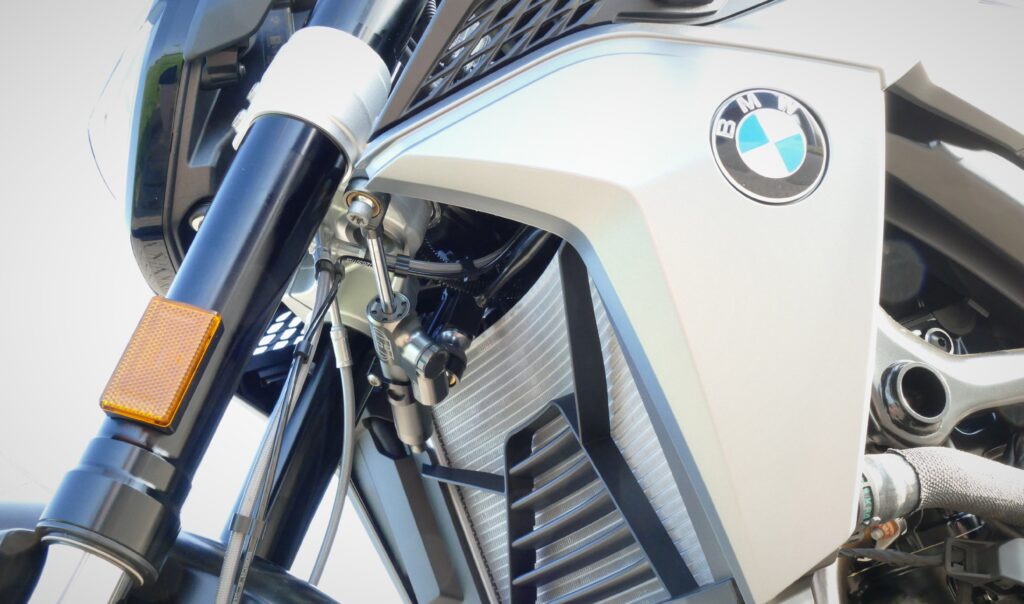
Yes, a steering damper is compatible with stock handlebars in the vast majority of cases. Most modern steering dampers are designed to work alongside your existing handlebar setup without requiring you to replace or modify the bars themselves. The damper mounts to the frame and steering head area, not to the handlebars directly, which means your grip position and bar configuration stay exactly as they are.
That said, fitment depends on the type of damper and the mounting kit used. Bike-specific mounting hardware is what bridges the gap between a universal damper unit and your particular motorcycle, and choosing the right kit makes all the difference. The questions below walk through everything you need to know before buying.
Will a steering damper work with stock handlebars?
A steering damper works with stock handlebars because it does not attach to the bars at all. The damper connects between the frame or triple clamp and a fixed point on the chassis, resisting unwanted steering movement without interfering with how your handlebars are positioned, shaped, or adjusted. Your stock setup remains fully intact.
This is one of the most common misconceptions riders have before buying a steering damper. Because the damper controls rotational or linear resistance at the steering axis, it operates independently of the handlebar style. Whether your bike runs clip-ons, a crossbar, or high-rise adventure bars, the damper system works the same way. The only requirement is that your motorcycle has compatible mounting points, which is where a model-specific mounting kit becomes important.
What mounting hardware does a steering damper require?
A steering damper requires a mounting kit that connects the damper body to the frame or subframe and attaches the damper rod to the steering head or triple clamp. The kit typically includes brackets, bolts, and pivot hardware specific to your motorcycle model. Without the correct mounting kit, a damper cannot be fitted safely or securely.
Generic or universal mounting solutions exist, but they often require drilling, cutting, or fabrication work that most riders want to avoid. Model-specific mounting kits eliminate that problem entirely. We design and manufacture CNC-milled mounting kits for a wide range of motorcycles, available in Hyperpro Gold or Black finishes. In 98% of applications, these kits are true plug-and-play fitments that use existing bolt holes on the bike, requiring no modification to the frame or bodywork whatsoever.
When evaluating any mounting kit, check for the following:
- CNC-milled construction for precision and durability
- Model-specific design rather than a universal bracket with adapters
- Compatibility with both the damper body and your frame mounting points
- A finish that matches or complements your bike’s aesthetic
Hyperpro
Ride with confidence
Find the nearest Hyperpro dealer and start your motorcycle upgrade.
Does installing a steering damper affect handlebar movement or reach?
Installing a steering damper does not reduce your steering range or change how far you can reach the handlebars. The damper resists sudden, unintended movement rather than limiting deliberate steering input. At normal riding speeds and during intentional turns, you steer the bike exactly as you would without a damper fitted.
What the damper does affect is the resistance you feel during rapid, uncontrolled steering events such as tank-slappers, speed wobbles, or sharp impacts from road debris. In those moments, the damper applies resistance to slow down the oscillation and return control to the rider. This is a safety function, not a restriction on normal handling.
Riders sometimes worry that a steering damper will make the bike feel heavy or slow to respond in corners. In practice, a properly set damper at the correct adjustment level for your riding style is barely noticeable during everyday riding. The resistance only becomes apparent when the steering moves faster than a deliberate turn would require, which is precisely the situation where you want intervention.
What’s the difference between a rotary and linear steering damper?
A rotary steering damper mounts centrally at the steering axis and resists rotational movement directly, while a linear steering damper uses a piston-and-cylinder mechanism mounted alongside the frame to resist steering movement through a push-pull action. The key difference is where and how each type generates damping force, which affects mounting options and damping characteristics.
Rotary steering dampers
Rotary dampers sit at the top of the steering head and rotate with the bars. Because they mount at the pivot point itself, they tend to offer a compact, low-profile installation. Their damping force is applied directly to the steering axis, which many riders find delivers a very linear and predictable feel. They are a common choice on sport and naked bikes where space around the triple clamp is limited.
Linear steering dampers
Linear dampers, sometimes called hydraulic bar-end or cylinder-type dampers, mount along the frame and connect via a rod to the steering assembly. As the bars turn, the rod pushes or pulls through the cylinder, generating resistance. This design allows for progressive damping characteristics, meaning the resistance can increase as steering deflection increases. We offer two linear damper models: the CSC (Constant Safety Control) for consistent damping across all 22 adjustment positions, and the RSC (Reactive Safety Control) for progressive damping that responds proportionally to the speed and severity of the steering event.
How do you know which steering damper fits your motorcycle?
The most reliable way to confirm which steering damper fits your motorcycle is to use a model-specific fitment guide or product catalogue that matches dampers and mounting kits to your exact make, model, and year. A steering damper that fits one bike will not necessarily fit another, even within the same brand family, because frame geometry and mounting point locations vary between models.
When checking fitment, you need to confirm two things separately: that the damper unit itself is compatible with your bike’s steering geometry, and that a matching mounting kit exists for your specific model. Both elements must be present for a clean, safe installation.
You can browse our full product range to find dampers and mounting kits listed by motorcycle model. If your bike is not listed or you are unsure which combination is correct, contact us directly and we will point you in the right direction. Purchases are always made through an authorised distributor, so once you have confirmed the right fitment, a dealer near you can handle the order and, if needed, the installation.
How Hyperpro helps you fit a steering damper to your bike
We make it straightforward to add a steering damper to your motorcycle without guesswork, fabrication work, or compatibility headaches. Here is what we offer:
- Two damper models for different riding needs: the CSC for consistent, adjustable damping and the RSC for progressive damping that reacts to the severity of the steering event
- 22 adjustment positions on both models, so you can dial in the damping level that suits your riding style and road conditions
- CNC-milled model-specific mounting kits in Hyperpro Gold or Black, designed as plug-and-play fitments for a wide range of motorcycle models
- No drilling or cutting required in 98% of applications, keeping your bike’s frame and bodywork fully intact
- A global dealer network to handle purchases and professional installation close to you
If you are ready to improve steering stability and ride with more confidence, find your nearest authorised dealer through our dealer locator and ask about the right steering damper setup for your motorcycle.