


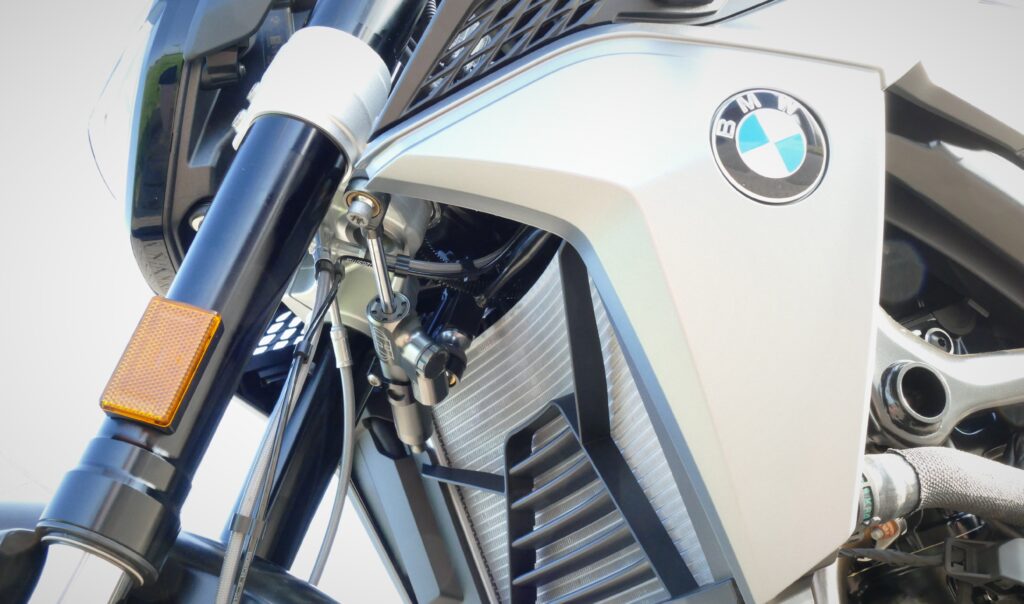
A rotary steering damper is a hydraulic device that controls unwanted handlebar movement by converting rotational steering input into resistance through a fluid-filled rotary mechanism. Unlike a linear (piston-based) damper, it mounts flat against the top of the steering head and resists rotation directly, making it more compact and better suited to modern motorcycle geometry. The sections below answer the most common questions riders have about how rotary steering dampers work, why they matter, and how to choose and set one up.
How does a rotary steering damper work?
A rotary steering damper works by using a vane or rotor submerged in hydraulic fluid inside a sealed housing. As the handlebars turn, the rotor moves through the fluid, generating resistance that slows rapid or uncontrolled steering inputs. The damping force is proportional to the speed of the steering movement, so gentle cornering inputs pass through freely while sudden, violent handlebar kicks are absorbed.
The housing is fixed to the frame or top yoke, and a central shaft connects to the opposing part of the steering assembly. When the front wheel deflects, the shaft rotates inside the housing. Hydraulic fluid is displaced from one chamber to another through calibrated ports, and the resistance created by that flow is what the rider feels as damping. Adjusting the size or restriction of those ports changes how firm or soft the damping response feels.
Because the resistance is generated by rotation rather than linear travel, the unit can be made very thin and positioned close to the steering axis. This keeps the center of gravity low and avoids the leverage arm associated with a traditional linear damper mounted across the front end.
Hyperpro
Ride with confidence
Find the nearest Hyperpro dealer and start your motorcycle upgrade.
What are the benefits of a rotary steering damper over a linear one?
A rotary steering damper offers a more compact profile, a cleaner installation, and a more direct damping response compared to a linear steering damper. Because it sits flat on top of the steering head rather than spanning across the front end, it adds minimal weight, keeps the cockpit uncluttered, and avoids the geometry complications that come with mounting a longer linear unit.
The key practical differences between the two types come down to packaging and performance:
- Compact size: A rotary unit occupies far less space than a linear damper, which is important on sport and adventure bikes with tight front-end packaging.
- Direct damping: Because the damper acts directly on the steering axis rather than through a lever arm, the response is more consistent across the full steering range.
- Cleaner aesthetics: No external rod or bracket spans the front end, which matters to riders who want a factory-finished appearance.
- Progressive response options: Rotary designs lend themselves well to progressive damping curves, where resistance builds more aggressively as steering speed increases.
Linear dampers still have their place, particularly on bikes where a rotary mounting position is not available or where the rider prefers a simpler, lower-cost solution. But for most modern street and sport motorcycles, the rotary format delivers a more refined result.
What causes a motorcycle to need a steering damper?
A motorcycle needs a steering damper when the front end becomes unstable under conditions that generate rapid, uncontrolled handlebar movement. The most common triggers are tank-slappers (also called speed wobbles), road surface irregularities at high speed, and the aerodynamic instability that comes from lifting the front wheel and putting it back down.
Several factors increase the likelihood of these instabilities:
- High-speed riding: At elevated speeds, small steering disturbances can amplify rather than dampen naturally through the bike’s geometry.
- Lightweight front ends: Sport and naked bikes with minimal front-end mass are more susceptible to oscillation after an impact or wheel lift.
- Worn or soft suspension: A front fork that lacks sufficient damping allows the wheel to deflect more freely, which makes a steering wobble harder for the bike to self-correct.
- Road surface changes: Expansion joints, gravel patches, and mid-corner bumps can introduce a sudden lateral force to the front wheel.
- Wheelies and hard acceleration: When the front wheel returns to the ground at speed, the fork can oscillate briefly before settling, and without a damper, that oscillation can escalate.
A steering damper does not fix underlying suspension problems, but it adds a controlled resistance layer that prevents a manageable disturbance from becoming a dangerous tank-slapper.
How is a rotary steering damper mounted on a motorcycle?
A rotary steering damper mounts between the top yoke (triple clamp) and the frame, with one part fixed to the frame and the other rotating with the steering. A model-specific mounting kit holds the damper body in the correct position and connects it to the steering assembly without requiring any modification to the bike.
The installation process generally follows these steps:
- Remove the existing top yoke hardware or handlebar clamps as required by the kit instructions.
- Attach the fixed bracket to the frame or headstock using the provided hardware.
- Mount the damper body to the bracket so it sits flat and centered over the steering axis.
- Connect the rotating arm or shaft to the top yoke so it moves with the handlebars.
- Check full lock-to-lock steering travel to confirm the damper does not restrict movement or bind at any point.
- Set the initial damping adjustment before the first ride and fine-tune from there.
Quality mounting kits are designed as plug-and-play fitments for specific bike models, which means no drilling, cutting, or fabrication is needed in the vast majority of cases. This makes the installation accessible to riders who are comfortable with basic mechanical work.
How do you adjust a rotary steering damper?
You adjust a rotary steering damper by turning the adjustment knob or dial, which changes the restriction on the hydraulic fluid flow inside the unit. Most rotary dampers offer a numbered range of positions, and turning toward a higher number increases damping resistance while turning toward a lower number softens it.
Finding the right setting is a process of trial and refinement:
- Start at a mid-range setting: Begin with the damper set roughly in the middle of its adjustment range so you have room to go firmer or softer based on feel.
- Test at low speed first: A damper set too firm will make the steering feel heavy and slow to respond in tight turns, which you will notice immediately at parking-lot speeds.
- Increase gradually for high-speed stability: If you experience any front-end wobble or nervousness at speed, add one or two clicks of firmness and retest.
- Avoid over-damping: A setting that is too firm reduces your ability to steer quickly in an emergency and makes the bike feel unresponsive.
Riders who use their bikes across a wide range of conditions, from slow urban riding to motorway cruising, may find it helpful to adjust the damper between sessions. Many Hyperpro steering damper models offer 22 adjustment positions, which gives a wide and precise range to dial in the right balance for different riding styles and road types.
Which motorcycles benefit most from a rotary steering damper?
Sport bikes, naked bikes, and adventure motorcycles benefit most from a rotary steering damper because their geometry, power output, and intended riding conditions make them more vulnerable to steering instability. Lightweight front ends, high power-to-weight ratios, and frequent high-speed use all increase the likelihood of a tank-slapper or wobble event.
Specific use cases where a steering damper delivers the most noticeable improvement include:
- Track day riding: High corner-entry speeds and aggressive braking create conditions where front-end instability is both more likely and more dangerous.
- Long-distance touring at motorway speeds: Sustained high-speed riding increases sensitivity to crosswinds, road irregularities, and aerodynamic disturbances.
- Off-road and adventure riding: Rough terrain generates constant lateral forces on the front wheel, and a damper prevents those forces from building into a full wobble.
- Bikes with a known instability: Some models have a documented tendency toward steering wobble at certain speeds, and a damper is one of the most direct ways to address that characteristic.
Cruisers and low-speed commuter bikes typically have geometry that is naturally more stable, so the benefit is less pronounced. However, any motorcycle ridden frequently at speed or on imperfect road surfaces can gain a meaningful safety and confidence advantage from a well-set steering damper.
How we can help you ride with more confidence
At Hyperpro, we design steering dampers specifically to address the instability issues described above. Our range covers two damping philosophies and fits a wide variety of motorcycle models:
- CSC (Constant Safety Control): A linear damping model that delivers consistent resistance across the full range of steering movement, adjustable across 22 positions.
- RSC (Reactive Safety Control): A progressive damping model that builds resistance as steering speed increases, so normal riding inputs feel natural while sudden wobbles are absorbed aggressively.
- Model-specific mounting kits: We CNC-mill bike-specific brackets in Hyperpro Gold or Black that fit directly to your motorcycle without drilling or cutting in 98% of applications.
If you want to know which damper fits your specific motorcycle or need advice on the right adjustment range for your riding style, get in touch with us. Purchases are made through our authorized distributor network. Use our dealer locator to find the closest point of sale and get your upgrade sorted.