


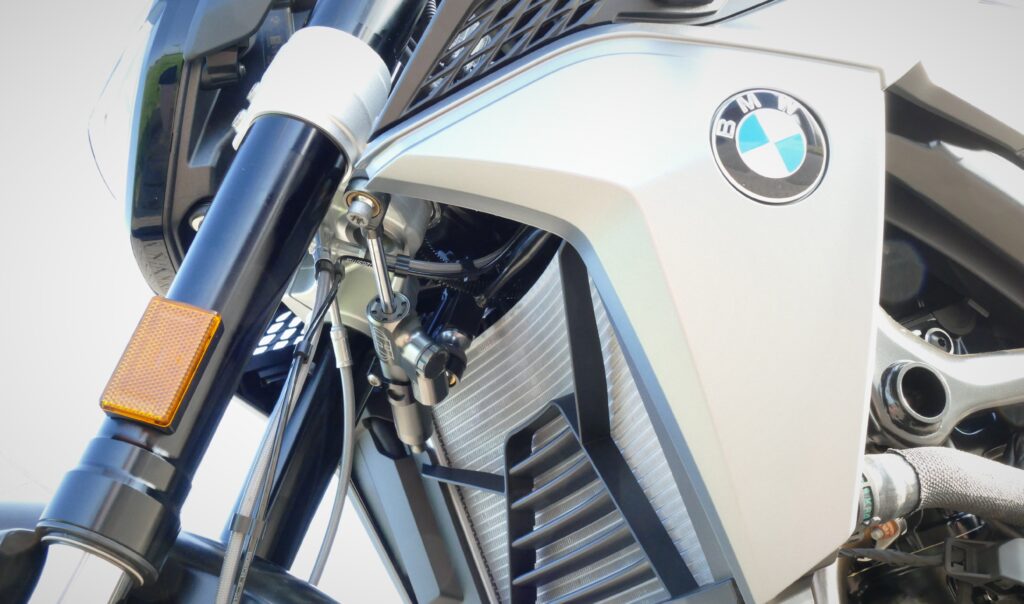
Budget and premium steering dampers differ primarily in their damping technology, build quality, and adjustability. A budget damper typically uses basic linear damping that applies the same resistance regardless of speed or input, while a premium damper uses progressive or reactive damping that adapts to riding conditions. For riders who push their bikes hard or ride at speed, that difference translates directly into safety and confidence. Below, we break down the key questions riders ask when choosing between price tiers.
How does damping technology differ between price tiers?
Budget steering dampers use linear damping, which applies a fixed level of resistance throughout the full range of handlebar movement. Premium dampers use progressive or reactive damping technology that varies resistance based on the speed and force of the steering input. This means a high-end damper stays light and responsive during normal cornering but firms up instantly when a tank-slapper or wobble begins.
Linear damping works reasonably well in predictable, low-speed situations. The problem is that real-world riding is unpredictable. A sudden wobble at motorway speed generates a very different steering force than a slow-speed parking manoeuvre, and a fixed-resistance damper cannot distinguish between the two. Progressive damping solves this by scaling its response to the actual input, giving you natural steering feel when you want it and firm control when you need it.
This distinction is not just a marketing claim. It reflects a genuine mechanical difference in how the damper’s internal valving and fluid channels are engineered. Budget units often use simpler valving with fewer internal components, which limits their ability to modulate resistance dynamically.
Hyperpro
Ride with confidence
Find the nearest Hyperpro dealer and start your motorcycle upgrade.
What materials and build quality separate cheap from high-end dampers?
Premium steering dampers are typically machined from billet aluminium or aerospace-grade alloys, with tight internal tolerances that prevent fluid bypass and maintain consistent performance over time. Budget dampers often use cast or lower-grade aluminium housings with less precise internal machining, which can lead to inconsistent damping, fluid degradation, and early wear.
The differences show up in several specific areas:
- Housing construction: CNC-milled housings on premium units hold tighter tolerances and resist flex under load, keeping the damping action consistent and predictable.
- Seals and fluid: High-end dampers use quality seals and purpose-formulated hydraulic fluid that resist heat and maintain viscosity. Cheaper units may use generic seals that degrade faster, causing fluid leaks or changes in damping feel.
- Mounting hardware: Premium dampers often come with model-specific mounting kits that fit without modification, reducing stress on the damper body and frame. Budget kits frequently require adaptation, which can introduce unwanted flex or misalignment.
- Finish and corrosion resistance: Anodised or hard-coated finishes on premium units protect against road grime, moisture, and UV exposure over years of riding.
Build quality also affects long-term reliability. A well-constructed damper maintains its performance characteristics across thousands of kilometres. A cheaper unit may feel acceptable when new but drift noticeably as internal components wear.
Does a premium steering damper actually improve safety and control?
Yes, a premium steering damper improves safety and control in measurable ways, particularly at higher speeds and in situations where the front wheel loses traction momentarily. By resisting rapid, uncontrolled handlebar movement during wobbles and tank-slappers, a quality damper gives the rider time to respond and the bike time to stabilise. Normal steering inputs remain light and unaffected.
The safety benefit is most apparent in three scenarios:
- High-speed stability: At motorway speeds, even small aerodynamic disturbances or surface irregularities can trigger a wobble. A reactive damper suppresses this before it escalates.
- Mid-corner bumps: Hitting a bump while leaned over can cause the front wheel to deflect. A damper limits how far and how fast the bars move in response.
- Braking instability: Hard braking on uneven surfaces can induce oscillation. A steering damper reduces the amplitude of these oscillations, keeping the bike tracking straight.
A budget damper with linear resistance can help in these situations too, but its fixed resistance may be too light to suppress a fast wobble effectively, or too heavy to allow natural steering at low speeds. A progressive damper avoids this compromise by scaling its response to the situation.
Are budget steering dampers adjustable?
Most budget steering dampers offer limited or no adjustability. Some include a basic dial with a few click positions, but the range is narrow and the increments are coarse. Premium dampers typically offer a wide adjustment range with clearly defined positions, allowing riders to fine-tune damping to their riding style, bike weight, and road conditions.
Adjustability matters because the right damping level varies between riders and situations. A lighter rider on a naked street bike needs different damping than a heavier rider on a loaded adventure bike. Without meaningful adjustment range, a fixed-resistance budget damper forces you to accept a compromise setting rather than dialling in what actually works for your setup.
Wide adjustment range also means the damper stays useful as your riding evolves. You can soften it for relaxed touring and firm it up for track days or fast mountain roads, all without replacing any components. That flexibility has real long-term value.
When is it worth spending more on a steering damper?
Spending more on a steering damper is worth it when you ride at higher speeds, on varied road surfaces, or with a bike that is known to be prone to wobbles or instability. It is also worth it when you want adjustability, long-term reliability, and a fitment that does not require drilling or cutting your frame. For casual low-speed urban riding on a stable platform, a basic damper may be sufficient.
Consider upgrading to a premium unit if any of the following apply:
- You regularly ride above 100 km/h on open roads or motorways
- Your bike has a known tendency towards front-end instability or tank-slappers
- You carry a pillion or luggage that shifts the weight balance
- You ride on mixed surfaces, including gravel, wet roads, or poorly maintained tarmac
- You want a plug-and-play fitment without custom fabrication
- You plan to keep the bike long-term and want components that last
The cost difference between a budget and a premium damper is often smaller than riders expect when measured against the years of reliable service a quality unit provides. When you factor in the safety benefit and the reduced need for replacement, the premium option frequently represents better value over time.
How Hyperpro helps you choose the right steering damper
We design our steering damper systems specifically to address the limitations that make budget units fall short. Our range includes two distinct models built around different riding needs:
- CSC (Constant Safety Control): A linear damping model with 22 adjustable positions, delivering consistent resistance across the full range of steering movement. Reliable, straightforward, and well-suited to riders who want a dependable upgrade without complexity.
- RSC (Reactive Safety Control): A progressive damping model that scales its resistance to the speed and force of the input. Light during normal riding, firm when a wobble begins. This is the model that genuinely changes how a bike behaves under stress.
Both models come with CNC-milled, model-specific mounting kits available in Hyperpro Gold or Black. In 98% of applications, fitting requires no drilling or cutting. You bolt it on and ride. You can explore our full range of motorcycle suspension products to find the right combination for your bike and riding style.
To find the right damper for your specific motorcycle and get it fitted correctly, contact your nearest authorised distributor. You can find one through our dealer locator, or get in touch with us directly if you have a technical question before you buy.