


A tank slapper is a rapid, self-amplifying oscillation of the front wheel and handlebars that occurs when the front wheel loses traction momentarily and then regains it at the wrong angle. The handlebars whip violently from side to side, often faster than a rider can react. Understanding what triggers this event and how to prevent it can be the difference between staying upright and a serious crash.
What actually happens during a tank slapper?
During a tank slapper, the front wheel deflects off its intended path, typically due to a sudden loss of grip or an external force. When it snaps back, it overshoots the center line. The suspension and chassis geometry then drive it back the other way, and if the corrective forces exceed the damping available, the oscillation grows with each cycle. The handlebars swing left, then right, each swing more violent than the last, sometimes fast enough to hit the fuel tank on both sides.
The term itself comes from exactly that physical reality: the bars literally slapping the tank. At high speeds, the frequency of these oscillations can reach a point where the rider cannot physically hold on, let alone steer. The event can unfold in under a second, which is why prevention matters far more than reaction.
Hyperpro
Ride with confidence
Find the nearest Hyperpro dealer and start your motorcycle upgrade.
Why does front-wheel oscillation become self-reinforcing?
Front-wheel oscillation becomes self-reinforcing because each swing of the wheel generates a corrective force that overshoots the neutral position, adding energy to the next swing rather than canceling it. This is a feedback loop: the wheel deflects, the geometry tries to correct it, but without adequate damping, the correction adds momentum in the opposite direction. Each cycle feeds the next, and the amplitude grows until something breaks the loop or the bike crashes.
Several physical factors drive this escalation. The steering geometry of a motorcycle, specifically the trail and rake angle, is designed to provide self-centering. Under normal conditions this is a stabilizing force. But at high speeds or in low-grip situations, that same self-centering force can overshoot, turning a stabilizer into an amplifier. The mass of the front wheel and forks also plays a role: more unsprung mass means more momentum in each swing, making the oscillation harder to damp naturally.
Tire characteristics matter too. A tire that grips suddenly after a moment of slide can snap the wheel back with significant force, injecting energy directly into the oscillation cycle. This is why tank slappers are particularly associated with moments of wheel lift, surface changes, or hard acceleration out of a corner.
What road and speed conditions trigger a tank slapper?
Tank slappers are most likely to occur at higher speeds, on surfaces with inconsistent grip, or following a moment of front-wheel unloading. Speed amplifies the energy in each oscillation cycle, which is why the event is far more dangerous at 120 km/h than at 60 km/h. Common triggering conditions include road surface changes, mid-corner bumps, aggressive acceleration that unloads the front end, and landing from a jump or crest with the wheel at an angle.
Specific situations that riders encounter regularly include:
- Cresting a hill at speed, where the front wheel briefly loses road contact
- Hitting a mid-corner bump that deflects the wheel off line
- Accelerating hard out of a low-speed corner, shifting weight to the rear
- Riding over road seams, gravel patches, or wet paint that momentarily reduces grip
- Landing from a wheelie or jump with the front wheel turned slightly
The common thread across all these scenarios is a brief disruption to front-wheel tracking, combined with enough speed for the oscillation to build before the rider or the suspension can correct it.
How does worn or mismatched suspension contribute to tank slappers?
Worn or mismatched suspension reduces a motorcycle’s ability to damp oscillations, making a tank slapper far more likely and more severe. Fork oil that has degraded loses its viscosity and damping effectiveness. Springs that have sagged alter the geometry of the front end, changing how the wheel responds to inputs. When damping is insufficient, the corrective forces in the steering geometry go unchecked and the oscillation cycle builds freely.
Mismatched suspension creates additional problems. If the front and rear suspension are not balanced, the bike pitches and rolls in ways that continuously unload and reload the front wheel unpredictably. A rear shock that is too stiff, for example, can cause the front to bounce excessively over rough surfaces, repeatedly creating the conditions for a tank slapper to start.
Factory suspension is also a known weak point on many production motorcycles. Standard setups are designed around an average rider weight and a broad range of riding styles, which means they are rarely optimized for any specific rider. Riders who push their bikes harder or who carry different loads than the factory assumed are particularly at risk from suspension that cannot keep up with the demands placed on it. Upgrading to bike-specific suspension components addresses this directly by matching spring rates and damping to the actual rider and riding style.
Can a tank slapper be stopped once it starts?
Stopping a tank slapper once it has started is extremely difficult and requires a specific response that goes against instinct. The correct action is to hold on firmly without fighting the bars, close the throttle smoothly to shift weight forward onto the front wheel, and avoid braking sharply. Gripping the tank with your knees helps stabilize your body independently of the bars, reducing the energy you inadvertently add to the oscillation by tensing your arms.
The reason most riders struggle is that the natural instinct is to fight the movement by gripping the bars tightly and steering against it. This actually adds energy to the oscillation and makes it worse. Relaxing your arms while maintaining a firm grip is a counterintuitive skill that takes deliberate practice to develop.
At very high frequencies, even the correct response may not be enough. The oscillation can reach a speed where no human reaction is fast enough to intervene. This is exactly why prevention through proper suspension setup and steering damping is far more reliable than trying to recover from a tank slapper in progress.
What suspension upgrades reduce the risk of tank slappers?
The most effective suspension upgrades for reducing the risk of a tank slapper are progressive-rate fork springs, a properly matched rear shock, and a steering damper. Progressive fork springs improve front-end control by providing appropriate resistance across a wide range of inputs, keeping the wheel better planted through surface changes and mid-corner disturbances. A balanced rear shock prevents the pitch dynamics that repeatedly unload the front wheel.
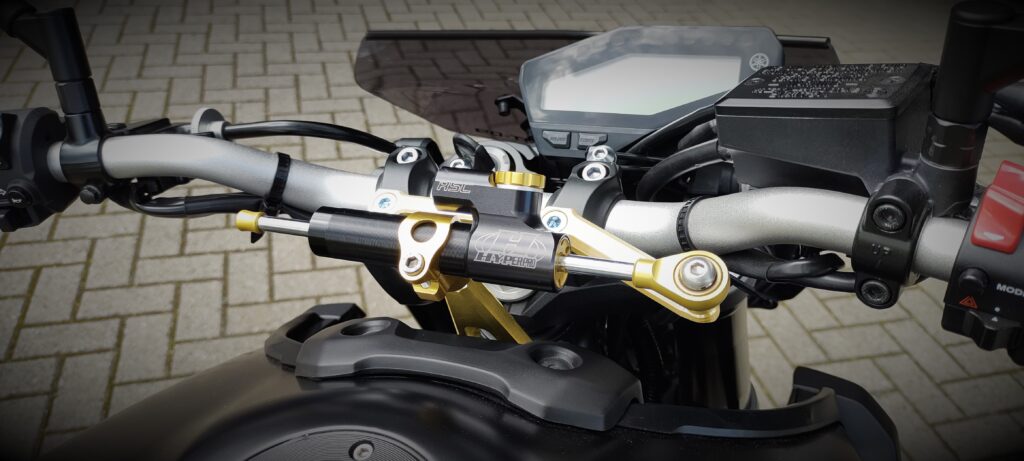
A steering damper is the most direct defense against tank slappers specifically. It adds resistance to rapid steering movements without affecting slow, deliberate inputs like normal cornering. When a tank slapper begins, the damper absorbs the energy of each oscillation cycle, preventing the amplitude from growing. This gives the rider time to react and the suspension time to stabilize the wheel.
How Hyperpro helps you prevent tank slappers
We design and manufacture suspension components and steering dampers specifically to address the conditions that cause tank slappers. Our product range gives you concrete tools to reduce risk and improve control:
- CSC steering damper: A linear damping model adjustable in 22 positions, designed to reduce wobbles, vibrations, and tank slappers across all riding conditions
- RSC steering damper: A progressive damping model also adjustable in 22 positions, which provides minimal resistance during normal steering and strong resistance during rapid, destabilizing movements
- Model-specific mounting kits: CNC-milled, plug-and-play fitments available in Hyperpro Gold or Black, requiring no drilling or cutting in 98% of applications
- Progressive-rate fork springs and shock absorbers: Bike-specific components that balance the front and rear suspension, reducing the pitch dynamics that repeatedly create the conditions for a tank slapper
Every component we produce is developed with a specific fitment in mind, so you get the right spring rate and damping characteristics for your motorcycle rather than a generic solution. If you want to discuss which setup suits your bike and riding style, contact us directly. To purchase, reach out to your nearest authorized Hyperpro distributor.