


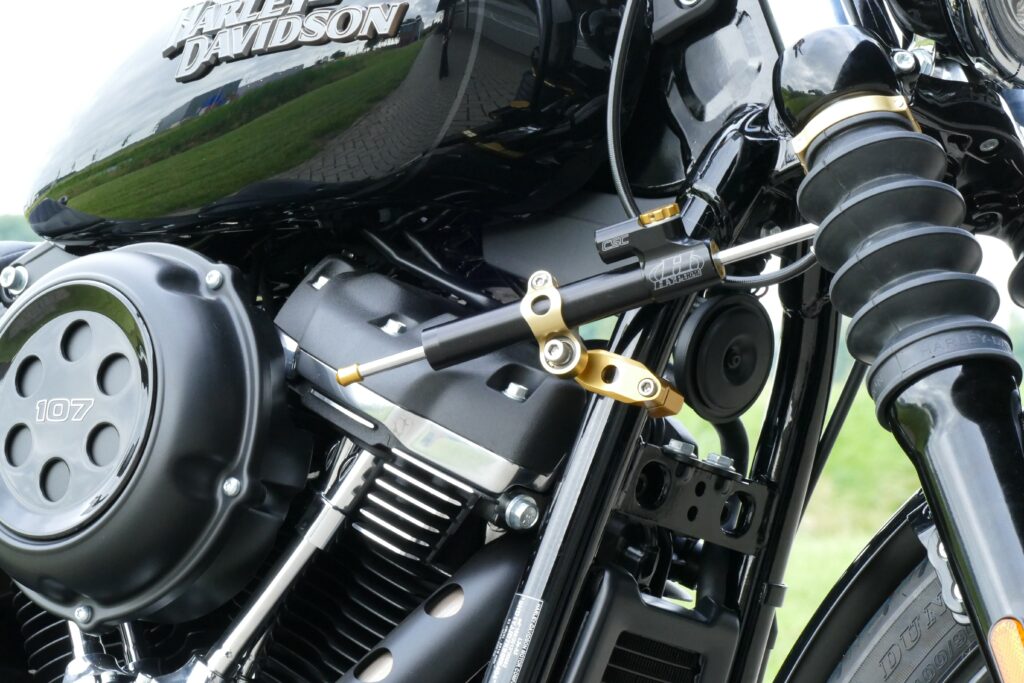
An electronic steering damper is a motorcycle safety device that automatically adjusts its resistance to unwanted handlebar movement in real time, using sensors and an electronic control unit rather than a fixed mechanical setting. Unlike traditional hydraulic dampers, the electronic version responds to speed, steering input, and riding conditions to deliver the right amount of damping at the right moment. The sections below cover how it works, who needs one, and whether it can be fitted to your bike.
How does an electronic steering damper work?
An electronic steering damper works by using sensors to monitor steering angle and vehicle speed, then sending that data to an electronic control unit (ECU) that adjusts the damper’s resistance in milliseconds. At low speeds, resistance stays low so the handlebar moves freely. At high speeds or during instability events, resistance increases instantly to counteract wobble or tank-slapper forces.
The core mechanism relies on a magnetorheological or electronically controlled valve system inside the damper body. When the ECU detects a rapid, unintended steering movement, it stiffens the fluid or adjusts the valve to absorb that energy before it transfers to the rider’s hands. The whole process happens faster than any rider could react manually.
This is a meaningful step beyond a fixed hydraulic damper, which applies the same resistance regardless of speed or conditions. The electronic system is essentially adaptive, making the motorcycle more stable during acceleration, braking, and cornering without making the steering feel heavy or unresponsive in normal riding.
Hyperpro
Ride with confidence
Find the nearest Hyperpro dealer and start your motorcycle upgrade.
What’s the difference between an electronic and hydraulic steering damper?
The key difference is adaptability. A hydraulic steering damper applies a fixed level of resistance set manually by the rider, while an electronic steering damper adjusts its resistance automatically based on speed and steering behaviour. Hydraulic dampers are simpler and more affordable; electronic dampers are more precise and require no manual adjustment as conditions change.
Here is how the two types compare across the most relevant factors:
- Damping behaviour: Hydraulic dampers deliver constant, linear or progressive resistance depending on the model. Electronic dampers vary their output continuously in response to real-time data.
- Rider input required: A hydraulic damper needs manual adjustment when switching between city riding and highway speeds. An electronic damper handles this automatically.
- Installation complexity: Hydraulic dampers are generally straightforward to fit with a model-specific mounting kit. Electronic dampers require wiring into the bike’s electrical system in addition to the physical mount.
- Cost: Electronic dampers carry a higher price point due to the sensor and ECU components involved.
- Performance ceiling: For high-speed sport and track riding, the electronic system’s ability to react faster than any manual setting offers a genuine safety advantage.
For most road riders, a well-specified hydraulic steering damper delivers a strong improvement in stability and control. The electronic option becomes more relevant for riders who regularly switch between very different riding environments or who push their bikes to higher speeds.
What causes a motorcycle to need a steering damper?
A motorcycle needs a steering damper when its front end becomes susceptible to unwanted oscillations, most commonly wobble at low speed and tank-slappers at high speed. These instabilities are caused by a combination of factors including wheel imbalance, road surface irregularities, aerodynamic forces, suspension geometry, and the natural flex characteristics of the frame and tyres.
Tank-slappers, the most dangerous form of instability, happen when the front wheel loses traction momentarily and the forks snap rapidly from side to side. Without damping, this oscillation can escalate faster than a rider can react. A steering damper absorbs that energy and prevents the movement from amplifying into a crash.
Several riding situations increase the likelihood of needing a damper:
- High-speed riding on motorways or tracks where aerodynamic lift reduces front wheel load
- Aggressive acceleration out of corners where the front wheel can lift slightly
- Riding on uneven or damaged road surfaces that generate repeated front-end inputs
- Bikes with longer wheelbases or modified suspension that shifts weight distribution
- Motorcycles fitted with wider or heavier aftermarket wheels and tyres
It is worth noting that some motorcycles are simply more prone to these behaviours by design, particularly older models built before modern chassis engineering addressed these tendencies directly.
Which motorcycles benefit most from an electronic steering damper?
Motorcycles that benefit most from an electronic steering damper are high-performance sport bikes, naked bikes with aggressive geometry, and adventure motorcycles ridden at speed on mixed surfaces. These categories share a common trait: they are ridden in conditions where steering forces change rapidly and unpredictably, making adaptive damping more valuable than a fixed setting.
Sport and superbike riders gain the most direct benefit because high cornering speeds and hard acceleration create the exact instability scenarios an electronic damper is designed to manage. The system’s ability to stiffen instantly during a tank-slapper event, then return to light damping for normal steering, is particularly relevant on track days and fast road riding.
Adventure bikes operating at speed on gravel, sand, or rutted roads also benefit significantly. Surface irregularities at speed generate constant front-end disturbances, and an electronic damper responds to each one without requiring the rider to pre-set the damper for conditions that change every few kilometres.
Naked bikes with short wheelbases and high-mounted handlebars can be sensitive to steering instability at motorway speeds. An electronic damper adds a layer of confidence for riders who use these bikes for longer journeys as well as urban riding.
Can an electronic steering damper be retrofitted to any motorcycle?
An electronic steering damper can be retrofitted to many motorcycles, but not universally. Fitment depends on available mounting points on the frame and triple clamp, access to a suitable electrical connection, and whether a model-specific mounting kit exists for the bike. For most popular sport, naked, and adventure models, a plug-and-play retrofit is practical and does not require cutting or drilling the frame.
The physical mounting is typically the easier part of the installation. Model-specific kits are designed to attach the damper body and rod to existing frame and steering head points without modifying the motorcycle. The more involved step for electronic dampers is the wiring, since the ECU needs speed signal input and a power source, which varies by bike model.
Before choosing an electronic damper for retrofit, consider the following:
- Whether a mounting kit is available for your specific model and year
- The accessibility of the bike’s speed sensor signal for ECU integration
- The space available around the steering head for the damper body and rod
- Whether your riding style and typical conditions justify the additional cost over a hydraulic alternative
How Hyperpro helps with steering stability
We design and manufacture steering damper systems specifically built to address the instability challenges described throughout this article. Our range includes two models to match different riding needs:
- CSC (Constant Safety Control): A linear damping model adjustable in 22 positions, suited to riders who want consistent, predictable damping across their typical riding conditions.
- RSC (Reactive Safety Control): A progressive damping model also adjustable in 22 positions, which delivers lighter resistance during normal steering and increases resistance automatically when instability is detected.
Both systems are supported by CNC-milled, model-specific mounting kits available in Hyperpro Gold or Black. In 98% of applications, these kits fit without any drilling or cutting to the frame, making the installation clean and reversible. You can browse the full range of suspension and damper products to find the right fit for your motorcycle. Purchases are made through our authorised distributor network. If you have a question about fitment or which model suits your bike, contact us directly and we will point you in the right direction.