


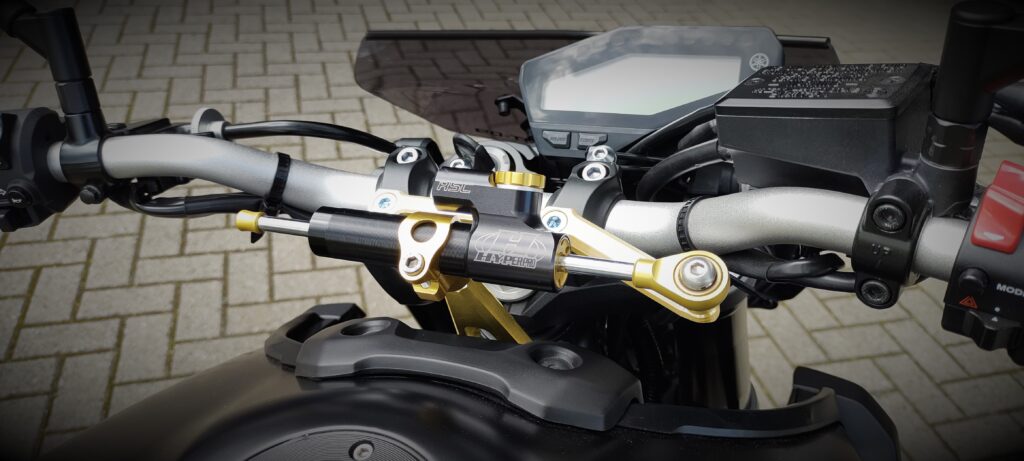
Once a tank slapper starts, you cannot reliably stop it through steering inputs. The safest response is to hold the handlebars firmly without fighting the oscillation, close the throttle gradually, and let the bike stabilize on its own. Gripping the tank with your knees helps absorb energy and keeps your upper body from amplifying the wobble. The sections below break down what causes tank slappers, why some bikes are more prone to them, and how your suspension setup plays a direct role in preventing them.
What actually happens during a tank slapper?
A tank slapper is a rapid, self-sustaining oscillation of the front wheel from side to side, typically triggered when the front wheel loses contact with the road surface and then reconnects at a slight angle. The handlebars swing violently left and right in quick succession, sometimes fast enough to strike the rider’s thighs or tank. Without intervention, the oscillation can escalate until the rider loses control.
The physics behind it are straightforward. When the front wheel lifts or skips, the gyroscopic forces that normally stabilize the steering disappear for a fraction of a second. On touchdown, the wheel’s contact patch re-engages the tarmac at a misaligned angle. The frame and forks then swing to correct, overshoot, and swing back. This feedback loop builds rapidly, especially at higher speeds where the forces involved are much greater. The term “tank slapper” comes from the handlebars literally slapping against the tank during severe episodes.
Can you recover from a tank slapper while it’s happening?
Recovery during an active tank slapper is possible but not guaranteed. The most effective technique is to grip the handlebars firmly without resisting the oscillation, ease off the throttle smoothly, and avoid braking sharply. Sudden counter-steering or braking can feed energy back into the wobble and make it worse. Squeezing the tank with your knees helps stabilize your body and reduces the amount of upper-body movement that amplifies the bars.
The key distinction is between gripping and fighting. Locking your arms and actively trying to steer against the oscillation transfers more energy into the front end, which is the opposite of what you need. A relaxed but firm grip lets the geometry of the bike work toward self-correction. In practice, many riders instinctively tense up, which is why tank slappers escalate so quickly. Riding experience and muscle memory are the only reliable ways to respond correctly under pressure.
Why do some motorcycles tank slap more than others?
Some motorcycles are inherently more prone to tank slappers because of their geometry, weight distribution, and suspension calibration. Bikes with longer wheelbases and more rake angle tend to be more stable, while sport bikes with aggressive, short-wheelbase geometry are more sensitive to front-end disturbances. Lightweight front ends combined with powerful engines increase the likelihood of the front wheel lifting, which is the most common trigger.
Frame stiffness also plays a role. A frame that flexes significantly under load can store and release energy in a way that reinforces oscillation rather than dampening it. Older or worn frames, loose steering head bearings, and improperly torqued components all increase vulnerability. Tire condition and pressure matter too. An underinflated or worn front tire has a contact patch that deforms unpredictably on reconnection, making the initial trigger more likely and the recovery more difficult.
Does suspension setup affect the risk of a tank slapper?
Yes, suspension setup directly affects how likely a tank slapper is to occur and how severe it becomes. A suspension that is too soft allows excessive front-end dive under braking and compression, which changes the steering geometry dynamically and increases the chance of the front wheel skipping. A suspension that is too stiff transmits road imperfections harshly into the frame, which can also trigger instability at speed.
The correct spring rate for the rider’s weight is a good starting point. A spring that matches your actual load keeps the fork in its optimal working range, maintaining consistent trail and castor angle throughout the ride. Damping settings matter equally. Insufficient rebound damping lets the fork extend too quickly after compression, which can flick the front wheel upward. Dialing in the right balance between compression and rebound damping reduces the amplitude of any oscillation before it has a chance to build.
Upgrading from factory springs to progressive-rate springs is one of the most practical improvements a rider can make. Progressive springs provide softer initial travel for comfort and progressively firmer resistance as load increases, which keeps the geometry more stable across a wider range of riding conditions.
Hyperpro
Ride with confidence
Find the nearest Hyperpro dealer and start your motorcycle upgrade.
What’s the difference between a steering damper and a suspension upgrade for preventing wobbles?
A steering damper and a suspension upgrade address tank slappers through different mechanisms. A steering damper directly resists rapid rotational movement of the steering head, absorbing the energy of an oscillation as it begins. A suspension upgrade improves the underlying stability of the front end by keeping the wheel in better contact with the road and maintaining consistent geometry, which reduces the conditions that trigger a tank slapper in the first place.
Think of it this way: good suspension prevents the problem, while a steering damper manages the problem if it occurs. Both are valuable, and they work well together. A quality steering damper will not compensate for a suspension that is badly mismatched to the rider’s weight or riding style, but it adds a meaningful layer of protection when the front end is already well set.
The type of damper also matters. A linear damper applies consistent resistance across all steering speeds, which works well in most conditions but can feel restrictive at low speed. A progressive damper applies light resistance during normal steering inputs and increases resistance rapidly during high-speed oscillations, making it more transparent during everyday riding while still catching a developing tank slapper effectively.
When should you upgrade your suspension to prevent tank slappers?
You should consider a suspension upgrade if your bike’s factory setup no longer matches your weight, riding style, or the roads you regularly ride. Factory suspension is calibrated for an average rider under average conditions, which means it is often a compromise. If you notice the front end feeling vague at speed, excessive dive under braking, or the bike feeling nervous over rough surfaces, these are signs the suspension is not performing optimally.
Mileage is another indicator. Fork springs fatigue over time and lose their rated spring rate, which means an older bike with original springs may be significantly softer than when it left the factory. If your bike has high mileage and has never had a suspension service, the components are likely no longer working as intended.
Upgrading before a long tour, a track day, or any riding that involves sustained higher speeds is a practical decision. The risk of a tank slapper increases with speed, so the higher your typical riding pace, the more important it is to have suspension that keeps the front wheel planted and the geometry consistent.
How Hyperpro helps you prevent tank slappers
We design and manufacture suspension components and steering damper systems specifically to reduce the conditions that cause tank slappers and to limit their severity when they do occur. Our approach combines two areas of improvement:
- Steering dampers: We offer two systems, the CSC (Constant Safety Control) linear model and the RSC (Reactive Safety Control) progressive model. Both are adjustable across 22 positions and are designed to absorb oscillation energy at the steering head before a wobble can escalate. Model-specific CNC-milled mounting kits are available in Hyperpro Gold or Black and fit without drilling or cutting in 98% of applications.
- Progressive-rate springs and shock absorbers: Our fork springs and shock absorbers are engineered to keep your front wheel in consistent contact with the road, maintain stable geometry under load, and reduce the front-end instability that creates the conditions for a tank slapper.
Both product lines are available through our authorized distributor network. If you want advice on which setup suits your bike and riding style, contact us and we will point you in the right direction.