


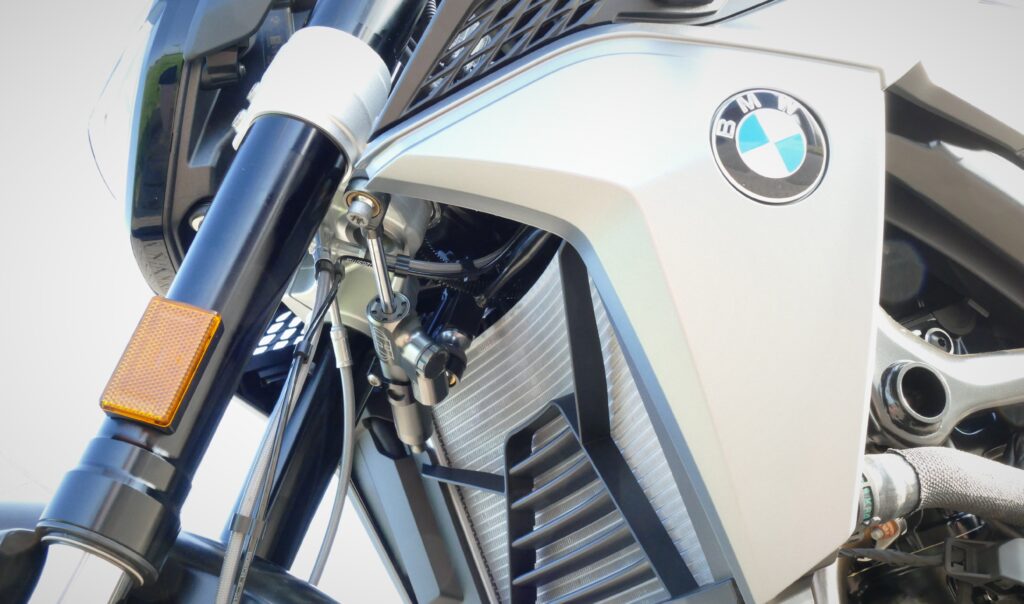
A fork-mounted steering damper is a hydraulic device that attaches directly to the front fork legs of a motorcycle to resist sudden, uncontrolled handlebar movements. It works by converting the kinetic energy of a wobble or tank-slapper into heat through a fluid-filled chamber, slowing the oscillation before it escalates. The sections below unpack how it works, what it prevents, and how to get the most from one on your bike.
How does a fork-mounted steering damper work?
A fork-mounted steering damper works by using a hydraulic cylinder attached to the fork leg to resist rapid side-to-side handlebar movement. As the forks turn, a piston moves through damping fluid inside the unit. The resistance this creates absorbs the energy of a wobble without blocking normal, deliberate steering inputs from the rider.
The damper connects at one end to the fork leg and at the other to a fixed point on the frame or triple clamp. When the bars move slowly, as they do in normal cornering, the fluid flows through the valve with little resistance. When the bars snap violently, as they do during a tank-slapper, the valve restricts flow sharply, generating the resistance needed to stabilise the front end.
Most modern fork-mounted dampers are adjustable, allowing you to dial in the level of resistance that suits your riding style and conditions. A lighter setting keeps steering feel natural at low speeds, while a firmer setting provides more support at highway speeds or on rough surfaces.
What causes the tank-slapper that a steering damper prevents?
A tank-slapper is caused by the front wheel losing and regaining traction rapidly, triggering an uncontrolled oscillation of the handlebars. This typically happens when the front wheel lifts slightly, such as during hard acceleration, and then returns to the ground at a slight angle. The front end then overcorrects, swings the other way, and the oscillation amplifies faster than most riders can react.
Several factors increase the risk of a tank-slapper occurring:
- Wheelies and front-end lift: Any moment where the front wheel leaves the ground and lands off-centre can trigger the oscillation.
- High-speed road imperfections: Hitting a bump or expansion joint at speed can disturb the front wheel enough to start a wobble.
- Worn or mismatched tyres: Uneven tyre wear changes how the front wheel tracks, making it more susceptible to instability.
- Incorrect suspension setup: Too little fork damping or incorrect spring preload allows the front end to move more freely than it should.
A steering damper does not eliminate the root cause of a tank-slapper, but it interrupts the feedback loop that allows the oscillation to grow. By absorbing the energy of each swing, it gives the rider time to react and regain control.
Hyperpro
Ride with confidence
Find the nearest Hyperpro dealer and start your motorcycle upgrade.
What’s the difference between a fork-mounted and a steering-head damper?
The key difference is mounting position and how each type interacts with the steering geometry. A fork-mounted steering damper attaches to one of the fork legs and acts on the fork directly. A steering-head damper, also called a rotary damper, mounts at the steering stem and resists rotation of the entire steering assembly around the head bearing.
Fork-mounted dampers
Fork-mounted units use a linear hydraulic cylinder. They are generally easier to fit on a wider range of motorcycles, often using model-specific bracket kits that require no drilling or modification. They are well suited to bikes where the steering head area is compact or where a rotary unit would interfere with other components. The linear action means damping force increases progressively as the bar movement becomes more extreme.
Steering-head dampers
Rotary or steering-head dampers sit closer to the pivot point of the steering and can offer a more direct feel because they act on the rotation itself rather than on the fork leg at a distance. They are commonly found as factory-fitted equipment on high-performance sport bikes. However, fitting an aftermarket rotary damper often requires more complex mounting solutions and may not be available for all models.
For most riders looking at an aftermarket upgrade, a fork-mounted damper offers a practical and effective solution without the fitment complexity of a rotary unit.
Do steering dampers affect low-speed handling and steering feel?
A correctly adjusted steering damper has minimal impact on low-speed handling and should not noticeably change everyday steering feel. At low speeds, the bars move slowly and deliberately, which generates very little resistance in the damper. The effect only becomes significant when the bars move rapidly, which is precisely the scenario the damper is designed to address.
If a steering damper is set too firm, it can make the bike feel heavy to steer at parking speeds or in tight slow-speed manoeuvres. This is why adjustability matters. A damper with a wide range of adjustment settings allows you to find a position that provides meaningful protection at speed without making the bike feel unresponsive in town.
Riders sometimes worry that adding a damper will dull the communication between the front tyre and the handlebars. In practice, a well-set damper filters out the unwanted noise of instability while leaving the intentional feedback from the road surface intact. The result is often a front end that feels more composed and easier to read, not less.
Which motorcycles benefit most from a fork-mounted steering damper?
Motorcycles that benefit most from a fork-mounted steering damper are those that combine high power output with a geometry that makes the front end prone to lift or instability. Sport bikes, naked bikes with aggressive power delivery, and adventure motorcycles ridden at speed on mixed surfaces are the strongest candidates.
Specific situations where a fork-mounted steering damper delivers the most noticeable improvement include:
- High-powered sport and naked bikes: Hard acceleration out of corners or on the straight can unload the front wheel, and any landing imperfection risks triggering a wobble.
- Adventure bikes on mixed terrain: Gravel, ruts, and road imperfections at highway speeds create the kind of sudden front-end disturbances a damper is built to absorb.
- Track day machines: Higher cornering speeds and more aggressive braking increase the forces acting on the front end, making damper support more valuable.
- Bikes with long wheelbases or tall ride heights: These geometries can be more susceptible to high-speed wobble, and a damper helps maintain stability.
Smaller-displacement commuter bikes ridden primarily in urban traffic at moderate speeds have less to gain, though any bike used at sustained highway speeds can benefit from the added stability a damper provides.
How do you adjust a fork-mounted steering damper correctly?
To adjust a fork-mounted steering damper correctly, start with the damper at its lightest setting and gradually increase resistance until the front end feels stable at your typical riding speed without becoming heavy to steer at low speed. Most adjustable dampers use a numbered dial or knob that you turn in small increments, testing the feel after each change.
A practical approach to finding the right setting:
- Set the damper to minimum: Start fully open so you have a baseline for how the bike steers without any added resistance.
- Increase in small steps: Add two or three positions of adjustment at a time, then ride at your normal speed range to assess the change.
- Test low-speed steering: After each adjustment, check that slow-speed manoeuvres still feel natural. If the bike starts to feel heavy or resistant to turning, back off one position.
- Test at speed: Ride at the speeds where you want protection, such as motorway speeds or on a track, and assess whether the front end feels settled.
- Fine-tune for conditions: You may want a slightly firmer setting for track use or rough roads and a lighter setting for mixed urban and motorway riding.
Never set a damper so firm that it fights your steering inputs. The goal is a front end that resists unwanted movement while remaining responsive to deliberate rider control.
How Hyperpro helps you ride with more confidence
We design and manufacture steering damper systems built specifically to address the instability problems described in this article. Our range gives you two clear options depending on your riding needs:
- CSC (Constant Safety Control): A linear damping model with 22 adjustable positions, offering consistent resistance across the full range of handlebar movement. Ideal for riders who want straightforward, reliable protection.
- RSC (Reactive Safety Control): A progressive damping model also with 22 positions, which increases resistance more aggressively as handlebar movement becomes more extreme. Better suited to performance-focused riders and track use.
- Model-specific mounting kits: We develop CNC-milled bracket kits for both systems in Hyperpro Gold or Black. In 98% of applications, these are plug-and-play fitments that require no drilling or cutting.
Browse our full range of motorcycle suspension products to find the right solution for your bike. Purchases are made through our authorised distributor network. Contact us if you have questions about fitment or which damper suits your riding style.