


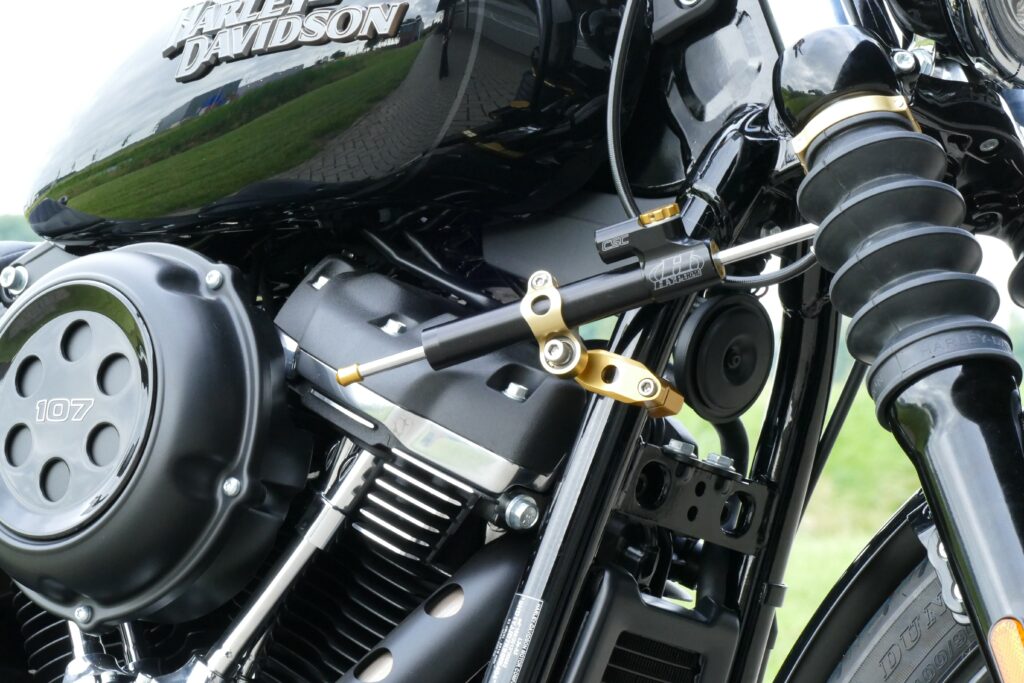
A manual adjustable steering damper is a hydraulic device mounted between a motorcycle’s frame and steering head that resists unwanted handlebar movement. You control the level of damping resistance by turning a knob or dial, allowing you to dial in more or less resistance depending on your riding conditions and speed.
Unlike electronic systems that adjust automatically, a manual steering damper puts the control directly in your hands. This makes it a practical, reliable, and cost-effective solution for riders who want to eliminate tank-slappers, wobbles, and high-speed instability without relying on sensors or software. The sections below answer the most common questions riders have before choosing and setting up a manual adjustable steering damper.
How does a manual adjustable steering damper work?
A manual adjustable steering damper works by using hydraulic fluid inside a cylinder to create resistance against rapid or erratic steering inputs. When the handlebars move, a piston pushes through the fluid. The damper’s adjustment knob controls how easily the fluid flows past the piston, which determines how much resistance the rider feels at the bars.
The key principle is that the damper resists sudden movement far more than deliberate, controlled steering. At low speeds and during normal cornering, the resistance is barely noticeable. But when the front wheel hits a bump, a rut, or loses and regains traction, the damper absorbs the energy before it can translate into a violent handlebar oscillation.
Most manual steering dampers offer a range of adjustment positions. Hyperpro’s CSC and RSC models, for example, both offer 22 adjustment positions, giving riders fine-grained control over damping intensity. The damper connects between the frame and a steering head bracket, and the piston rod moves as the steering turns. The whole system is self-contained, requires no power source, and adds minimal weight to the motorcycle.
Hyperpro
Ride with confidence
Find the nearest Hyperpro dealer and start your motorcycle upgrade.
What’s the difference between a manual and an electronic steering damper?
The main difference is how the damping level is set. A manual steering damper requires the rider to physically turn an adjustment knob to change resistance. An electronic steering damper uses sensors and a control unit to detect speed and steering behavior, adjusting damping automatically in real time without any rider input.
Manual steering dampers
Manual dampers are straightforward, durable, and require no electronics or wiring. You choose a setting before or during your ride, and the system holds that level until you change it. This simplicity makes them highly reliable and easier to service. They suit riders who understand their riding style and conditions well enough to pre-select an appropriate damping level.
Electronic steering dampers
Electronic systems react dynamically to changing conditions, increasing resistance at high speeds and reducing it at low speeds automatically. This offers a seamless experience but adds complexity, cost, and potential failure points. If a sensor or control unit fails, the system may not function correctly.
For most street, sport, and adventure riders, a well-adjusted manual steering damper delivers all the safety and control benefits they need at a significantly lower cost and with greater long-term reliability.
What causes a motorcycle to need more steering damping?
A motorcycle needs more steering damping when its front end becomes prone to instability, wobble, or oscillation. The most common triggers are high-speed riding, rough or uneven road surfaces, aggressive acceleration out of corners, and front-end geometry changes caused by modifications like lowering kits or different tire profiles.
Several specific situations increase the demand for damping:
- Tank-slappers: A sudden loss and regain of front-wheel traction causes the handlebars to oscillate violently from side to side. Without a damper, this can lead to a crash in seconds.
- High-speed instability: Above certain speeds, aerodynamic forces and road imperfections can destabilize the front end, especially on lightweight sport bikes.
- Road surface changes: Gravel, expansion joints, wet tram lines, and uneven tarmac all create sudden lateral inputs at the front wheel.
- Worn or incorrect steering head bearings: These introduce play into the steering, which a damper can help manage, though replacing the bearings remains the correct fix.
- Aftermarket modifications: Changing tire size, fork height, or ride height alters the bike’s steering geometry, sometimes making it more susceptible to instability.
Adventure riders who regularly transition between tarmac and off-road terrain face particularly variable conditions, making adjustable damping especially useful for adapting quickly to changing surfaces.
How do you adjust a manual steering damper correctly?
To adjust a manual steering damper correctly, start with a low- to mid-range setting and increase resistance gradually until instability disappears without the steering feeling heavy or restricted. The goal is the minimum effective damping for your current riding conditions, not the maximum available.
Follow this practical process:
- Start low: Set the damper to a low position (for example, position 5 to 8 on a 22-position damper) before heading out.
- Ride and assess: At your typical riding speed, check whether the steering feels natural. If you notice wobble or instability, increase the setting by a few positions.
- Adjust for conditions: On a track day or fast motorway run, increase damping. On slow urban roads or off-road trails, reduce it to keep steering light and responsive.
- Never max out the setting: A fully locked damper restricts steering movement and reduces your ability to react quickly. This is unsafe.
- Check full lock: After any adjustment, turn the handlebars to full left and right lock while stationary to confirm the damper does not bind or restrict steering range.
Adjustment takes less than a minute once you know your bike’s range. With experience, most riders develop a feel for their preferred baseline setting and only adjust it for significantly different conditions.
Which motorcycles benefit most from a manual adjustable steering damper?
Motorcycles that benefit most from a manual adjustable steering damper are high-performance sport bikes, large-displacement adventure bikes, and any motorcycle ridden regularly at high speeds or on variable road surfaces. Bikes with lightweight chassis, long wheelbases, or aggressive riding positions are especially sensitive to front-end instability.
The following categories gain the most from adding a steering damper:
- Sport and supersport bikes: Their geometry prioritizes cornering performance over straight-line stability, making them more susceptible to wobbles at speed.
- Adventure and dual-sport bikes: Transitioning between tarmac and gravel or dirt creates unpredictable front-end inputs that a damper helps absorb.
- Naked and streetfighter bikes: The upright riding position and wide handlebars make the rider more sensitive to handlebar oscillation.
- Bikes with modified suspension or geometry: Any modification that alters the steering head angle or front-end weight distribution can introduce instability a damper helps correct.
That said, virtually any motorcycle can benefit from a steering damper if the rider experiences instability or wants an additional layer of safety and control. The right fitment depends on the specific model, which is why model-specific mounting solutions matter as much as the damper itself.
How Hyperpro helps with steering damper fitment and control
We design and manufacture steering dampers specifically built for real-world riding conditions. Our range includes two damper types, both adjustable across 22 positions, so you can fine-tune your setup to match your bike and riding style:
- CSC (Constant Safety Control): A linear damping model that delivers consistent resistance across the full steering range, suited to riders who want predictable, straightforward control.
- RSC (Reactive Safety Control): A progressive damping model that increases resistance as steering movement intensifies, offering a more dynamic response to sudden instability.
- Model-specific mounting kits: We develop CNC-milled mounting kits designed for your exact motorcycle. In 98% of applications, installation requires no drilling or cutting. The kits are available in Hyperpro Gold or Black and fit as a direct plug-and-play solution.
You can browse our full range of motorcycle suspension products to find the right combination of damper and mounting kit for your bike. To purchase, connect with your nearest authorized Hyperpro distributor or contact us if you have questions about fitment.