


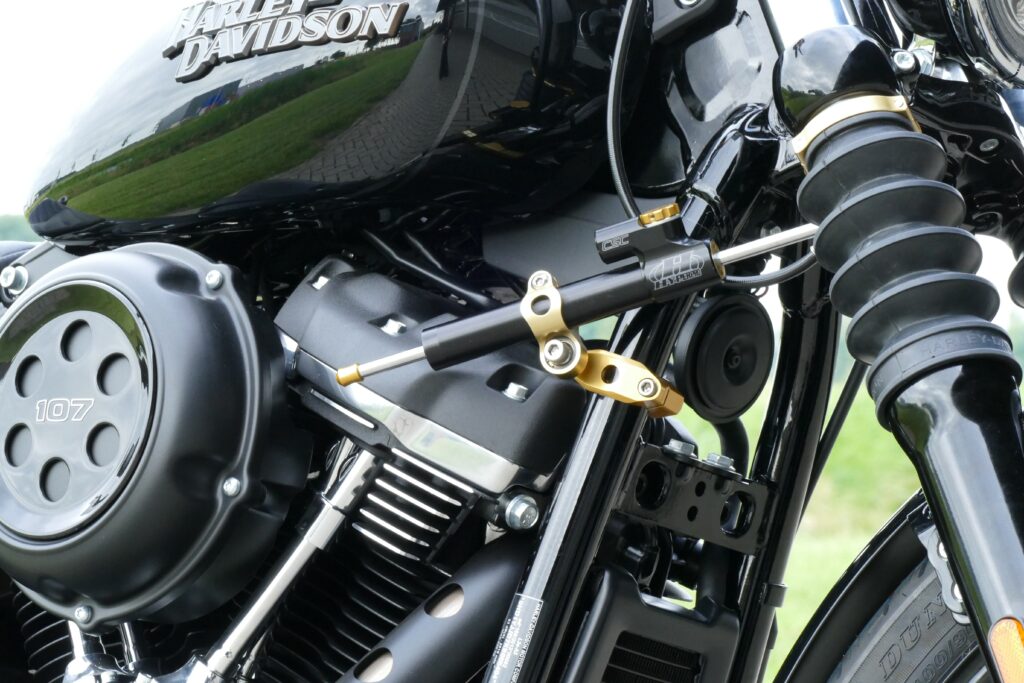
Your handlebars suddenly ripped out of your hands because your front wheel lost traction or entered a rapid oscillation, triggering what riders call a tank slapper. This violent handlebar movement happens when the front wheel deflects off a bump, patch of loose surface, or mid-corner irregularity and the steering overcorrects left and right faster than you can respond. Understanding what causes this and how to prevent it can make a real difference to your safety on the road.
What causes handlebars to violently shake or wobble?
Handlebars shake or wobble violently when the front wheel enters a rapid side-to-side oscillation that the rider cannot control. This is commonly known as a tank slapper, and it happens when a destabilizing force exceeds the steering system’s ability to self-correct. The result is a feedback loop where the wheel swings further with each oscillation rather than returning to center.
Several factors can trigger this kind of event:
- Surface irregularities at speed such as expansion joints, gravel patches, or mid-corner bumps that deflect the front wheel suddenly
- Lifting the front wheel during hard acceleration and landing slightly off-center
- Incorrect tire pressure that reduces the contact patch and makes the front end less stable
- Worn or mismatched tires that create uneven rolling behavior
- Aerodynamic disturbance at high speed, such as passing a truck or riding through a crosswind
In most cases, the wobble begins as a small deviation that amplifies rapidly. Without a mechanism to absorb and dampen that steering movement, the oscillation builds until the rider loses control or the bike corrects itself violently.
Hyperpro
Ride with confidence
Find the nearest Hyperpro dealer and start your motorcycle upgrade.
What is a speed wobble and why does it happen on motorcycles?
A speed wobble is a rapid, self-reinforcing oscillation of the front wheel and steering assembly that occurs most often at higher speeds. It happens because the front wheel, once deflected off its intended path, lacks sufficient damping to return smoothly to center. Instead, it overshoots, swings the other way, and the cycle repeats with increasing intensity.
The term tank slapper comes from the most severe version of this event, where the handlebars swing so far and so fast that they literally slap against the fuel tank on each side. It is one of the most dangerous situations a rider can encounter because it happens faster than most people can physically react.
Speed wobbles tend to occur in specific conditions:
- At higher speeds where gyroscopic forces are greater and corrections happen faster
- When the front wheel is lightly loaded, for example during hard acceleration when weight shifts to the rear
- On bikes with worn steering head bearings that introduce play into the steering system
- On motorcycles with no steering damper or with a damper set too lightly
The physics behind a tank slapper are straightforward: any steering system has a natural oscillation frequency, and when an external disturbance matches or approaches that frequency, the wobble amplifies rather than decays. A well-functioning steering damper interrupts this cycle by adding resistance to rapid steering movement without interfering with normal, deliberate steering inputs.
How does suspension affect handlebar stability?
Suspension directly affects handlebar stability because the front forks and rear shock control how the wheels respond to road inputs. When suspension is too soft, too stiff, or worn out, the wheels cannot track the road surface consistently, and that inconsistent contact translates directly into steering instability and, in severe cases, a tank slapper.
Here is how specific suspension issues create handlebar problems:
- Worn fork seals or low fork oil reduce damping, allowing the front end to dive and rebound unpredictably over bumps
- Springs that are too soft for the rider’s weight allow the front end to compress excessively under braking, changing the steering geometry and making the bike harder to control
- Incorrect preload settings alter the rake and trail of the front end, which directly affects how stable the steering feels at speed
- Rear suspension that is too stiff can transfer more energy to the front wheel by bouncing the rear rather than absorbing it
Well-matched suspension keeps the tires in contact with the road surface throughout corners, over bumps, and during acceleration and braking. When that contact is consistent, the steering remains stable. When it is not, the front wheel can deflect and trigger exactly the kind of oscillation that leads to a tank slapper. Upgrading to bike-specific suspension components with the correct spring rate for your weight and riding style is one of the most effective ways to improve front-end stability.
What other mechanical issues can cause sudden handlebar movement?
Beyond suspension, several other mechanical problems can cause sudden, unexpected handlebar movement. Steering head bearings, wheel balance, tire condition, and axle torque all play a role in keeping the front end tracking straight and true. When any of these components degrade or are incorrectly set up, the result can range from a mild vibration to a full tank slapper.
Steering head bearings
Worn or pitted steering head bearings are one of the most common mechanical causes of handlebar instability. These bearings allow the front forks to pivot smoothly during steering. When they develop play or flat spots, the steering can feel notchy, vague, or prone to wobbling. In extreme cases, a bearing that is too loose allows the steering to oscillate freely rather than self-centering, which dramatically increases the risk of a speed wobble.
Wheel balance and tire condition
An out-of-balance front wheel creates a rhythmic vibration that increases with speed. At certain speeds, this vibration can couple with the steering system’s natural frequency and trigger a wobble. Similarly, a tire that is unevenly worn, incorrectly inflated, or has a flat spot from a locked-up braking event will not roll true, introducing the kind of irregular inputs that destabilize the steering. Always check tire pressure and tread condition regularly, and have wheels rebalanced whenever you fit new tires.
Should I upgrade my suspension if my bike wobbles at speed?
Yes, upgrading your suspension is worth considering if your bike wobbles at speed, but it should not be your first step. Before investing in new components, rule out mechanical faults first. Check your steering head bearings, tire pressure, wheel balance, and fork oil level. If all of those are in good condition and your bike still feels unstable at speed, a suspension upgrade will make a meaningful difference.
A suspension upgrade addresses the root cause of many stability problems by ensuring your springs and damping are matched to your weight, riding style, and the roads you ride on. Factory suspension is designed around an average rider profile, which means it is often a compromise that does not suit every rider well. Progressive-rate springs, for example, offer a more compliant response to small bumps while still providing firm support under hard braking or cornering loads.
That said, if your bike has experienced repeated tank slappers or you regularly ride at higher speeds, a steering damper is a direct and highly effective solution. A steering damper adds resistance to rapid, unintended steering movement without interfering with normal slow-speed maneuvering. It acts as a safety net that prevents a small wobble from escalating into a full tank slapper.
How Hyperpro helps you ride with more control
We design and manufacture suspension and steering control products specifically to address the kind of instability that leads to tank slappers and handlebar wobbles. Our approach is practical and bike-specific, which means you get components that fit and perform correctly from the first ride.
- CSC Steering Damper (Constant Safety Control): A linear damping model with 22 adjustable positions that reduces wobbles and vibrations across a wide range of riding conditions
- RSC Steering Damper (Reactive Safety Control): A progressive damping model that provides lighter resistance during normal steering and increases resistance automatically when rapid, unintended movement is detected, making it ideal for sport and performance riding
- Model-specific mounting kits: CNC-milled brackets available in Hyperpro Gold or Black that fit directly to your bike in 98% of applications without drilling or cutting
- Progressive-rate fork springs and shock absorbers: Matched to your bike model and rider weight to improve front-end tracking and reduce the conditions that trigger speed wobbles
All our products are available through our authorized distributor network. Contact us if you have questions about which setup suits your bike, or find your nearest dealer to get started.