


Yes, bad road surfaces can trigger a tank slapper. When your front wheel hits a bump, pothole, or uneven surface at speed, the impact can momentarily lift or deflect the wheel, breaking the contact patch’s grip and sending oscillating forces through the steering. Those forces can set the handlebars swinging rapidly from side to side in the classic tank-slapper pattern. The sections below break down exactly how this happens, what makes it worse, and what you can do about it.
What actually happens during a tank slapper?
A tank slapper is a rapid, self-reinforcing oscillation of the front wheel and handlebars. It begins when a disturbance, such as a bump, rut, or mid-corner patch of gravel, causes the front wheel to deflect sideways or momentarily lose consistent road contact. The steering geometry then tries to self-correct, but if the correction overshoots, the wheel swings to the opposite side. Each swing feeds the next, and the oscillation can escalate within fractions of a second to the point where the handlebars are literally striking the rider’s knees or tank.
The physics behind it involve the interplay between the motorcycle’s rake, trail, and the gyroscopic forces generated by the spinning front wheel. At low speeds, those forces are usually strong enough to self-damp the wobble. At higher speeds, aerodynamic lift on the front end reduces tyre load, which weakens the self-correcting effect and allows the oscillation to grow rather than decay. The result is a feedback loop that can become uncontrollable in under a second if nothing interrupts it.
Which road surface conditions most commonly trigger handlebar wobble?
The road conditions most likely to trigger handlebar wobble are those that cause sudden, asymmetric, or repeated disturbances to the front wheel’s contact patch. Potholes, expansion joints, tramlines, and coarse chip-seal surfaces are the most common culprits, because each creates a sharp lateral or vertical input that can deflect the steering before the rider or suspension can react.
Hyperpro
Ride with confidence
Find the nearest Hyperpro dealer and start your motorcycle upgrade.
Some of the highest-risk surface types include:
- Tramlines and longitudinal grooves: These run parallel to your direction of travel and can trap the front tyre, forcing it to track the groove rather than follow your intended line. When the tyre escapes the groove, it can snap sideways and initiate a wobble.
- Patched or uneven asphalt: Height differences between patches create small but sharp impacts. At speed, these repeated inputs can excite the steering’s natural oscillation frequency.
- Loose surface material: Gravel, sand, or wet leaves reduce grip unpredictably, allowing the front tyre to slip sideways without warning.
- Expansion joints on bridges and highways: The sudden lateral edge can kick the front wheel sideways, especially if you cross it at a slight angle.
- Rippled or corrugated roads: The rhythmic bumps can match the suspension’s natural frequency and amplify rather than absorb the inputs, a phenomenon known as resonance.
How does motorcycle speed affect tank slapper risk on rough roads?
Speed significantly increases tank slapper risk on rough roads. At higher speeds, each road surface disturbance delivers more energy to the front wheel in a shorter time, giving the suspension and tyres less opportunity to absorb and recover. At the same time, aerodynamic lift reduces the load on the front tyre, weakening the self-stabilising effect of the contact patch and making it easier for an oscillation to grow.
At low urban speeds, the gyroscopic stability of the front wheel and the relatively high tyre load mean that most surface disturbances damp out almost immediately. As speed increases, the energy in each impact grows with the square of velocity, so a bump that causes a minor wobble at 60 km/h can trigger a full tank slapper at 120 km/h. Sport and adventure riders who carry highway speeds across deteriorated road surfaces are therefore at meaningfully higher risk than riders travelling at lower speeds on the same road.
Speed also compresses the time available to react. A tank slapper that might take two or three seconds to develop at moderate speed can escalate to an uncontrollable state in under a second at high speed, which is why prevention through good suspension setup matters far more than reaction alone.
Can worn or mismatched suspension components make tank slappers more likely?
Yes, worn or mismatched suspension components directly increase the likelihood of a tank slapper. When fork springs lose their rate, fork oil degrades, or a rear shock no longer controls rebound properly, the suspension cannot absorb and recover from road inputs quickly enough. The result is that disturbances from poor road surfaces are transferred more directly to the steering, increasing the chance of an oscillation starting and sustaining itself.
Mismatched components create an additional problem: imbalance. If the front suspension is significantly stiffer or softer than the rear, the motorcycle’s weight distribution shifts dynamically under braking, acceleration, and over bumps. An overly soft front end, for example, dives under braking and then rebounds quickly, momentarily reducing front tyre load at exactly the moment when stability is most needed. Similarly, a rear shock with worn damping can allow the rear of the bike to bounce and pitch, which transfers load to the front unpredictably.
Tyre condition and pressure also interact with suspension performance. An underinflated or worn front tyre has a larger, less consistent contact patch that responds more erratically to surface inputs, which compounds the effect of poor suspension. Checking both suspension condition and tyre health together is the most reliable way to assess your overall wobble risk.
How should a rider respond when a tank slapper starts?
When a tank slapper starts, the correct response is to relax your grip, keep your body upright, and avoid braking or accelerating sharply. Tensing your arms and fighting the handlebars makes the oscillation worse because your rigid grip transfers energy back into the steering rather than allowing it to damp out. Gradually reducing throttle to reduce speed is the most effective action, but do it smoothly to avoid upsetting weight distribution further.
More specifically, follow these steps in order:
- Loosen your grip immediately. A relaxed grip allows the steering to self-correct rather than amplifying the oscillation through your arms.
- Keep your weight central and upright. Leaning or shifting weight during the wobble adds an additional variable that can worsen the oscillation.
- Roll off the throttle gradually. Reducing speed lowers the energy driving the oscillation. Avoid snapping the throttle shut, as this can transfer a sudden weight shift to the front tyre.
- Avoid braking during the wobble. Hard braking during an active tank slapper loads the front tyre suddenly and can cause the bike to fall. Wait until the oscillation subsides before applying the brakes.
- Ride it out if the wobble self-damps. Many tank slappers, particularly at lower speeds, will damp out on their own once the initial energy dissipates. If you have relaxed your grip and reduced speed, give the bike a moment to stabilise.
Wearing a steering damper on your motorcycle means you may never need to execute these steps at all, because the damper interrupts the oscillation before it builds. But knowing the correct response remains important for every rider.
What suspension upgrades reduce tank slapper risk on poor road surfaces?
The most effective suspension upgrades for reducing tank slapper risk on poor road surfaces are a quality steering damper, upgraded fork springs, and a properly rated rear shock absorber. These components work together to ensure that road surface disturbances are absorbed and controlled before they can excite the steering into oscillation.
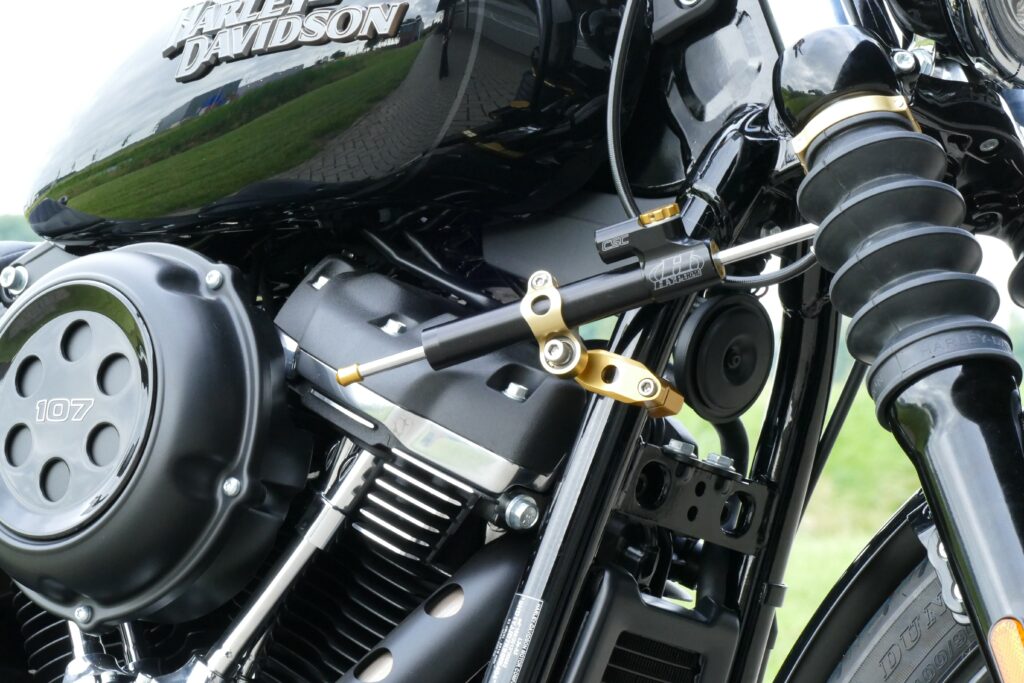
A motorcycle steering damper is the most direct solution specifically for tank slappers. It adds resistance to rapid steering movements without interfering with normal slow steering inputs. This means that the fast oscillations characteristic of a tank slapper are damped before they can build, while everyday cornering and manoeuvring feel completely natural. This is particularly valuable on roads where surface quality is unpredictable.
Upgraded fork springs and a matched rear shock absorber address the root cause by ensuring the suspension actually controls the tyre’s contact with the road. Factory suspension is often calibrated for an average rider weight and average road conditions. If your weight, riding style, or typical road surfaces fall outside that average, factory settings leave meaningful performance on the table.
How Hyperpro helps you ride with more control on bad roads
We design and manufacture suspension components specifically to address the kind of instability that bad road surfaces create. Our range gives you targeted tools to reduce tank slapper risk at every level:
- CSC Steering Damper (Constant Safety Control): A linear damping model adjustable in 22 positions, designed to reduce wobbles and vibrations while keeping steering feel natural. A direct and practical upgrade for riders who regularly encounter variable road conditions.
- RSC Steering Damper (Reactive Safety Control): A progressive damping model that responds proportionally to the speed of steering movement. It offers minimal resistance during normal riding and strong resistance during rapid oscillations, making it particularly effective against tank slappers triggered by sudden surface impacts.
- Model-specific mounting kits: CNC-milled kits available in Hyperpro Gold or Black, designed as plug-and-play fitments for your specific motorcycle. In 98% of applications, no drilling or cutting is required, so installation is straightforward and reversible.
- Progressive-rate fork springs and shock absorbers: Bike-specific springs that improve how your suspension tracks uneven surfaces, reducing the sharp inputs that initiate handlebar wobble in the first place.
If you want to discuss which combination of components suits your motorcycle and riding conditions, contact us directly. For purchasing, our products are available through authorised distributors worldwide. Use the dealer finder to locate your nearest stockist and get the right upgrade fitted correctly.