


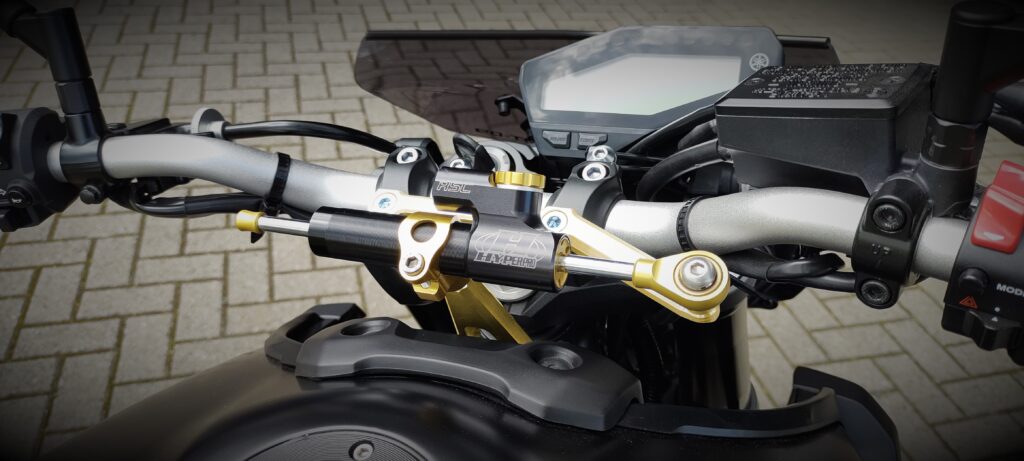
Yes, a steering damper can help with wobble under braking. When you apply the brakes hard, the front end loads up and the geometry of the bike shifts, which can trigger oscillations in the steering. A steering damper resists those rapid, uncontrolled steering movements and helps the front wheel track straight. That said, it is not a fix for every cause of wobble, and understanding why the instability happens in the first place matters just as much as the hardware you fit.
What actually causes wobble under braking on a motorcycle?
Wobble under braking is caused by a rapid, self-reinforcing oscillation of the front wheel and steering assembly. When you brake hard, weight transfers forward, compressing the forks and changing the steering geometry. If the front tyre, wheel, or steering components cannot absorb that energy smoothly, the steering begins to oscillate left and right in a feedback loop. This is commonly called a tank-slapper when it becomes severe.
Several factors can trigger or worsen this kind of instability:
- Tyre condition and pressure: A worn, underinflated, or mismatched tyre cannot maintain a consistent contact patch under braking loads, making oscillations far more likely.
- Wheel and rim runout: Even minor imbalances or bends in the wheel become amplified at speed or under hard braking.
- Worn steering head bearings: Loose or pitted bearings allow play in the steering, giving oscillations a starting point they would not otherwise have.
- Fork spring rate: Springs that are too soft for the rider’s weight and riding style allow the forks to dive excessively under braking, destabilising the geometry.
- Speed and braking force: Higher speeds and sharper brake inputs increase the energy the steering system needs to manage, raising the risk of wobble in bikes that are otherwise stable at lower speeds.
Understanding the root cause is important because a steering damper addresses the symptom of rapid oscillation, but it does not fix a worn bearing or an out-of-balance wheel.
Hyperpro
Ride with confidence
Find the nearest Hyperpro dealer and start your motorcycle upgrade.
How does a steering damper reduce wobble during braking?
A steering damper reduces wobble by adding hydraulic resistance to lateral steering movement. When the front wheel starts to oscillate under braking, the damper absorbs the energy of those rapid left-right movements and slows them down before they can build into a full tank-slapper. The result is a front end that stays composed and tracks straight even when braking forces are high.
The damper connects between the steering head and the frame or triple clamp. As the bars try to flick left or right, hydraulic fluid inside the damper is forced through a valve, converting that kinetic energy into heat. The stiffer the damping setting, the more resistance is applied to steering movement. This is why damper adjustment matters: too little damping and the wobble is not controlled effectively, too much and the steering feels heavy and unresponsive at low speeds or when you need to make deliberate corrections.
It is worth noting that a steering damper does not prevent you from steering normally. It is specifically designed to resist the kind of rapid, unintended oscillations that wobble produces, not the slower, deliberate inputs you make when cornering or manoeuvring.
Is wobble under braking always a steering damper problem?
No, wobble under braking is not always a steering damper problem. A damper helps manage oscillations once they start, but if your bike has worn steering head bearings, a damaged tyre, an imbalanced wheel, or fork springs that are far too soft for your weight, those mechanical issues need to be resolved first. Fitting a damper on top of unresolved mechanical problems can mask symptoms without making the bike genuinely safer.
A useful diagnostic approach is to check the basics before reaching for aftermarket parts:
- Check tyre pressure and tread condition on both wheels.
- Inspect the front wheel for balance and rim runout.
- Check the steering head bearings for play or roughness.
- Assess whether the fork springs suit your riding weight and style.
- Look at whether the wobble only happens at specific speeds or under specific braking loads, which helps narrow down the cause.
If the bike is mechanically sound and wobble still occurs under hard braking, particularly at higher speeds, a steering damper becomes a genuinely useful and relevant upgrade. Many sport and adventure riders fit one as a preventive measure precisely because the consequences of a tank-slapper at speed are severe.
What’s the difference between a rotary and a linear steering damper?
The key difference between a rotary and a linear steering damper is the mechanism they use to generate hydraulic resistance. A rotary damper uses a rotating vane inside a housing to displace fluid as the bars turn, while a linear damper uses a piston moving back and forth inside a cylinder. Both achieve the same goal of resisting rapid steering oscillations, but they differ in packaging, adjustability, and damping characteristics.
Rotary steering dampers
Rotary dampers mount compactly at the steering head and rotate with the bars. Because the damping force is generated through rotation, the resistance profile can be engineered to vary depending on how far the bars have turned. This makes them well suited to bikes where space around the steering head is limited and where a low-profile installation is preferred.
Linear steering dampers
Linear dampers use a traditional piston-and-cylinder layout, similar in principle to a fork damper. They mount between a fixed point on the frame and a moving point on the triple clamp or bars. Because the piston travels in a straight line, the damping force is applied progressively as the bars move. Linear dampers are often easier to tune and adjust and can deliver a wide range of damping force across their travel.
Our own range covers both approaches. The CSC (Constant Safety Control) model uses linear damping with consistent resistance across the range of movement, while the RSC (Reactive Safety Control) model uses progressive damping that increases resistance as oscillation speed rises. Both are adjustable across 22 positions, giving riders precise control over how much damping they apply in different riding conditions.
Should you adjust damper settings differently for braking situations?
Yes, your damper settings should reflect the kind of riding you do, and braking performance is a relevant factor in that decision. If you regularly brake hard from high speeds, a slightly firmer damper setting gives the front end more resistance to oscillation during the critical moment when weight transfers forward and the steering geometry is most stressed. A setting that feels fine at moderate speeds may not provide enough control under aggressive braking.
That said, the right setting is always a balance. Increasing damping too far makes the steering feel heavy, slows your response in corners, and can make the bike feel unnatural at low speeds or during slow manoeuvring. The goal is to find the point where the damper controls unwanted oscillation without interfering with deliberate steering inputs.
A practical approach to finding the right setting:
- Start from the middle of the adjustment range as a baseline.
- Increase damping gradually if you notice wobble or instability under hard braking.
- Reduce damping if the steering feels heavy or slow to respond in corners.
- Test changes on familiar roads at progressively higher speeds before committing to a final setting.
- Revisit settings if you change tyres, adjust tyre pressure significantly, or modify other suspension components.
Riders who use their bikes across varied conditions, such as track days combined with road riding, may find it useful to adjust their damper settings between sessions rather than using a single fixed setting for everything.
How Hyperpro helps with steering stability and wobble control
We design and manufacture steering damper systems specifically to address the kind of instability this article covers. Our product range gives riders a direct, practical way to improve front-end control without requiring a full suspension rebuild. Here is what we offer:
- CSC (Constant Safety Control): A linear damping model with 22 adjustable positions, delivering consistent resistance to steering oscillations across the full range of movement.
- RSC (Reactive Safety Control): A progressive damping model that increases resistance as oscillation speed rises, responding more aggressively to the rapid movements that characterise a tank-slapper.
- Model-specific mounting kits: CNC-milled brackets engineered for your exact bike, available in Hyperpro Gold or Black. In 98% of applications, fitting requires no drilling or cutting, making installation straightforward.
- Plug-and-play fitment: Our kits are designed to bolt directly onto your bike using existing mounting points, so you get a clean, secure installation without modifications to your frame or triple clamp.
You can browse our full suspension product range to find the right damper for your bike. Purchases are made through our authorised distributor network. If you have a question about fitment or want advice on the right model for your riding style, get in touch with us directly.