


Yes, a wheelie can cause a tank slapper. When your front wheel lifts off the ground and then comes back down at speed, it can land out of alignment or meet an uneven surface, triggering a rapid, uncontrolled steering oscillation. This risk increases significantly when the front end is unloaded for too long or the landing is poorly managed. The sections below break down exactly why this happens and what you can do about it.
What actually happens to your front wheel during a wheelie?
During a wheelie, your front wheel leaves the ground entirely, which means it loses all contact with the road and stops receiving the stabilizing feedback that normal riding provides. With no surface resistance acting on the tyre, the wheel and forks are free to move laterally without correction. The longer the front end stays up, the more opportunity there is for the wheel to drift slightly off-centre before it lands.
Under normal riding conditions, the front tyre generates what engineers call self-aligning torque. This is the natural tendency of a rolling tyre to track straight due to the contact patch trailing behind the steering axis. The moment the wheel lifts, that force disappears completely. Any minor crosswind, body movement, or throttle input can introduce a small lateral bias into the front end. You may not feel it while the wheel is in the air, but it becomes very apparent the instant the tyre touches down again.
The fork geometry also plays a role here. Trail and caster angle are designed to work with a loaded front end. When the forks are unloaded mid-wheelie, the suspension extends fully and the geometry shifts outside its intended operating range. This makes the steering feel lighter and less predictable on landing.
Hyperpro
Ride with confidence
Find the nearest Hyperpro dealer and start your motorcycle upgrade.
How does a tank slapper start after a wheelie?
A tank slapper after a wheelie starts when the front wheel lands with a small misalignment and the forks begin oscillating left and right faster than the rider can correct. The handlebars swing violently from side to side, sometimes fast enough to hit the rider’s hands or tank. This oscillation is a resonance effect: once it starts, each swing amplifies the next unless something interrupts the cycle.
The sequence typically unfolds like this. The front wheel touches down slightly off-centre. The tyre generates a corrective force, but if that force overshoots the centre line, the wheel swings the other way. At speed, this back-and-forth happens in fractions of a second. Without a damping mechanism to absorb the energy, the oscillation builds rather than settles.
Steering geometry, tyre condition, and suspension setup all influence how quickly this escalates. A worn front tyre with reduced grip, or a fork setup that is too soft in rebound damping, gives the oscillation less resistance. The result is a tank slapper that develops from a minor wobble into a full handlebar-slamming event within one or two seconds. Speed makes everything worse: the faster you are travelling when the front wheel lands, the more energy the system has to oscillate with.
What riding conditions make this more likely?
Tank slappers after wheelies are more likely at high speed, on uneven road surfaces, and when the rider has limited body control during the landing. Several specific conditions raise the risk considerably.
- High entry speed: The faster the bike is travelling when the front wheel comes down, the more kinetic energy is available to drive the oscillation.
- Uneven or cambered road surfaces: A landing on a bump, ridge, or surface irregularity introduces an immediate lateral force into the front end that can trigger a wobble instantly.
- Worn or mismatched tyres: A front tyre with reduced tread or one that does not match the rear in profile can generate unpredictable contact patch behaviour on landing.
- Incorrect suspension setup: Forks with insufficient rebound damping allow the front end to bounce back too quickly after landing, reducing stability.
- Rider tension: Gripping the handlebars too tightly actually makes a tank slapper worse. Tense arms transmit the oscillation directly into the rider’s body rather than allowing the bike to self-correct.
- Crosswind: Even a moderate side wind can push the unloaded front wheel off-centre during the wheelie, setting up a misaligned landing.
Combination conditions are the most dangerous. A high-speed wheelie on a bumpy road with worn tyres and a tense rider is a scenario where a tank slapper can escalate to a crash within seconds.
Can suspension upgrades reduce the risk of a tank slapper?
Yes, the right suspension setup reduces the risk of a tank slapper by improving how the front end behaves both during the wheelie and on landing. Properly tuned fork springs and rebound damping help the front wheel settle quickly and track straight after touchdown, rather than bouncing or oscillating. A steering damper is the most direct upgrade for this specific risk.
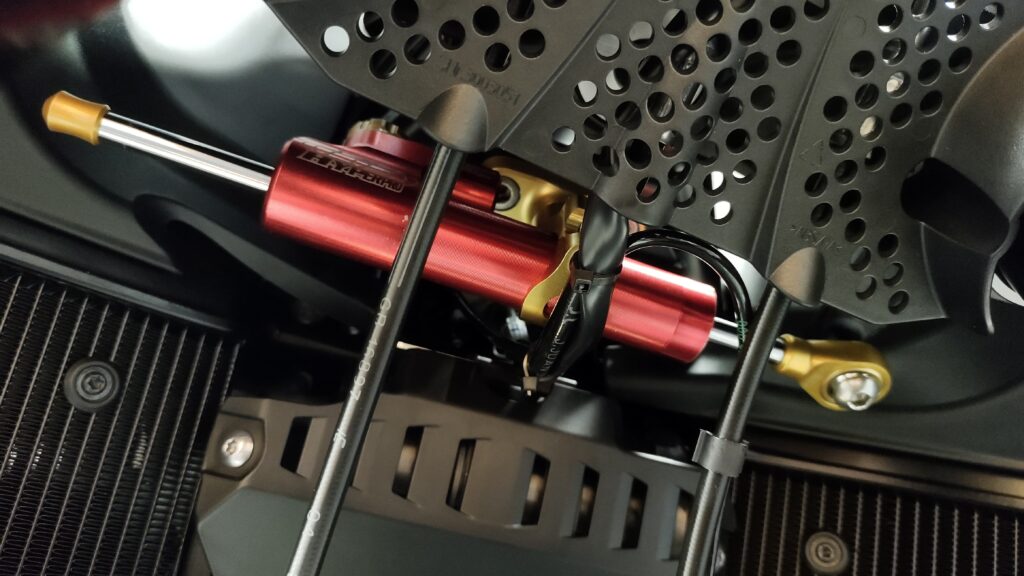
A steering damper works by adding controlled resistance to the steering axis. When the handlebars begin to oscillate, the damper absorbs that energy and prevents the swing from amplifying. This does not eliminate the initial misalignment on landing, but it interrupts the resonance cycle before it builds into a full tank slapper. For riders who regularly push their bikes hard, this is one of the most practically useful safety upgrades available.
Fork spring rate also matters. A spring that is too soft for the rider’s weight and riding style allows the front end to bottom out or rebound aggressively on landing, both of which contribute to instability. Upgrading to a correctly rated progressive fork spring helps the suspension absorb the landing load smoothly and return to its neutral position in a controlled manner. You can browse suspension components to find bike-specific options that match your model and riding style.
What should you do if a tank slapper starts?
If a tank slapper starts, the most important thing to do is relax your grip on the handlebars, keep your weight central, and avoid braking or accelerating sharply. Counterintuitively, loosening your grip is the correct response. Tight hands transfer the oscillation energy back into the bike and make the wobble worse. Relaxed arms allow the steering to self-correct, which is exactly what the geometry is designed to do.
Follow these steps in the moment:
- Relax your arms immediately. Loosen your grip so the handlebars can move without your body fighting them.
- Keep your weight central and low. Shift your body weight down and toward the tank to help stabilize the chassis.
- Hold a steady throttle. Do not snap the throttle shut or crack it open. Sudden power changes shift chassis weight and can worsen the oscillation.
- Avoid braking hard. Grabbing the front brake during a tank slapper is very likely to cause a crash. If you need to slow down, apply rear brake gently and progressively.
- Let the bike settle before changing direction. Give the steering time to self-correct before attempting any steering input.
Most tank slappers, if caught early and handled calmly, resolve within a second or two. The danger comes when riders panic and fight the bars. If your bike experiences wobbles or tank slappers regularly at speed, treat it as a signal to review your suspension setup and tyre condition before your next ride.
How Hyperpro helps reduce tank slapper risk
We develop suspension and steering control products specifically designed to address the kind of instability that leads to tank slappers. Our approach combines properly rated spring components with dedicated steering damper technology to give your front end the control it needs under demanding conditions.
- CSC Steering Damper (Constant Safety Control): A linear damping model adjustable in 22 positions, designed to reduce handlebar oscillation, wobbles, and vibrations across all riding speeds.
- RSC Steering Damper (Reactive Safety Control): A progressive damping model that responds proportionally to the intensity of the steering movement, offering more nuanced control at both low and high oscillation frequencies.
- Model-specific mounting kits: CNC-milled brackets designed as plug-and-play fitments for your exact motorcycle, requiring no drilling or cutting in 98% of applications. Available in Hyperpro Gold or Black.
- Progressive fork springs: Bike-specific springs that improve front-end stability on landing and during fast direction changes, reducing the conditions that allow a tank slapper to develop.
All purchases are made through our authorised distributor network. Find your nearest dealer at hyperpro.com/where-to-buy, or contact us if you have questions about which products suit your specific bike and riding style.