


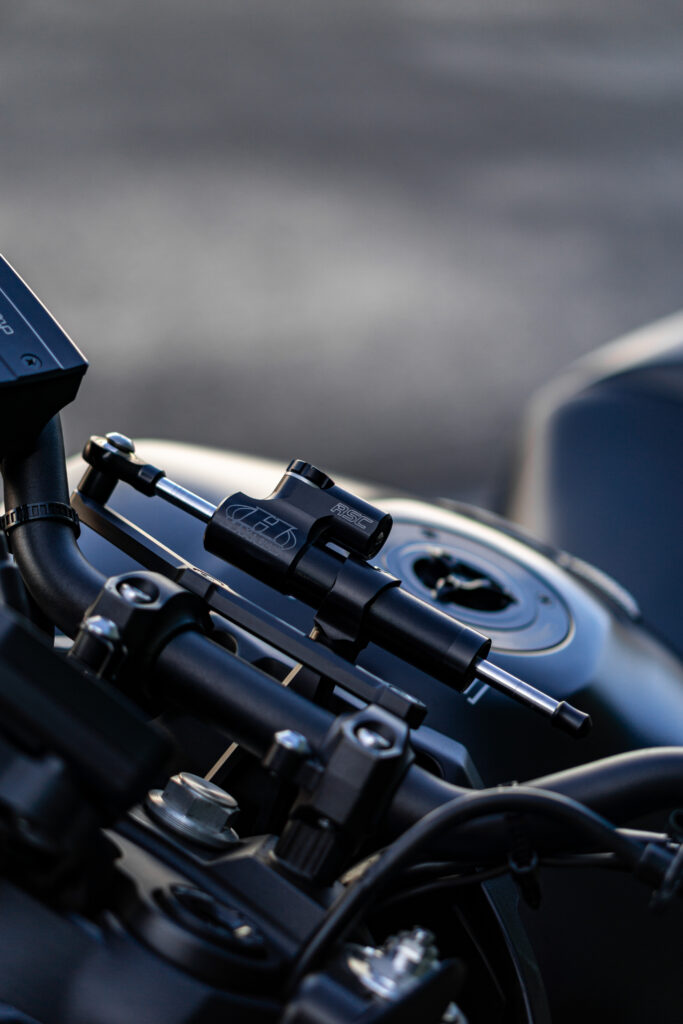
In most countries, removing a steering damper is not explicitly illegal, but it can put you on the wrong side of road safety regulations if your motorcycle was originally fitted with one as standard equipment. Whether it matters legally depends on your country’s vehicle modification rules and how your bike was type-approved. Below, we cover the key questions riders ask before deciding to remove or replace a steering damper.
What happens to a motorcycle without a steering damper?
Without a steering damper, a motorcycle becomes significantly more vulnerable to tank-slappers, high-speed wobbles, and handlebar vibrations. A steering damper resists sudden, uncontrolled steering inputs by absorbing the energy that causes the front wheel to oscillate. Remove it, and those forces transfer directly to the bars and the rider’s hands, especially at speed or over uneven road surfaces.
The risk is not theoretical. Tank-slappers, where the handlebars snap violently from side to side, can happen in a fraction of a second and are one of the most dangerous situations a rider can face. Motorcycles that generate significant power or have geometry prone to instability are especially vulnerable. Even at moderate speeds, rough surfaces, mid-corner bumps, or sudden braking can trigger a wobble that a steering damper would normally suppress before the rider even notices it.
The steering damper does not replace rider skill, but it provides a critical buffer between an unstable moment and a crash. Its absence raises the physical and cognitive demand on the rider during the moments when control is hardest to maintain.
Hyperpro
Ride with confidence
Find the nearest Hyperpro dealer and start your motorcycle upgrade.
Is removing a steering damper illegal in most countries?
Removing a steering damper is not universally illegal, but it can violate road traffic regulations in countries where modifications to standard safety equipment are restricted. If your motorcycle was type-approved with a steering damper as original equipment, removing it may make the bike non-compliant with its homologation, which can result in a failed roadworthiness inspection or a fine.
The legal picture varies by region:
- European Union: EU vehicle type-approval regulations require that a motorcycle conform to its original specification for road use. Removing a component listed as standard safety equipment can breach those rules and invalidate the bike’s roadworthiness certificate.
- United Kingdom: The Construction and Use Regulations require vehicles to be maintained in a roadworthy condition. Removing a damper that was part of the original design could be interpreted as reducing the vehicle’s safety standard.
- United States: Federal regulations do not explicitly prohibit steering damper removal, but state laws vary. Some states have general provisions against modifications that impair vehicle safety or control.
- Australia: Vehicle Standards Bulletins in several states restrict modifications that affect steering and stability systems. Removing a factory-fitted steering damper may require engineering certification.
The practical takeaway is that even where no specific law bans removal, the legal exposure comes indirectly through inspection failures, insurance disputes, and liability in the event of an accident. Always check the specific regulations in your country or state before making any changes to your steering system.
Does removing a steering damper void your insurance?
Removing a steering damper can void your motorcycle insurance or significantly reduce your coverage in the event of a claim. Most insurance policies require the motorcycle to be maintained in a roadworthy condition and to conform to the manufacturer’s original specification. Removing a factory-fitted safety component is a modification that most insurers consider material information.
If you are involved in an accident after removing a steering damper, an insurer may argue that the modification contributed to the incident or that you failed to disclose a material change to the vehicle. Either argument can lead to a denied claim or a reduced payout, leaving you personally liable for damages, medical costs, or third-party claims.
The safest approach is to notify your insurer before making any changes to the steering system. Some insurers will accept the modification with an adjusted premium or an endorsement on the policy. Others may decline to cover the bike at all. Getting clarity in advance protects you from a far more expensive situation after an incident.
Which motorcycles are most affected by steering damper removal?
Motorcycles with high power outputs, aggressive geometry, or a design that prioritises agility over straight-line stability are most affected by steering damper removal. Sport bikes, naked bikes with short wheelbases, and large-displacement adventure tourers are the categories where the absence of a damper creates the greatest risk.
Specific characteristics that increase vulnerability include:
- Short wheelbase: Less physical distance between the axles means the front wheel has less geometric resistance to oscillation.
- High centre of gravity: Adventure bikes and upright naked bikes transfer weight quickly during direction changes, making them more prone to wobble at speed.
- High horsepower: Powerful engines can accelerate the front wheel into instability faster than the rider can react, especially during hard acceleration out of corners.
- Worn or soft front suspension: A front end that lacks damping from the forks relies more heavily on the steering damper to absorb unwanted inputs.
- Factory-fitted dampers: If the manufacturer included a steering damper as standard, it is a strong signal that the bike’s dynamics require it. Removing it goes against the engineering intent.
Cruisers and touring bikes with long wheelbases and relaxed geometry are generally less sensitive to steering damper removal, though they are not immune to wobble, particularly at highway speeds under crosswind conditions.
Should you replace or remove a worn steering damper?
You should always replace a worn steering damper rather than remove it. A damper that has lost its effectiveness still provides some resistance to unwanted steering inputs, but more importantly, replacing it restores the safety margin the manufacturer designed into the bike. Removing it entirely eliminates that margin and introduces the legal, insurance, and safety risks described above.
A worn steering damper typically shows these signs:
- Handlebar vibration that was not present before
- A noticeable wobble at higher speeds
- The damper body feeling loose, leaking fluid, or moving without resistance
- Reduced steering confidence in corners or over uneven surfaces
Replacing the damper is a straightforward upgrade that restores control and, in many cases, improves on the original factory unit. Rather than viewing replacement as a maintenance cost, treat it as an opportunity to fit a unit better suited to how you actually ride.
How Hyperpro helps with steering damper replacement
We design and manufacture steering dampers built specifically to address the instability risks that come with a worn or missing damper. Our product range gives you two clear options depending on your riding style and the demands of your motorcycle:
- CSC (Constant Safety Control): A linear damping model adjustable in 22 positions, suited to riders who want consistent, predictable resistance across all steering inputs.
- RSC (Reactive Safety Control): A progressive damping model also adjustable in 22 positions, which responds proportionally to the intensity of the steering input. It allows light, natural steering at low speeds while providing stronger resistance during the high-speed wobbles and tank-slappers where it matters most.
Both models come with CNC-milled, model-specific mounting kits available in Hyperpro Gold or Black. These are plug-and-play fitments that require no drilling or cutting in 98% of applications, so installation is clean and reversible. You can browse the full product range to find the right fit for your motorcycle. Purchases are always made through our authorised distributor network. If you have questions about which damper suits your bike, contact us directly and we will point you in the right direction.