


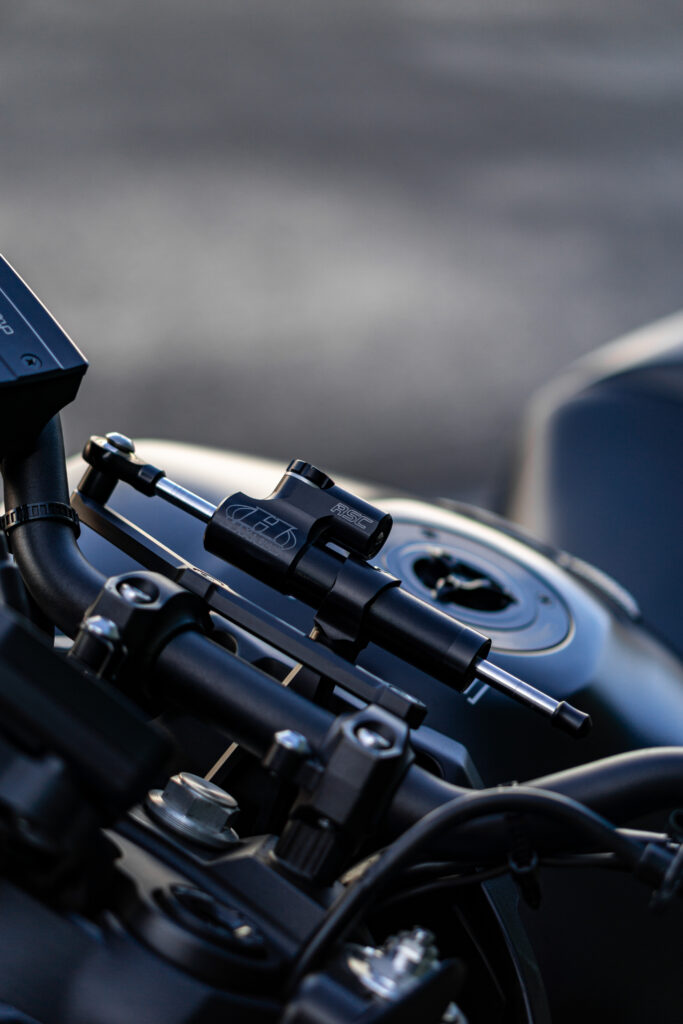
OEM and aftermarket steering dampers serve the same basic purpose, but they differ significantly in how they do it. OEM units use fixed, linear damping tuned for average conditions, while aftermarket steering dampers offer adjustable, often progressive damping that riders can fine-tune to their riding style, bike setup, and road conditions. For riders who push beyond everyday commuting, that difference is meaningful.
The sections below walk through how each type works, where factory units fall short, and what to look for when deciding whether an upgrade makes sense for your riding.
How do OEM and aftermarket steering dampers actually work differently?
OEM steering dampers use a fixed hydraulic resistance to slow unwanted handlebar movement. The damping rate is set at the factory and does not change regardless of speed, riding style, or road surface. Aftermarket steering dampers, by contrast, offer adjustable damping that riders can tune by hand, and the better models use progressive or reactive damping that automatically varies resistance based on the speed and force of the steering input.
In practical terms, a fixed-rate OEM unit applies the same resistance whether you are navigating a slow urban corner or recovering from a high-speed wobble. An adjustable aftermarket unit lets you dial in light damping for relaxed riding and increase resistance for track sessions or fast road work. Progressive aftermarket models go further by responding dynamically to the intensity of the input, providing minimal resistance during normal steering and firm resistance during sudden, destabilising movements.
This distinction matters because steering instability does not arrive at a predictable rate. Tank-slappers, speed wobbles, and vibrations from road imperfections all involve rapid, high-force inputs that a fixed damper handles less effectively than one tuned to respond proportionally.
Hyperpro
Ride with confidence
Find the nearest Hyperpro dealer and start your motorcycle upgrade.
What are the performance limitations of OEM steering dampers?
OEM steering dampers are designed around a compromise: they must work acceptably for a wide range of riders, speeds, and conditions without requiring any adjustment. That compromise means they are rarely optimised for any single use case. The damping rate is typically conservative, which keeps the steering from feeling heavy at low speeds but leaves the front end under-supported during high-speed instability.
Several limitations follow from this fixed-rate design:
- No adjustability. You cannot increase resistance for track days or reduce it for slow technical riding. The setting is permanent.
- Calibrated for average use. Factory damping is tuned for a stock bike with standard tyres and a rider of average weight. Any deviation from that, such as different tyres, a pillion, or luggage, changes the handling dynamics without any corresponding change in damping.
- Limited response range. Linear dampers apply roughly the same force across all input speeds. During a sudden wobble, where damping needs to increase rapidly, a fixed linear unit cannot adapt quickly enough.
- No fine-tuning after suspension changes. If you upgrade your fork springs or shock absorber, the OEM damper was not calibrated for your new suspension setup and may no longer be well matched to it.
Not all motorcycles even come with a steering damper fitted as standard. In those cases, riders have no factory baseline at all, and any instability at speed goes entirely unmanaged.
What makes aftermarket steering dampers better for performance riding?
Aftermarket steering dampers improve on OEM units by giving riders direct control over damping strength and, in more advanced models, by using progressive or reactive damping that adjusts automatically to the situation. For performance riding, both of those qualities translate directly into more confidence and better handling.
Adjustability is the most immediate advantage. A rider heading to a track day can increase damping resistance to manage the higher speeds and more aggressive inputs involved. The same rider can back off the adjustment for a relaxed weekend road ride where heavy damping would make the steering feel sluggish. That flexibility simply does not exist with a factory unit.
Progressive damping takes this further. Rather than applying a fixed resistance, a progressive damper increases its resistance in proportion to the speed and force of the handlebar movement. During normal riding, it stays light and unobtrusive. During a sudden wobble or tank-slapper, it firms up rapidly to arrest the instability. This reactive behaviour is particularly valuable at speed, where the window for recovery is narrow.
Aftermarket units are also built to tighter tolerances and with higher-quality internal components than most OEM dampers, which means more consistent performance across a wider temperature range and longer service life under hard use.
Are aftermarket steering dampers a direct bolt-on replacement?
In most cases, yes, but fitment depends on whether a model-specific mounting kit is available for your motorcycle. A steering damper body alone cannot simply be attached to any bike. It requires a bracket or mounting kit that positions the damper correctly relative to the steering head and frame geometry. When a properly engineered kit exists for your model, installation is typically straightforward and requires no drilling, cutting, or fabrication.
The important distinction is between a universal mounting approach and a model-specific one. Universal brackets require more setup time and may involve compromises in damper positioning. Model-specific kits are designed for a single motorcycle or a closely related family of models, which means the geometry, damper travel, and mounting points are all matched to the bike from the start. That precision affects both installation ease and how well the damper performs once fitted.
You can browse the full range of suspension products and mounting kits to check fitment for your specific model before purchasing.
When should a rider upgrade from OEM to an aftermarket steering damper?
A rider should consider upgrading when their current damper no longer matches how or where they ride. The most common triggers are a change in riding style, a significant suspension upgrade, or recurring instability at speed that the OEM unit is not managing adequately.
Specific situations that point towards an upgrade include:
- Track riding or regular high-speed road use. At higher speeds, the consequences of instability are more severe and the need for responsive damping increases. A fixed OEM unit is rarely calibrated for sustained performance use.
- After upgrading fork springs or the rear shock. Changing your suspension setup alters the handling balance of the bike. An OEM damper calibrated for the stock setup may no longer be well matched to the new configuration.
- Experiencing wobbles or tank-slappers. If you have felt the front end become unstable at speed, that is a direct sign that your current damping is insufficient for the conditions you are riding in.
- Riding a bike with no factory damper fitted. If your motorcycle did not come with a steering damper as standard, any performance riding is happening without that layer of stability control.
- Wanting more control over your setup. Even without a specific problem, riders who tune other parts of their bike often find that an adjustable damper completes the picture by giving them the same level of control over steering stability that they now have over suspension.
Timing the upgrade alongside other suspension work makes practical sense. If you are already fitting new springs or a shock absorber, adding a matched steering damper at the same time ensures all the components are calibrated to work together from the start.
How Hyperpro helps with steering stability
We design and manufacture two steering damper systems built around the limitations described above. The CSC (Constant Safety Control) model uses linear damping with 22 adjustment positions, giving riders a straightforward way to dial in the right resistance for their riding. The RSC (Reactive Safety Control) model uses progressive damping that automatically increases resistance during sudden, high-speed inputs while staying light and unobtrusive during normal steering. Both models directly address tank-slappers, wobbles, and vibrations that an OEM unit handles less effectively.
To make fitment as simple as possible, we develop CNC-milled model-specific mounting kits for both damper systems, available in Hyperpro Gold or Black. These kits are engineered for individual motorcycle models, which means correct geometry, correct damper travel, and a plug-and-play installation that requires no drilling or cutting in 98% of applications.
- Two damper types to match different riding needs: linear (CSC) and progressive (RSC)
- 22 adjustment positions on both models for precise tuning
- Model-specific mounting kits for clean, accurate fitment
- Available in Gold or Black finish
- No drilling or cutting required in nearly all applications
If you have questions about which damper suits your bike and riding style, contact us directly. To purchase, find your nearest authorised distributor through our dealer locator.