


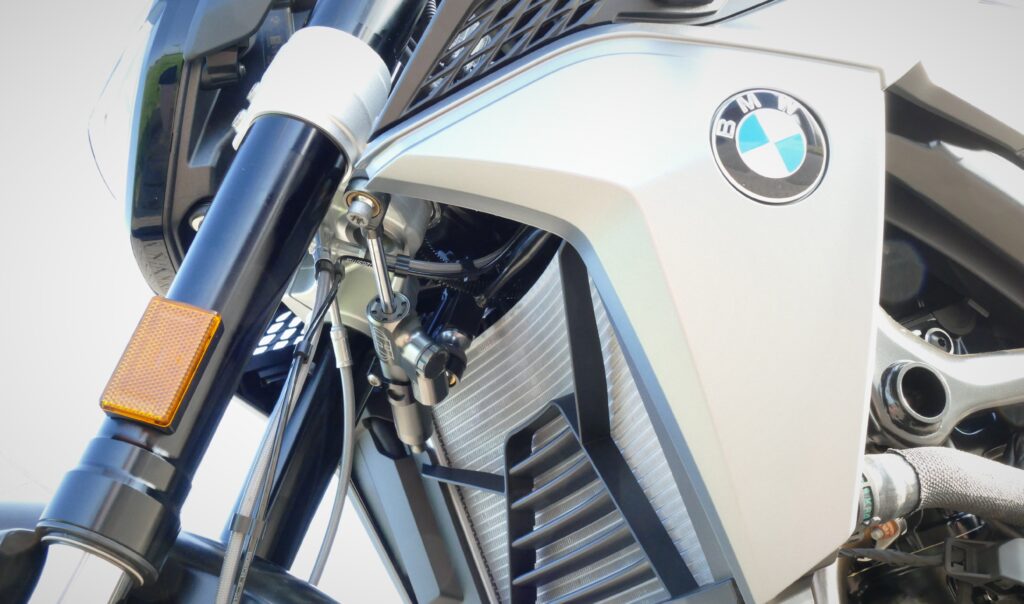
The compression setting on a steering damper controls how much resistance the damper applies when the handlebars are pushed toward full lock or deflected by an external force. It determines how quickly or slowly the steering can move under sudden inputs, such as a tank slapper, road shock, or high-speed instability. The sections below break down exactly how that works and how to dial in the right setting for your riding.
How does compression damping actually control steering movement?
Compression damping controls steering movement by resisting the force that pushes the damper’s internal piston through its fluid. When the handlebars move rapidly, the damper generates resistance proportional to the speed of that movement. The faster the steering deflects, the more the damper pushes back, slowing the motion and preventing the handlebars from snapping violently from one side to the other.
Inside the damper, oil flows through a series of valves or channels when the piston moves. The compression setting adjusts how restricted that flow is. A tighter restriction means the oil moves more slowly, creating higher resistance. A more open setting lets oil pass through freely, producing a softer, more compliant steering response.
This mechanism is what makes a steering damper effective against tank slappers and speed wobbles. A tank slapper is a rapid oscillation of the front wheel where the handlebars swing back and forth at high frequency. Without damping, that oscillation can escalate quickly. With compression damping engaged, each swing is slowed just enough to break the feedback loop before it becomes dangerous.
Hyperpro
Ride with confidence
Find the nearest Hyperpro dealer and start your motorcycle upgrade.
What happens when compression is set too high or too low?
When compression damping is set too high, the steering becomes heavy and slow to respond. The rider has to apply noticeably more effort to turn, especially at low speeds or when navigating tight corners. Countersteering inputs feel wooden and delayed, which reduces confidence rather than building it. At the extreme, an overly stiff setting can actually cause instability by preventing the front wheel from self-correcting naturally.
When compression damping is set too low, the steering offers little meaningful resistance to sudden deflections. Road imperfections, braking forces, and surface changes can push the handlebars around without the damper doing much to intervene. This is where wobbles and oscillations can develop, particularly at higher speeds where instability builds faster than the rider can react.
The goal is a middle ground where the damper is firm enough to catch rapid, unwanted movements but light enough to let intentional steering inputs flow through without interference. Neither extreme improves safety. Both make the bike harder to ride well.
When should you increase the compression setting on a steering damper?
You should increase the compression setting when the bike shows signs of instability at speed, particularly under hard acceleration, after hitting a bump mid-corner, or when the front wheel lifts and lands. These are the conditions where a tank slapper is most likely to develop, and a firmer compression setting gives the damper more authority to suppress the oscillation before it escalates.
Other situations where a higher compression setting makes sense include:
- Track riding or high-speed road riding where the consequences of a wobble are more severe and the bike spends more time at speeds where instability is a real risk
- Riding on poor road surfaces where repeated impacts continuously disturb the front end
- After fitting a higher-powered engine upgrade that increases the likelihood of wheelspin and front wheel lift
- When carrying a pillion or luggage that shifts weight distribution and changes how the front end behaves
Increasing compression damping is not a substitute for properly set-up suspension elsewhere on the bike. If the fork springs or rear shock are significantly out of balance, adjusting the steering damper alone will not resolve the underlying instability. It is a targeted tool for steering control, not a fix for suspension geometry problems.
Does the compression setting affect low-speed and high-speed steering differently?
Yes, compression damping affects low-speed and high-speed steering in meaningfully different ways. At low speeds, even a moderate compression setting can make the steering feel noticeably heavier because the rider’s inputs are slower and the damper’s resistance is more present relative to the forces involved. At high speeds, the same setting may feel almost transparent because the rider is applying less physical effort to steer and the damper is primarily managing rapid, unintended movements rather than deliberate ones.
This is one of the reasons progressive damping models behave differently from linear ones. A linear damper applies the same resistance curve regardless of how fast the steering moves. A progressive model scales its resistance with the speed of the movement, which means it can remain relatively light during slow, intentional steering while generating much stronger resistance during the rapid oscillations of a tank slapper.
For riders who split time between slow technical riding and high-speed runs, this distinction matters. A compression setting that works well on a fast motorway may feel intrusive in a car park, and vice versa. Understanding how your specific damper responds across that speed range helps you find a setting that performs across both.
How do you find the right compression setting for your riding style?
Finding the right compression setting starts from the middle of the adjustment range and works outward based on feel. Set the damper to its midpoint, then ride in a controlled environment and pay attention to two things: how much effort steering requires, and whether the front end feels settled or nervous at speed. From there, adjust one or two positions at a time and ride again before making a further change.
A practical approach to dialing in the setting:
- Start at the midpoint of the available adjustment range, typically around position 11 on a 22-position damper
- Ride at your typical speeds and note whether steering feels natural or heavy
- Introduce a controlled stress test, such as accelerating hard over a known bump, to check whether the front end stays settled
- Adjust in small increments, moving up if the front feels nervous, moving down if steering feels laboured
- Re-test after each adjustment before making a further change
Your riding environment also shapes the ideal setting. Riders who spend most of their time on smooth, fast roads can typically run a firmer setting without noticing the added steering weight. Riders who frequently navigate urban traffic or winding back roads with variable surfaces often prefer a softer setting that keeps steering natural and responsive.
If you are unsure where to begin or your bike has specific handling characteristics, speaking with a specialist who knows the model is a faster route to the right result than trial and error alone.
How Hyperpro helps you get steering control right
We design our steering dampers to give you precise, adjustable control over exactly the kind of instability described throughout this article. Our range covers two distinct damping approaches, both adjustable across 22 positions so you can tune the compression response to your riding style and conditions:
- CSC (Constant Safety Control): a linear damping model that delivers consistent resistance across the full steering range, well suited to riders who want a straightforward, predictable setup
- RSC (Reactive Safety Control): a progressive damping model that scales resistance with the speed of the steering movement, staying light during slow inputs and generating strong resistance during rapid oscillations
- Model-specific mounting kits: CNC-milled brackets designed as plug-and-play fitments for your specific bike, requiring no drilling or cutting in 98% of applications, available in Hyperpro Gold or Black
You can explore the full range of suspension and damping products to find what fits your bike. Purchases are always made through our authorised distributors. If you have a technical question or need guidance before buying, contact us directly and we will point you in the right direction.