


Yes, tire pressure directly affects steering stability on a motorcycle. When pressure is too low or too high, the contact patch between the tire and road changes shape, which alters how the bike responds to steering input, cornering forces, and surface feedback. Getting tire pressure right is one of the simplest and most impactful things you can do for confident, predictable handling.
The sections below walk through exactly what happens at both extremes, how to find the right pressure for your bike, and whether a steering damper can pick up the slack when pressure is off.
How does tire pressure change the way a motorcycle handles?
Tire pressure determines the shape and size of the contact patch, which is the small area of rubber that actually touches the road. When pressure is correct, the contact patch is optimally shaped for the tire’s design, giving you predictable steering input, consistent grip, and stable tracking through corners. Change the pressure in either direction and the contact patch deforms, making the bike respond differently than the manufacturer intended.
At the correct pressure, a tire flexes in a controlled way. That flex absorbs small road imperfections, maintains consistent contact with the surface, and communicates what the road is doing through the handlebars. This feedback loop is what allows experienced riders to make small, confident steering adjustments. When pressure shifts away from the recommended range, that loop becomes distorted. The bike may feel vague, heavy, or twitchy, depending on which direction the pressure has gone.
Tire pressure also interacts with suspension behavior. A tire that is too soft effectively adds uncontrolled compliance to the front end, while an overinflated tire transfers more shock directly into the suspension components. Neither condition allows your suspension to work as designed.
Hyperpro
Ride with confidence
Find the nearest Hyperpro dealer and start your motorcycle upgrade.
What happens to steering stability when tire pressure is too low?
When tire pressure is too low, the contact patch spreads wider and becomes irregular in shape. This causes the tire to roll and flex excessively under load, making steering feel heavy, sluggish, and unpredictable. In corners, the front end can feel like it wants to fall in rather than hold a line. At higher speeds, a severely underinflated front tire increases the risk of a wobble or weave developing.
Underinflation also generates more heat through increased flex. Over a long ride, that heat buildup degrades the tire compound faster and can cause the carcass to deform in ways that permanently affect handling. Even a drop of a few PSI below the recommended level is enough to make a noticeable difference in how the front end responds to steering input.
Riders often describe a low-pressure front tire as feeling “lazy” or “vague.” Countersteering inputs feel muted, and the bike requires more effort to change direction. At the rear, low pressure causes the tire to squirm under acceleration and braking, reducing the confidence you feel when leaning into a corner.
Can over-inflated tires make a motorcycle harder to steer?
Yes, overinflated tires make a motorcycle harder to steer in a specific way. When pressure is too high, the contact patch shrinks and becomes more rounded, reducing the tire’s footprint on the road. The bike sits on a smaller, stiffer contact area, which makes it feel darty and nervous. Small bumps and road imperfections transmit directly into the handlebars because the tire has lost its ability to absorb them.
An overinflated front tire tends to deflect off surface irregularities rather than rolling over them smoothly. This can cause the front end to skip or twitch, particularly on worn or uneven road surfaces. The steering becomes lighter and quicker, but in an unsettled way rather than a responsive one. Riders sometimes mistake this sensation for improved handling, but it actually represents a reduction in grip and control.
At the rear, overinflation reduces traction under acceleration and makes the back end more likely to step out on slippery surfaces. The tire cannot conform to the road surface as effectively, so grip is inconsistent rather than predictable.
What is the correct tire pressure for motorcycle stability?
The correct tire pressure for your motorcycle is the figure specified by the bike’s manufacturer, found in the owner’s manual or on a sticker typically located on the swingarm or frame. This figure is calculated for your specific bike’s weight, geometry, and tire size. Using the tire manufacturer’s recommended pressure printed on the sidewall is not the same thing and can result in handling that is too stiff for your setup.
A few important factors influence what the right pressure is in practice:
- Load: Most manufacturers provide separate pressure recommendations for solo riding and riding with a passenger or luggage. Increase pressure when carrying extra weight.
- Tire temperature: Always check pressure cold, before the bike has been ridden. Pressure rises as tires heat up, so a reading taken mid-ride will be higher than the true baseline.
- Riding style and conditions: Track riding and high-speed touring may call for slight adjustments within a safe range, but street riders should stay close to the manufacturer’s specification.
- Tire type: Sport tires, touring tires, and adventure tires each have different construction and may have different optimal pressure ranges even on the same bike.
When in doubt, follow the bike manufacturer’s recommendation rather than guessing or using a round number. Even a few PSI off in either direction affects how the bike tracks and steers.
How often should motorcycle tire pressure be checked?
Motorcycle tire pressure should be checked before every ride, or at minimum once a week if you ride daily. Tires lose pressure naturally over time through microscopic permeation of the rubber, even without a puncture. Temperature changes also affect pressure significantly. A drop of 10 degrees Celsius can reduce tire pressure by roughly 1 to 2 PSI, which is enough to shift handling behavior.
Checking pressure takes less than two minutes with a quality gauge and is one of the most impactful pre-ride checks you can perform. Many riders skip it because the change feels gradual, but handling degradation from low pressure accumulates over days of riding without the rider necessarily noticing until something feels wrong at a critical moment.
Check pressure more frequently in the following situations:
- After a significant change in ambient temperature
- Before a long trip or track day
- When carrying a passenger or extra luggage
- After the bike has been parked for more than a few days
Can suspension setup compensate for incorrect tire pressure?
No, suspension setup cannot effectively compensate for incorrect tire pressure. Suspension and tires work together as a system, and each component is designed to operate within specific parameters. When tire pressure is wrong, the tire itself behaves unpredictably, and no amount of preload, damping, or spring rate adjustment will fully restore the handling balance that correct pressure provides.
Attempting to compensate for soft tires by stiffening the suspension, for example, simply shifts the problem. The suspension becomes too harsh for normal road use while the tire still lacks the structural rigidity to hold a clean line. The two corrections fight each other rather than working together.
That said, a well-set-up suspension system does make the consequences of minor pressure variation less severe. A bike with correctly matched spring rates and damping will handle a small pressure deviation more gracefully than a bike with factory springs that are poorly matched to the rider’s weight. Suspension upgrades improve the baseline, but they do not replace correct tire pressure management.
How Hyperpro helps with steering stability
Correct tire pressure is the foundation of steering stability, but it is only one part of the picture. Once your tires are properly inflated, the quality of your suspension and steering control hardware determines how well your bike responds to every input you make.
We design and manufacture products that give you real control over your motorcycle’s handling behavior:
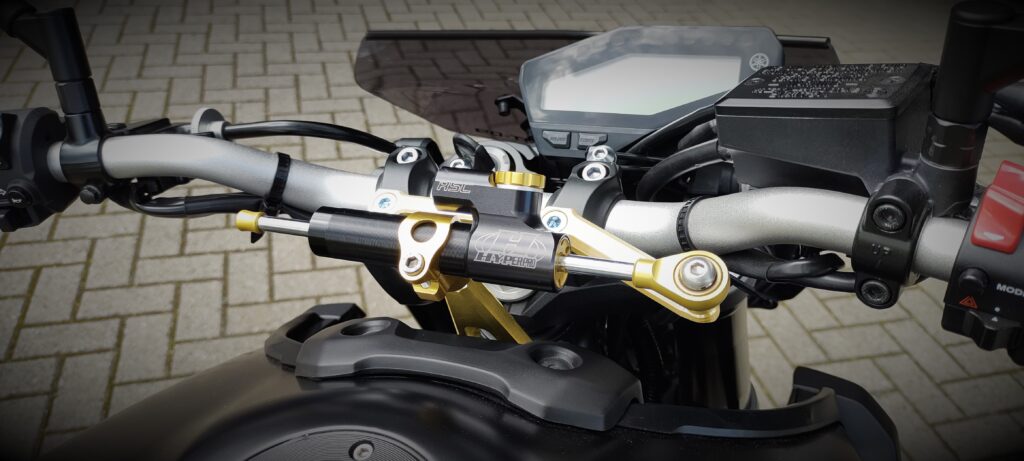
- Steering dampers (CSC and RSC models): Both models are adjustable across 22 positions and reduce tank-slappers, wobbles, and vibrations. The CSC uses linear damping for consistent control, while the RSC uses progressive damping that reacts to the severity of the steering disturbance. Both are designed to improve rider safety and steering confidence without interfering with normal handling.
- Model-specific mounting kits: Our CNC-milled mounting kits are engineered for specific bike models, available in Hyperpro Gold or Black. In 98% of applications, they fit as a direct plug-and-play replacement with no drilling or cutting required.
- Progressive-rate springs and shock absorbers: Our suspension components are developed for specific bike models, giving you a matched system that works with your tires rather than against them.
Purchases are available through our authorized distributor network. Browse our full product range to find the right components for your bike, or contact us if you have questions about which setup suits your riding style.