


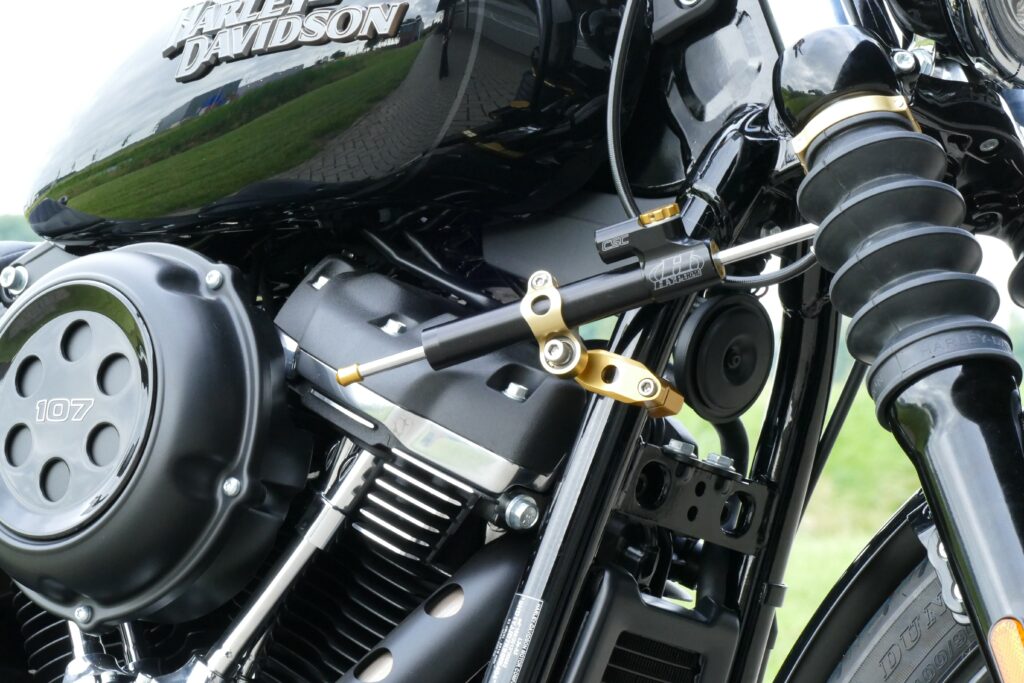
Yes, a steering damper can significantly reduce the severity of a tank slapper. By resisting rapid, uncontrolled handlebar oscillations, a steering damper slows down the violent side-to-side movement that defines a tank slapper, giving the rider a better chance of regaining control. It does not eliminate the root cause, but it can be the difference between a recoverable wobble and a crash. The sections below break down how this works and what else you should know.
What actually causes a tank slapper on a motorcycle?
A tank slapper is caused by a sudden loss of front-wheel traction followed by rapid, uncontrolled oscillation of the handlebars. When the front wheel loses contact with the road, even momentarily, it can spin freely and realign at an angle. As it reconnects with the surface, the steering geometry fights itself, sending the bars into a violent left-right rhythm that can escalate within fractions of a second.
Several factors make a tank slapper more likely to occur:
- Wheelies or front-wheel lift: When the front wheel leaves the ground, it loses its gyroscopic stability. On landing, misalignment can trigger immediate oscillation.
- Road surface irregularities: Bumps, ruts, or sudden changes in grip level can destabilize the front end at speed.
- Worn or mismatched tyres: Tyres that are worn unevenly or incorrectly inflated reduce the front wheel’s ability to track straight.
- Suspension that is too soft or too stiff: Poorly tuned suspension fails to absorb impacts correctly, increasing the chance of the front wheel losing contact with the road.
- High speed: The faster you are travelling, the less time the steering geometry has to self-correct before oscillation builds into a full tank slapper.
Understanding these triggers matters because a steering damper addresses the symptom, which is the oscillation itself, rather than the underlying cause. Addressing both gives you the strongest protection.
How does a steering damper work to control handlebar oscillation?
Hyperpro
Ride with confidence
Find the nearest Hyperpro dealer and start your motorcycle upgrade.
A steering damper works by applying hydraulic resistance to the rotational movement of the steering head. It connects between the frame and the steering assembly, and when the handlebars try to move rapidly from side to side, the damper’s internal fluid is forced through restricted channels, slowing the movement down. The faster the bars try to oscillate, the more resistance the damper generates.
This is a key point: a steering damper does not prevent normal steering input. At low speeds and under deliberate rider control, the damper offers minimal resistance. It is specifically the high-frequency, rapid oscillations of a tank slapper that trigger its strongest effect. This makes it a passive safety device that activates exactly when you need it most.
Dampers vary in how they deliver this resistance. A linear damper applies the same level of resistance throughout the full range of steering movement. A progressive damper increases resistance as the speed or severity of the oscillation grows, which means it responds more aggressively to a tank slapper while remaining less intrusive during normal riding. Both styles are typically adjustable so you can tune the damping level to your riding style and conditions.
Can a steering damper fully prevent a tank slapper?
A steering damper cannot fully prevent a tank slapper, but it can reduce its severity enough to make recovery possible. The damper slows the oscillation and buys the rider time to react, which is often the difference between staying upright and crashing. It does not fix the conditions that caused the tank slapper in the first place.
Think of it this way: if a bump or a wheelie landing triggers a front-end wobble at speed, a damper will resist the escalation of that wobble. Without one, the oscillation can build exponentially within a second or two, reaching an amplitude that overwhelms the rider’s ability to respond. With one fitted, the same event may produce a manageable wobble that settles on its own or with light input from the rider.
The severity of the original trigger also plays a role. A very high-speed event with significant wheel lift may still produce a serious tank slapper even with a damper fitted. This is why experienced riders combine a steering damper with properly tuned suspension, quality tyres, and smooth throttle control rather than relying on the damper alone.
What’s the difference between a steering damper and a steering stabilizer?
A steering damper and a steering stabilizer refer to the same type of device, just described using different terminology. Both terms describe a hydraulic component that resists rapid handlebar oscillation to improve stability and safety. In practice, the two names are used interchangeably across the motorcycle industry, and there is no meaningful technical distinction between them.
The confusion sometimes arises because different manufacturers use different branding, and some riders associate “stabilizer” with a gentler, comfort-focused product while associating “damper” with a more performance-oriented one. In reality, the underlying mechanism, a hydraulic unit that resists rotational movement at the steering head, is the same in both cases.
What does vary meaningfully is the damping characteristic: linear versus progressive. A linear unit applies consistent resistance across all steering speeds, while a progressive unit scales its resistance with the intensity of the movement. For riders primarily concerned with tank slappers and high-speed stability, a progressive unit generally offers a better balance between safety and everyday steering feel.
Which motorcycles benefit most from a steering damper?
Motorcycles that are most likely to experience tank slappers benefit most from a steering damper. This includes sport bikes, supermotards, and high-performance naked bikes that are ridden at speed, as well as adventure motorcycles that encounter unpredictable terrain. Lightweight front ends, aggressive geometry, and powerful engines all increase the risk of front-end instability.
Specific scenarios where a damper adds clear value include:
- Track-day motorcycles: High-speed cornering, hard braking, and the occasional front-wheel lift make tank slappers a real risk on circuit.
- Supermoto and motocross-derived bikes: These bikes have light front ends and are ridden in conditions where the front wheel regularly loses traction.
- Adventure tourers on mixed terrain: Gravel, ruts, and off-road sections create sudden changes in front-wheel grip that can trigger oscillation.
- Sport bikes used for spirited road riding: Fast road riding over imperfect surfaces exposes riders to the same risks as track riding, without the controlled environment.
Cruisers and standard commuter bikes at moderate speeds are less prone to tank slappers due to their geometry and typical riding pace, though they can still benefit from added stability if ridden hard or on poor road surfaces.
Should you upgrade your suspension alongside a steering damper?
Yes, upgrading your suspension alongside a steering damper is strongly recommended. A steering damper manages oscillation after it begins, but well-tuned suspension reduces the chance of it starting in the first place. Together, they address both the cause and the effect, giving you a much more stable and confidence-inspiring setup than either component can deliver alone.
Factory suspension on most production motorcycles is built to a general specification that suits a wide range of riders and conditions. For riders who push their bikes harder, carry different loads, or simply want more precise handling, that factory setup often falls short. Soft springs allow excessive fork dive under braking, which can unsettle the front end. Poorly damped rear shocks allow the rear to squat and pitch the bike’s geometry out of balance. Either condition makes a tank slapper more likely.
Upgrading to progressive-rate fork springs and a correctly tuned rear shock absorber keeps the bike’s geometry stable under a wider range of inputs. When the front wheel does lose traction briefly, a well-set suspension returns it to the road more predictably, reducing the severity of any resulting oscillation. The steering damper then has less work to do, and the overall system performs better than the sum of its parts. You can explore the full range of suspension upgrade options to find components matched to your specific model.
How Hyperpro helps you control tank slappers
We design and manufacture steering dampers specifically to address tank slappers, wobbles, and front-end instability. Our range gives you two distinct options depending on your riding style and priorities:
- CSC (Constant Safety Control): A linear damping model that applies consistent resistance across the full range of steering movement. Adjustable across 22 positions, it suits riders who want straightforward, reliable protection.
- RSC (Reactive Safety Control): A progressive damping model that scales its resistance with the speed and severity of the oscillation. It responds more aggressively to a tank slapper while remaining unobtrusive during normal riding, making it a strong choice for performance-focused riders.
Both models are paired with CNC-milled, model-specific mounting kits available in Hyperpro Gold or Black. These kits are designed as plug-and-play fitments that require no drilling or cutting in 98% of applications, so installation is straightforward and does not compromise your bike’s frame or components.
If you want to know which damper suits your motorcycle, or if you have questions about combining a damper with a suspension upgrade, get in touch with us. For purchasing, our products are available through authorised distributors worldwide. Use our dealer locator to find your nearest stockist and get the right setup for your bike.