


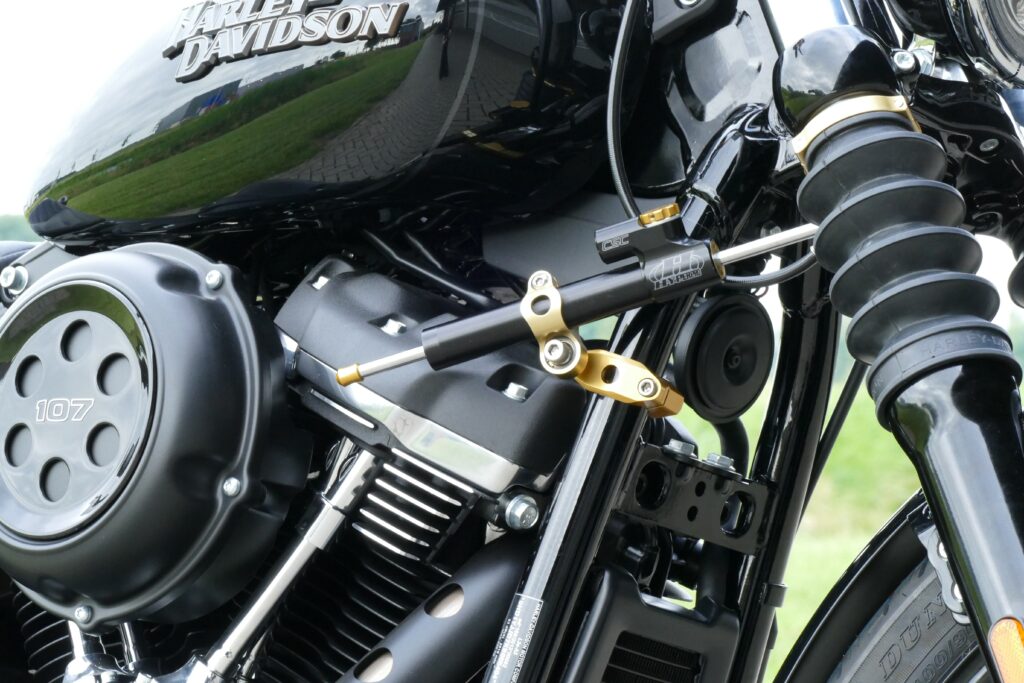
A steering damper set too soft fails to resist handlebar oscillations, which means the front end can shake, wobble, or snap into a tank slapper before you have time to react. The damper’s job is to absorb unwanted steering inputs, and without enough resistance, small disturbances escalate quickly into dangerous instability. The sections below cover every related question, from recognizing the symptoms to understanding how your spring setup influences the right damper setting.
What are the signs that a steering damper is set too soft?
The clearest signs of a steering damper set too soft are persistent handlebar wobble at speed, a front end that feels vague or twitchy over surface imperfections, and an uncomfortable lightness in the steering that makes the bike feel unpredictable. These symptoms tend to appear first at higher speeds or under acceleration out of corners.
Riders often describe the sensation as the bars “hunting” slightly from side to side rather than tracking cleanly. On smooth roads this can feel almost imperceptible, but the moment you hit a patch of road paint, a drain cover, or a slight crosswind, the front end reacts more than it should. If you find yourself gripping the bars more firmly than normal just to keep the bike pointed straight, that is a reliable indicator that the damper is not providing enough resistance.
Other signs include:
- Handlebar vibration that does not settle quickly after hitting a bump
- A weaving sensation during hard acceleration, especially on powerful bikes
- Reduced confidence when riding at motorway speeds or in crosswinds
- The front end feeling like it wants to “fall into” corners rather than hold a line
Hyperpro
Ride with confidence
Find the nearest Hyperpro dealer and start your motorcycle upgrade.
Why does a loose steering damper cause tank slappers?
A loose or under-damped steering damper causes tank slappers because it cannot absorb the initial oscillation that triggers the chain reaction. A tank slapper begins with a small, rapid handlebar deflection, typically caused by a bump, a wheelie landing, or a momentary loss of front traction. Without adequate damping resistance, that deflection bounces back, amplifies, and the bars begin oscillating side to side at increasing speed.
The physics behind this are straightforward. Every steering system has a natural oscillation frequency. When something disturbs the front end, the geometry wants to self-correct, but in doing so it can overshoot the center point and swing to the other side. A properly set steering damper bleeds energy out of each oscillation so it dies down quickly. A damper set too soft allows each swing to carry almost as much energy as the last, which is how a small wobble becomes a violent, uncontrollable tank slapper within fractions of a second.
Tank slappers are particularly dangerous at speed because the rider’s arms are in the path of the bars. The forces involved can be strong enough to throw a rider off the bike entirely, which is why correct damper setup is not just a comfort issue but a genuine safety concern.
How does damper stiffness affect cornering stability?
Damper stiffness directly affects how settled the front end feels through a corner. A damper set too soft allows minor mid-corner disturbances, such as road texture changes or small bumps, to translate into handlebar movement that can unsettle your line. A correctly stiffened damper keeps those inputs from feeding back into the steering, so the bike holds its arc more predictably.
However, stiffness in cornering is a balance. Too much damping resistance slows down the rate at which you can initiate a turn, making the steering feel heavy and unresponsive when you want to tip into a corner. The ideal setting resists unwanted oscillations without fighting the rider’s intentional steering inputs.
For riders who spend time on technical, winding roads or track days, this balance becomes especially noticeable. A damper that is slightly too soft may feel fine on a straight motorway but reveal its shortcomings the moment you start asking more of the front end in fast, linked corners where the chassis is working hard.
What’s the difference between a soft and a correctly set steering damper?
The difference between a soft and a correctly set steering damper comes down to how much resistance the damper applies to unwanted steering movement. A soft setting offers minimal resistance, allowing the bars to move freely in response to any input, including ones you did not make intentionally. A correct setting provides enough resistance to dampen disturbances while still allowing clean, responsive steering when you deliberately turn the bars.
In practice, the distinction feels like this:
- Too soft: The bars feel light and slightly nervous at speed. Surface irregularities cause the front end to wander. Wobbles do not settle quickly.
- Correctly set: The bars feel planted and confident. The bike absorbs road imperfections without transmitting them into handlebar movement. Steering response to your inputs remains precise and direct.
A correctly set damper should be almost invisible in normal riding. You should not feel it fighting you when you turn in for a corner, and you should not notice unwanted movement between corners. If either of those things is happening, the setting needs adjustment.
How do you know when to adjust your steering damper setting?
You need to adjust your steering damper setting when your riding conditions, speed range, or motorcycle setup changes in a way that shifts the balance between stability and steering responsiveness. The most common triggers are a change in riding style, a tyre swap, a suspension modification, or a move to a different type of road or track.
Specific situations that call for a damper adjustment include:
- Noticing handlebar wobble or instability at speeds where the bike previously felt settled
- Moving from road riding to track use, where speeds are higher and the front end works harder
- Fitting new tyres with a different profile, which changes how the front end responds to bumps and steering inputs
- Adjusting fork preload, compression, or rebound, since suspension changes alter how forces are transmitted to the steering
- Carrying a passenger or luggage, which shifts the weight balance of the bike
Most adjustable dampers, including those with 22-position adjustment, allow you to make small incremental changes without tools. Start from the manufacturer’s recommended baseline setting for your model and adjust one or two positions at a time, testing at a safe speed before committing to the change.
Can a progressive-rate spring setup affect how a steering damper should be set?
Yes, a progressive-rate spring setup can affect the ideal steering damper setting because it changes how the suspension responds to varying load inputs, which in turn influences how forces are transmitted to the front end and steering. Progressive springs build resistance gradually as compression increases, meaning the fork or shock behaves differently under light loads compared to heavy ones, and this affects the overall chassis dynamics the damper works within.
When you fit progressive-rate fork springs, the front end typically gains more composure under hard braking and mid-corner bumps because the spring rate rises to meet the increased load. This can reduce some of the instability that a soft damper setting might otherwise struggle to control. In practice, riders who upgrade to progressive springs sometimes find they can run a slightly softer damper setting without sacrificing stability, because the suspension itself is doing more work to keep the chassis settled.
Conversely, if your progressive spring rate is set up for a heavier rider or load than you typically carry, the spring may feel too stiff under normal conditions, causing the front end to deflect more sharply over small bumps and pushing more energy into the steering. In that case, a slightly firmer damper setting helps compensate. The relationship between spring rate and damper setting is always interactive, so any change to one should prompt a reassessment of the other. You can explore the full range of suspension upgrade options to find components that work together for your specific bike and riding style.
How Hyperpro helps you dial in the right steering damper setup
Getting the steering damper setting right is straightforward when you have the right hardware and clear guidance. We design our steering dampers specifically to give riders meaningful, precise control over their front-end stability, without requiring specialist tools or a workshop visit.
Here is what we offer to help you get it right:
- CSC (Constant Safety Control): A linear damping model with 22 adjustable positions, suited to riders who want consistent, predictable damping across all riding conditions.
- RSC (Reactive Safety Control): A progressive damping model that also adjusts across 22 positions, providing lighter resistance during normal steering and firmer resistance when oscillations occur, adapting automatically to what the front end is doing.
- Model-specific mounting kits: CNC-milled brackets designed as plug-and-play fitments for your exact motorcycle, requiring no drilling or cutting in 98% of applications, available in Hyperpro Gold or Black.
- Bike-specific fitment guidance: We match products to your model so you are not guessing about compatibility or baseline settings.
If you are unsure which damper setup suits your bike and riding style, get in touch with us and we will point you in the right direction. To purchase, visit one of our authorised distributors, who can advise you on the best option for your setup.