


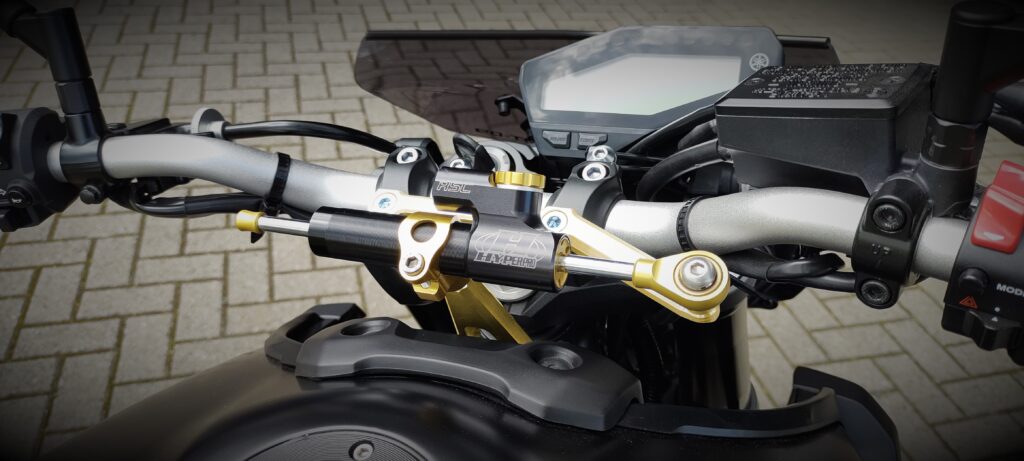
Yes, frame flex can directly influence the need for a steering damper. A frame that flexes excessively under load or during hard cornering reduces the structural rigidity that normally keeps the front wheel tracking true, which makes the steering system more vulnerable to oscillations and wobbles. The following questions break down exactly how this relationship works and what it means for your setup.
How does frame flex influence motorcycle steering stability?
Frame flex affects steering stability by reducing the predictability of how forces transfer between the front wheel, forks, and chassis. When a frame flexes under braking, cornering, or acceleration, the geometry of the steering system shifts momentarily, causing the front wheel to respond differently than the rider expects. This inconsistency is what makes a flexible frame a contributing factor to steering instability.
Every motorcycle frame is designed with a degree of intentional flex. Manufacturers engineer a specific amount of lateral and torsional compliance to absorb road impacts and smooth out rider feedback. The problem arises when that flex exceeds the intended range, either through age, crash damage, heavy modification, or a design that was marginal from the start.
When the frame twists or bends beyond its design tolerance, the steering head angle changes dynamically. This means the trail and rake values, which are the geometric properties that give a motorcycle its self-centering behavior, shift unpredictably mid-corner or under braking. The result is a front end that feels vague, nervous, or prone to sudden direction changes.
What causes a motorcycle to develop a wobble or tank-slapper?
A wobble or tank-slapper is caused by a self-reinforcing oscillation of the front wheel around the steering axis. It typically starts when a disturbance, such as a road imperfection, a sudden weight shift, or a bump mid-corner, pushes the front wheel off its intended path. If the steering system lacks sufficient damping to absorb that input, the wheel overcorrects, then overcorrects again in the opposite direction, and the oscillation builds rather than dies out.
Several factors increase the likelihood of this happening:
- Worn or incorrectly set up steering head bearings, which reduce the steering’s ability to self-center
- Incorrect tire pressure or a worn front tire, which changes the contact patch and steering response
- Suspension that is too soft or too stiff, preventing proper weight transfer management
- A flexible or damaged frame, which allows the steering geometry to shift dynamically
- Aerodynamic lift at high speed, which reduces front-wheel load and makes the steering feel light and nervous
Frame flex amplifies the problem because it adds an additional variable to an already unstable system. Instead of the oscillation being purely a function of steering geometry, the frame itself begins to participate in the movement, making the wobble harder to damp out naturally.
Hyperpro
Ride with confidence
Find the nearest Hyperpro dealer and start your motorcycle upgrade.
Can a steering damper compensate for a flexible frame?
A steering damper can reduce the symptoms caused by frame flex, but it does not fix the underlying structural issue. What it does is add resistance to rapid steering movements, which slows down the onset of oscillations and gives the rider more time to react or for the system to self-stabilize. In many real-world cases, this is enough to make a bike with a moderately flexible frame feel significantly more controlled.
Think of it this way: a steering damper works on the steering axis, resisting unwanted rapid inputs at the handlebars. Frame flex works on the chassis as a whole, shifting geometry at a structural level. These are two different problems occurring at different points in the system. A damper addresses the steering response; it cannot stop the frame from moving.
That said, the combination of a steering damper with an otherwise well-maintained motorcycle, including properly set up suspension and good tires, often produces a ride that is stable and confidence-inspiring even on frames that are not perfectly rigid. The damper fills a gap that the frame’s natural rigidity cannot always close on its own.
Which bikes are most likely to need a steering damper due to frame characteristics?
Bikes most likely to benefit from a steering damper due to frame characteristics include older motorcycles with steel tube frames, heavily modified streetfighters, long-travel adventure bikes, and high-powered naked bikes where the chassis was not originally engineered for aggressive riding at speed.
More specifically, the following categories stand out:
- Older sport and naked bikes where frame rigidity has reduced over time through use, minor impacts, or metal fatigue
- Adventure motorcycles with long-travel suspension and tall, upright geometry, which are more susceptible to high-speed wobble on paved roads
- Custom builds and streetfighters where the original frame was modified, subframes were added, or the geometry was altered
- High-displacement naked bikes that produce strong acceleration forces the frame must manage without the aerodynamic stability of a full fairing
- Bikes with known flex characteristics from the factory, particularly some older Japanese and European designs from the 1990s and early 2000s
It is worth noting that even modern, well-engineered frames can benefit from a steering damper in specific riding conditions, particularly at high speeds or on rough road surfaces where the front end receives repeated irregular inputs.
What’s the difference between a hydraulic and a rotary steering damper?
The key difference between a hydraulic (linear) steering damper and a rotary steering damper is the mechanism they use to generate resistance. A hydraulic damper uses a piston moving through fluid inside a cylinder, mounted in a straight line between the frame and the steering head. A rotary damper uses a vane rotating inside a fluid-filled housing, mounted concentrically around the steering stem.
Hydraulic (linear) steering dampers
Linear dampers are effective and straightforward. They provide consistent resistance across the full range of steering movement and are easy to adjust and service. The main limitation is packaging: the cylinder needs a straight mounting path between two fixed points, which can be difficult to achieve cleanly on some bikes without custom brackets.
Rotary steering dampers
Rotary dampers sit directly on the steering stem, which makes them more compact and easier to package on a wider range of motorcycles. They also tend to offer more progressive damping characteristics, meaning they resist slow, deliberate steering inputs less than they resist the rapid oscillations associated with wobbles and tank-slappers. This makes them well suited to everyday road riding where the damper should be largely transparent during normal cornering.
Both types are available in adjustable versions that let you tune the damping force to match your riding style and conditions. The right choice depends on your bike’s geometry, available mounting points, and how you ride.
Should you fix frame flex or install a steering damper first?
You should address frame flex first if the flex is caused by a specific, fixable problem such as a cracked weld, damaged gusset, or loose steering head bearing. Installing a steering damper on a structurally compromised frame masks a safety issue without resolving it. However, if the flex is a design characteristic of the frame rather than damage, a steering damper is a practical and effective first step.
In practice, the decision comes down to diagnosing the cause. Start by inspecting the steering head bearings and frame for visible damage or wear. Have the frame checked by a qualified mechanic if you suspect structural damage after a crash or if the flex appeared suddenly rather than gradually.
If the frame is structurally sound and the flex is simply a characteristic of the design, adding a steering damper delivers an immediate, noticeable improvement in stability. It is a targeted solution that addresses the symptom, which in many cases is the most sensible approach, particularly for riders who want to improve control without undertaking a full chassis rebuild.
Improving suspension setup in parallel is also worth considering. Better-matched fork springs and a properly tuned rear shock reduce the dynamic loads the frame has to manage, which in turn reduces the degree to which frame flex influences steering behavior.
How Hyperpro helps with steering stability
We design and manufacture steering dampers specifically to address the kind of instability described throughout this article. Our range covers two distinct damping systems:
- CSC (Constant Safety Control): A linear damping model adjustable in 22 positions, offering consistent resistance across the full range of steering movement
- RSC (Reactive Safety Control): A progressive damping model, also adjustable in 22 positions, that responds more strongly to rapid oscillations while staying transparent during normal steering inputs
Both systems are designed to reduce tank-slappers, wobbles, and vibrations, giving you more control and confidence regardless of your frame’s characteristics. We also develop CNC-milled, model-specific mounting kits in Hyperpro Gold or Black that fit as plug-and-play installations, with no drilling or cutting required in 98% of applications. You can browse the full range of suspension and damper products to find the right fit for your motorcycle.
Purchases are made through our authorized distributor network. Contact us if you have questions about which system suits your bike, and we will point you in the right direction.