


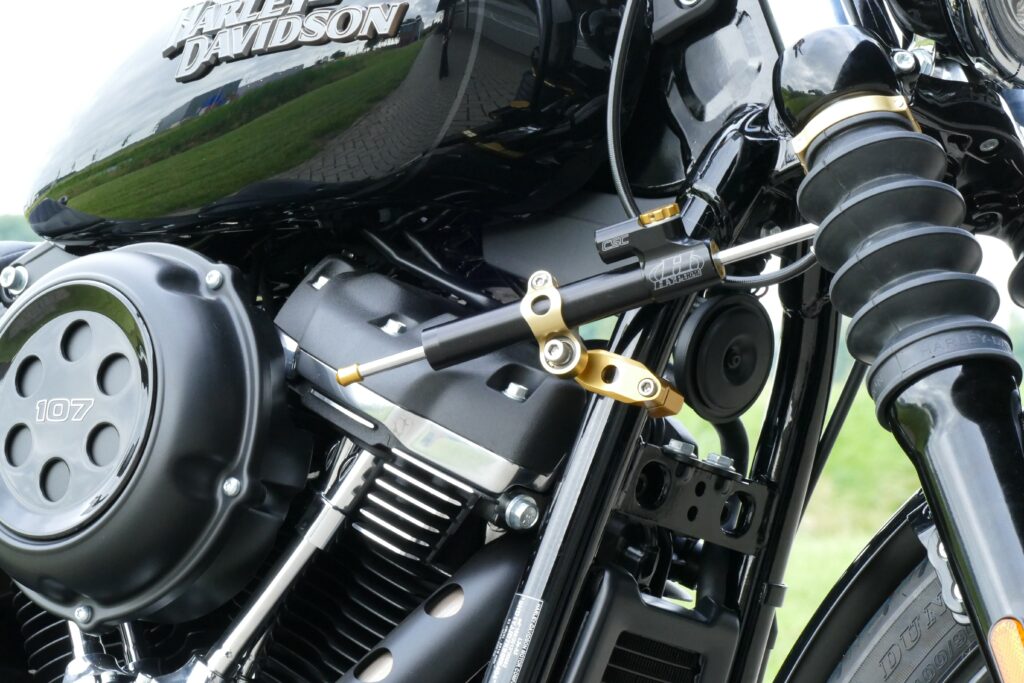
The best steering damper for tank slapper protection is one that reacts quickly enough to absorb the oscillation before it escalates, while remaining adjustable so it doesn’t interfere with normal steering. A progressive damping system outperforms a fixed-rate unit in real-world conditions because it responds proportionally to the severity of the wobble. The sections below cover how these systems work, which type suits your riding, and how to know whether your bike needs one.
How does a steering damper actually prevent tank slappers?
A steering damper prevents tank slappers by resisting the rapid, uncontrolled oscillation of the front wheel from side to side. When a tank slapper begins, the handlebar swings left and right at high frequency. The damper applies hydraulic resistance to slow that movement, giving the rider time to regain control and preventing the oscillation from amplifying into a full crash.
The physics behind a tank slapper are straightforward. A momentary loss of front wheel traction, caused by a bump, a wheelie landing, or a surface change, allows the wheel to deflect. Without resistance, that deflection triggers a counter-deflection, and the cycle accelerates. A steering damper interrupts this feedback loop by absorbing energy at each swing, damping the amplitude until the wheel stabilizes.
The speed at which a tank slapper develops is what makes it so dangerous. At highway speeds, a full oscillation can happen in a fraction of a second. Rider reaction time alone is rarely fast enough to correct it. A well-calibrated damper works passively and instantly, without requiring any input from the rider.
Hyperpro
Ride with confidence
Find the nearest Hyperpro dealer and start your motorcycle upgrade.
What’s the difference between a rotary and a linear steering damper?
A rotary steering damper mounts centrally on the steering head and rotates with the steering axis, while a linear steering damper uses a hydraulic cylinder mounted horizontally between the frame and the steering assembly. The rotary design is more compact and often cleaner-looking on modern bikes. The linear design typically offers a longer stroke and more damping range, making it a strong choice for performance and adventure applications.
Rotary steering dampers
Rotary dampers sit directly on the top yoke and rotate as the bars turn. Their compact footprint makes them well suited to sport bikes where space is limited. Because the damping action follows the steering arc directly, they tend to feel very natural and linear in response. They are generally easier to install on bikes where a model-specific mounting kit is available.
Linear steering dampers
Linear dampers use a piston-and-cylinder mechanism mounted at an angle across the front end. They offer a longer damping stroke, which can provide stronger resistance at the extremes of steering travel. This makes them popular on adventure bikes and motocross-derived machines that encounter more aggressive terrain. The trade-off is that they require more mounting space and are sometimes more visible on the bike.
Both types are available in adjustable configurations, which is the more important variable for most riders. A damper you can tune to your riding conditions will always outperform a fixed-rate unit, regardless of its form factor.
What are the signs that your motorcycle needs a steering damper?
Your motorcycle likely needs a steering damper if you have experienced handlebar wobble at speed, noticed instability when landing from a wheelie, or felt the front end deflect unpredictably on rough surfaces. Bikes that feel nervous or twitchy at motorway speeds, particularly when lightly loaded or in crosswinds, are also strong candidates for a steering damper upgrade.
More specific warning signs include:
- Handlebar vibration or flutter at speeds above 100 km/h
- A weaving sensation when accelerating hard out of corners
- Front-end instability after hitting a pothole or expansion joint at speed
- Difficulty holding a straight line on uneven road surfaces
- Increased rider fatigue caused by constant micro-corrections at the bars
It is worth noting that some of these symptoms can also point to worn fork seals, incorrect tyre pressure, or unbalanced wheels. Ruling out those factors first is sensible. However, if the bike checks out mechanically and the instability persists, a steering damper addresses the dynamic cause rather than a component failure.
Does damping strength affect everyday steering feel?
Yes, damping strength directly affects how the steering feels during normal riding, which is why adjustability matters. Too little damping provides minimal tank slapper protection. Too much makes the steering feel heavy, slow to respond, and tiring on winding roads. The goal is a setting that remains transparent during everyday riding but activates meaningfully when rapid oscillation begins.
This is where progressive damping has a clear advantage over fixed-rate systems. A progressive damper applies low resistance during slow, deliberate steering inputs, such as navigating a car park or leaning into a gentle bend, and increases resistance sharply only when the steering moves rapidly and unexpectedly. The rider feels little difference from an undamped bike in normal conditions, but the system intervenes effectively when a tank slapper threatens.
Adjustable dampers allow you to dial in the right balance for your specific bike, tyre setup, and riding style. A sport rider pushing hard on track will want a firmer setting than a tourer covering long motorway miles. Having 22 positions of adjustment, as found on performance-grade systems, gives you enough range to find that balance precisely rather than compromising between two fixed options.
Which motorcycles benefit most from a steering damper upgrade?
Sport bikes, adventure motorcycles, and naked bikes with high power-to-weight ratios benefit most from a steering damper upgrade. These are the categories most exposed to the conditions that trigger tank slappers: high speeds, aggressive acceleration, uneven surfaces, and reduced front wheel load under hard acceleration. That said, any motorcycle ridden at sustained highway speeds can benefit from the added stability a damper provides.
The following categories see the most meaningful improvement:
- Supersport and superbike models where front wheel lift under acceleration is common and speeds are high
- Adventure tourers that transition between tarmac and rough terrain, where surface changes can trigger sudden front-end deflection
- Naked and streetfighter bikes with upright riding positions that expose the front end to more aerodynamic instability
- Older motorcycles where factory suspension was not designed with modern tyre profiles or riding speeds in mind
- Modified bikes where aftermarket exhausts, bodywork, or suspension changes have altered the original handling balance
Commuter bikes and low-speed urban motorcycles are the least likely to notice a dramatic difference, though riders who regularly use motorways as part of their commute will still gain meaningful stability from a well-fitted damper.
How Hyperpro helps with tank slapper protection
We design and manufacture two steering damper systems built specifically to address tank slappers and high-speed instability. Both are adjustable across 22 positions, giving you precise control over damping strength without sacrificing everyday steering feel.
- CSC (Constant Safety Control): A linear damping model that delivers consistent resistance across the steering range, well suited to riders who want reliable, predictable protection at a straightforward setting
- RSC (Reactive Safety Control): A progressive damping model that applies low resistance during normal steering and increases sharply only when rapid oscillation is detected, making it transparent in daily use and highly effective when it counts
- Model-specific mounting kits: CNC-milled brackets engineered for your exact motorcycle, available in Hyperpro Gold or Black, requiring no drilling or cutting in 98% of applications
- Plug-and-play fitment: Kits are designed to install without modification, so you spend time riding rather than fabricating
You can browse our full range of motorcycle suspension products to find the right fit for your bike. Purchases are made through our authorised distributor network. Contact us if you need guidance on which system suits your motorcycle and riding style.