


Tank slappers most commonly happen at speeds above 80 mph (130 km/h), though they can occur at lower speeds under the right conditions. The risk increases significantly at high speed because the front wheel has less time to self-correct once oscillation begins, and the forces involved grow exponentially with velocity. This article unpacks what triggers them, how suspension plays a role, and what you can do to stay in control.
What triggers a tank slapper at high speed?
A tank slapper is triggered when the front wheel loses contact with the road surface or is deflected sideways, causing the steering to oscillate rapidly from side to side. At high speed, this happens most often after a jump, a bump, or a sudden weight shift that unloads the front wheel. Once the wheel returns to the road at an angle, the self-steering geometry tries to correct itself but overshoots, creating a feedback loop of left-right oscillation.
Several factors can set off this chain reaction:
- Front wheel lift: Hard acceleration, especially on powerful bikes, can briefly unload the front end. When the wheel touches back down, even a slight misalignment can start the wobble.
- Road surface disruptions: Expansion joints, potholes, gravel patches, and painted road markings all introduce sudden lateral forces to the front wheel.
- Crosswinds: A strong gust hitting the front fairing or wheel at speed can push the steering off-center just enough to begin the oscillation cycle.
- Incorrect tire pressure: An underinflated front tire deforms more under load, making it slower to return to a neutral position and more prone to wobble.
- Worn or mismatched tires: Tires with uneven wear or different profile shapes front and rear can destabilize the steering geometry at speed.
The common thread in all these triggers is a sudden disruption to the front wheel’s tracking. The faster you are traveling, the less margin there is for the geometry to recover before the oscillation amplifies into a full tank slapper.
Hyperpro
Ride with confidence
Find the nearest Hyperpro dealer and start your motorcycle upgrade.
Is there a specific speed range where tank slappers are most likely?
Tank slappers are most likely to occur at speeds above 80 mph (130 km/h), though the threshold varies depending on the bike’s geometry, tire condition, and suspension setup. At lower speeds, the front wheel’s self-correcting geometry typically damps out minor oscillations before they can build. Above 80 mph, the same oscillations can amplify faster than the geometry can correct them.
That said, speed alone is not the deciding factor. A heavily loaded adventure bike with worn suspension can develop a wobble at 60 mph, while a well-set-up sport bike might remain stable well past 100 mph. What matters is the relationship between speed, geometry, and the ability of the suspension to keep the front wheel in firm, consistent contact with the road. The higher the speed, the smaller the margin for error in any of those variables.
Certain speed bands are also worth noting. Many riders report that tank slappers begin during rapid acceleration through the 80 to 110 mph range, particularly when the front wheel briefly lifts under power and then returns to the road. This transition moment, where the tire reconnects with the tarmac at speed, is one of the highest-risk points for triggering an oscillation cycle.
What’s the difference between a tank slapper and a speed wobble?
A tank slapper and a speed wobble are related but distinct phenomena. A speed wobble is a slower, lower-frequency oscillation that typically involves the whole front end weaving gently, often felt through the handlebars as a rhythmic side-to-side movement. A tank slapper is a faster, more violent oscillation where the handlebars swing so rapidly and forcefully that they literally slap against the rider’s tank or thighs.
Speed wobbles tend to develop gradually and can sometimes be ridden out with a relaxed grip and steady throttle. Tank slappers escalate quickly and leave very little time to react. Both involve front-end instability, but a tank slapper is the more severe version, often occurring at higher speeds and with greater amplitude in the steering movement.
The underlying physics are similar: both result from a resonance between the front wheel’s self-steering tendency and the bike’s geometry. The difference lies in frequency and severity. Speed wobbles typically occur at lower speeds or under lighter conditions, while tank slappers represent the point where that resonance becomes self-amplifying and dangerous.
How does suspension setup affect the risk of a tank slapper?
Suspension setup directly affects the risk of a tank slapper by controlling how well the front wheel maintains contact with the road surface. A front end that is too soft will dive excessively under braking and bounce back unpredictably, making the wheel more likely to skip or deflect. A front end that is too stiff will transmit road shocks directly into the steering rather than absorbing them, which can also trigger oscillation.
Correct suspension setup keeps the front tire loaded and tracking consistently. Key factors include:
- Spring rate: A spring rate matched to the rider’s weight and riding style ensures the fork compresses and rebounds at the right speed, keeping the tire in contact with the road.
- Damping: Correct compression and rebound damping prevents the fork from bouncing back too quickly after a bump, which is one of the most common triggers for front-end oscillation.
- Sag and preload: Proper sag settings ensure the bike sits at the correct ride height, which directly affects steering geometry and how the front wheel tracks at speed.
- Tire condition and pressure: Suspension cannot compensate for a tire that is underinflated, worn, or mismatched to the bike’s geometry.
Many factory suspension setups are calibrated for an average rider weight and a compromise between comfort and performance. Riders who are heavier, who carry luggage, or who ride at higher speeds will often find that aftermarket suspension components better matched to their specific use case significantly reduce the risk of instability at speed.
Can a steering damper prevent a tank slapper?
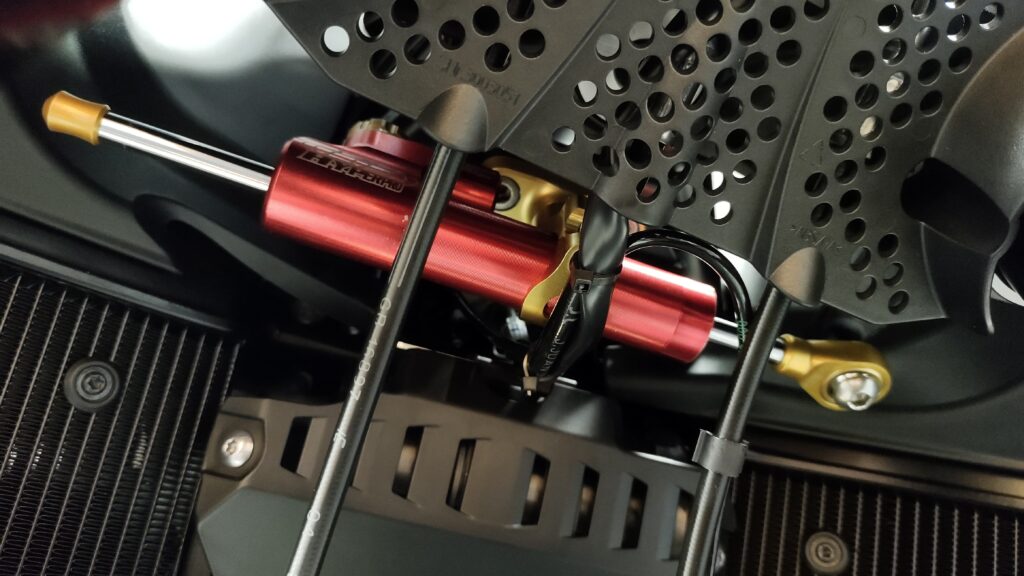
A steering damper can significantly reduce the severity of a tank slapper and, in many cases, prevent it from escalating into a dangerous situation. It works by adding resistance to the steering’s rotational movement, which slows down the oscillation cycle and gives the bike’s geometry time to self-correct. A damper does not eliminate the root cause, but it interrupts the feedback loop that allows a wobble to amplify into a full tank slapper.
The effectiveness of a steering damper depends on how it is designed. A linear damper applies the same resistance throughout the steering range, which is effective but can feel heavy in slow-speed maneuvers. A progressive damper applies light resistance during normal steering inputs and increases resistance sharply as the steering speed increases, which is the behavior pattern that makes it most useful against tank slappers specifically.
Our steering damper systems are available in two models: the CSC (Constant Safety Control) linear model and the RSC (Reactive Safety Control) progressive model, both adjustable across 22 positions. Both are paired with CNC-milled, model-specific mounting kits that fit without drilling or cutting in 98% of applications, making them a practical upgrade for riders who want meaningful protection against tank slappers without a complex installation.
What should you do if a tank slapper starts while riding?
If a tank slapper starts while you are riding, the most important thing to do is keep a relaxed, loose grip on the handlebars and avoid fighting the movement. Gripping tightly and trying to force the bars straight is the most common mistake, and it typically makes the oscillation worse by adding energy to the system rather than letting it dissipate.
Follow these steps in order:
- Relax your grip: Loosen your hands on the bars without letting go. A tight grip transfers your body’s tension into the steering and amplifies the wobble.
- Close the throttle smoothly: Reduce speed gradually. Chopping the throttle suddenly can shift weight abruptly and worsen the instability.
- Grip the tank with your knees: Pressing your knees into the tank transfers some of your body weight directly to the frame, reducing the amount of rider input going through the handlebars.
- Avoid braking hard: Heavy braking during a tank slapper can lock the front wheel or shift weight forward in a way that amplifies the oscillation. Gentle, progressive braking is safer if you need to slow further.
- Let the bike stabilize: In many cases, reducing speed by even 10 to 15 mph is enough to bring the oscillation below the resonance threshold and allow the bike to settle.
After the event, inspect the bike carefully. Check tire pressure, look for any loose components in the front end, and assess whether the suspension is set up correctly for your weight and riding conditions. A recurring tank slapper is a sign that something in the bike’s setup needs attention, not just a one-off incident to ride through.
How Hyperpro helps you ride without tank slappers
Tank slappers are rarely random. They are almost always the result of a combination of factors that a well-set-up motorcycle can resist. We design suspension and steering control products specifically to address those factors at the component level.
Here is how our products directly reduce the risk:
- Progressive-rate fork springs: Matched to your specific bike and rider weight, these keep the front end loaded and tracking consistently, reducing the likelihood of the front wheel deflecting or skipping at speed.
- Shock absorbers: Correctly damped rear suspension keeps the bike’s geometry stable under acceleration and over rough surfaces, which reduces the weight transfer events that often trigger front-end oscillation.
- RSC and CSC steering dampers: Both models add controlled resistance to steering oscillation. The RSC progressive model is particularly well suited to high-speed riding, where the damping force increases precisely when it is needed most.
- Model-specific mounting kits: Plug-and-play fitment means the damper is correctly positioned and aligned for your bike’s geometry, which is important for effective performance.
If you want to find out which products are the right fit for your motorcycle, get in touch with us and we will point you in the right direction. Purchases are handled through our authorized distributor network. Use our dealer locator to find the nearest stockist and get your bike set up correctly.