


Yes, a passenger or luggage can make a tank slapper significantly worse. Adding weight to the rear of the motorcycle raises the front wheel’s tendency to lift under acceleration, reducing front-end grip and steering stability. This creates exactly the conditions where a tank slapper, an uncontrolled oscillation of the handlebars, can develop and escalate. The sections below break down how load affects stability, what you can do to reduce the risk, and how to respond if it happens.
What makes a tank slapper more likely to happen?
A tank slapper becomes more likely when the front wheel loses contact with or grip on the road surface and the steering geometry cannot self-correct fast enough. This typically happens during hard acceleration, after hitting a bump at speed, or when the front wheel lands unevenly after a wheelie or compression. Once the wheel starts oscillating side to side, the handlebars follow, and without damping, the movement can amplify rapidly.
Several factors increase the likelihood of a tank slapper developing:
- Insufficient front-end weight: When the front wheel carries too little load, it has less grip and less gyroscopic stability.
- Worn or incorrectly set up suspension: Springs that are too soft or damping that is too low allow the front end to move excessively and recover slowly.
- High speeds: The faster the bike is moving, the more energy an oscillation carries and the harder it is to interrupt.
- Road surface irregularities: Bumps, ruts, or uneven tarmac can trigger the initial steering deflection that starts the cycle.
- Tyre condition and pressure: Worn or incorrectly inflated tyres reduce the self-centering force that keeps steering stable.
Understanding these triggers matters because adding a passenger or luggage directly influences several of them, particularly front-end load distribution and suspension behavior.
Hyperpro
Ride with confidence
Find the nearest Hyperpro dealer and start your motorcycle upgrade.
How does a passenger’s weight change motorcycle stability?
A passenger adds significant weight to the rear of the motorcycle, which shifts the overall center of gravity rearward. This reduces the proportion of total weight carried by the front wheel, which directly lowers front-end grip and the steering’s natural self-correcting ability. The result is a front end that feels lighter, responds more slowly to steering inputs, and is more vulnerable to the kind of oscillation that causes a tank slapper.
Beyond weight distribution, a passenger also introduces a dynamic element. A rider sits still and moves with the bike instinctively. A passenger, particularly an inexperienced one, may shift their weight unpredictably, lean in the wrong direction, or grip the rider during a moment of instability. Each of these movements can add an off-axis force to the bike at exactly the wrong moment.
The rear suspension also plays a role here. Most factory suspension setups are calibrated for a solo rider. Adding a passenger compresses the rear shock further than it was designed for in its default setting, which can reduce rear damping effectiveness and allow the rear end to move in ways that upset the bike’s balance. Adjusting preload to compensate for the extra weight is a straightforward step that many riders skip, and it makes a meaningful difference to how the bike handles under load.
Does luggage placement affect the risk of a tank slapper?
Yes, luggage placement has a direct effect on tank slapper risk, and the higher or farther back the load is positioned, the greater the impact on stability. Weight placed high on the bike raises the center of gravity, which makes the motorcycle more sensitive to lateral forces. Weight placed far to the rear reduces front-wheel load, which reduces steering stability in the same way a heavy passenger does.
Panniers fitted low and close to the bike’s centerline have the least negative effect on handling because they keep the center of gravity low and distribute weight symmetrically. A large top box loaded with heavy items is a much more disruptive configuration. It raises the center of gravity, adds rotational inertia around the steering axis, and shifts weight away from the front wheel.
Uneven loading is particularly problematic. A pannier that is significantly heavier on one side creates an asymmetric weight distribution that pulls the bike toward that side, requiring constant steering correction. Under acceleration or over a bump, that asymmetry can trigger the steering deflection that starts a tank slapper. Keeping loads balanced and as low as possible is one of the most practical things you can do to maintain stability when touring with luggage.
Can suspension setup reduce tank slapper risk when loaded?
Properly set up suspension reduces tank slapper risk significantly when the bike is carrying extra load. The key adjustments are rear preload, damping, and front fork settings. When you add a passenger or luggage, the suspension compresses more than usual, which changes the bike’s geometry, rake angle, and weight distribution. Correcting for this through suspension adjustment restores the handling balance the manufacturer intended.
Rear preload should be increased to account for the additional weight. This prevents the rear from sitting too low, which would otherwise steepen the steering head angle and reduce front-end stability. Many bikes offer preload adjustment via a collar on the shock absorber, and some have a dedicated two-up setting.
Front fork damping is also worth reviewing. Softer forks that work well for solo riding may not provide enough resistance to oscillation under a heavier total load. Increasing compression damping slightly can help the front end resist the initial deflection that triggers a wobble.
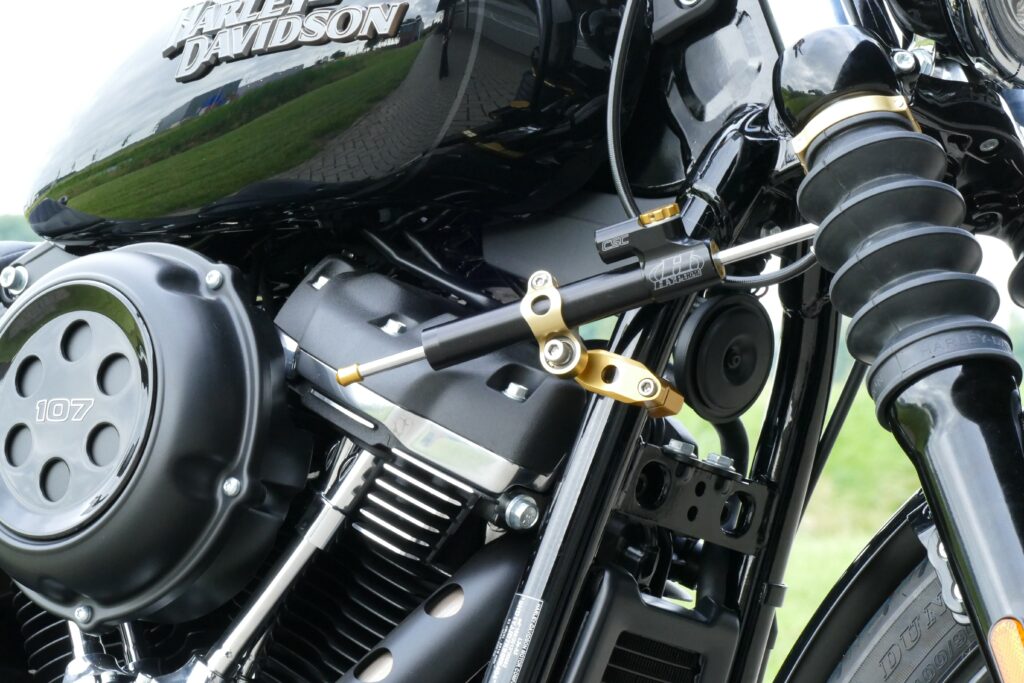
Beyond standard suspension tuning, a steering damper adds a layer of protection that suspension alone cannot provide. A steering damper applies resistance directly to the steering axis, slowing down the oscillation that causes a tank slapper. This is particularly valuable when the bike is loaded, because the front end is already carrying less proportional weight and is therefore more susceptible to instability. You can browse the full range of suspension and damper products to find options suited to your bike and riding style.
What should you do if a tank slapper starts while carrying a load?
If a tank slapper starts while you are carrying a passenger or luggage, the immediate priority is to avoid fighting the handlebars. Gripping the bars tightly and trying to force the steering straight is one of the most common and dangerous instincts, because it can amplify the oscillation rather than dampen it. Instead, hold the bars firmly but without locking your arms, and let the steering move while you focus on keeping the bike upright and on course.
The steps to manage a tank slapper in progress are:
- Ease off the throttle gradually. Do not snap the throttle shut, as this transfers weight abruptly and can worsen the oscillation. Roll off smoothly to reduce speed and shift weight forward.
- Hold the bars with a firm but relaxed grip. Keep your elbows slightly bent so your arms can absorb movement rather than transmit it back into the steering.
- Press your knees into the tank. This stabilizes your upper body and reduces the amount of rider movement that feeds back into the steering.
- Avoid braking sharply. Hard braking, especially at the rear, can unsettle the bike further. If you need to slow down, use gentle, progressive braking once the oscillation begins to subside.
- Communicate with your passenger. If you have a passenger, tell them calmly to hold still and not lean. Unexpected passenger movement during a wobble can make recovery harder.
Once the bike stabilizes, pull over safely and assess the situation. Check tyre pressures, review your load distribution, and adjust suspension settings before continuing. A tank slapper that happens once at a given speed or load condition is a warning that the setup needs attention before you ride on.
How Hyperpro helps reduce tank slapper risk when loaded
Carrying a passenger or luggage puts your suspension and steering stability under real pressure. We design products specifically to address that pressure and give you confident control in loaded riding conditions.
Our steering damper range is built to reduce the risk of tank slappers directly:
- CSC (Constant Safety Control): A linear damping model with 22 adjustable positions, designed to smooth out wobbles and vibrations across a consistent range of steering resistance.
- RSC (Reactive Safety Control): A progressive damping model that applies more resistance as steering movement increases, providing stronger protection precisely when a tank slapper is developing.
- Model-specific mounting kits: CNC-milled brackets designed for your exact bike, available in Hyperpro Gold or Black. In 98% of applications, fitting requires no drilling or cutting.
Pairing a steering damper with correctly adjusted suspension, including preload and damping settings suited to your loaded weight, gives you a setup that handles the demands of two-up riding or fully loaded touring with far greater stability. Contact us via our contact page if you have questions about which products suit your bike. To purchase, reach out to your nearest authorized Hyperpro distributor.