


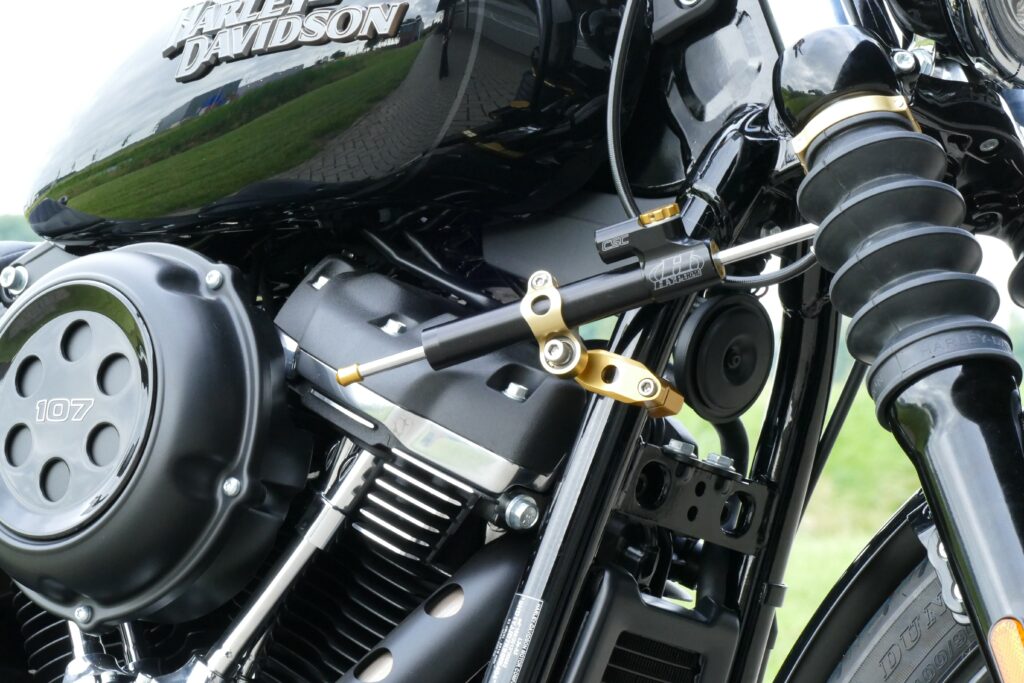
Sport bikes do experience tank slappers more often than most other motorcycle types. Their geometry, power delivery, and lightweight construction make them more susceptible to the rapid handlebar oscillation that defines a tank slapper. That said, any motorcycle can develop a speed wobble under the right conditions. The sections below break down the key factors, from riding dynamics to suspension setup and steering control.
What makes sport bikes more vulnerable to speed wobbles?
Sport bikes are more vulnerable to speed wobbles because of their aggressive geometry, high power-to-weight ratio, and stiff chassis tuning. These characteristics are designed to maximize cornering performance, but they also reduce the bike’s natural ability to self-correct when the front wheel loses tracking stability. The result is that small disturbances can escalate into a tank slapper faster than on a heavier, more upright machine.
Several design factors work against stability at the limit:
- Short wheelbase: Brings the front and rear axles closer together, which reduces the bike’s resistance to oscillation
- Steep rake angle: Gives sport bikes their sharp steering response but also makes them more sensitive to inputs and surface irregularities
- High horsepower: Aggressive acceleration can lift the front wheel or cause it to skip, both of which can trigger a wobble on landing
- Lightweight frame: Less rotational inertia means the bike reacts more sharply to destabilizing forces
Adventure and touring bikes, by contrast, have longer wheelbases, more conservative steering geometry, and greater overall mass. These traits naturally damp oscillations before they build into a full tank slapper.
What causes a tank slapper on a motorcycle?
A tank slapper is caused by the front wheel losing contact with or tracking on the road surface, which allows the steering to oscillate rapidly from side to side. This can happen after a wheelie landing, over a bump at speed, through a compression change mid-corner, or when the front tire loses grip momentarily. Once the oscillation starts, it can amplify quickly if nothing interrupts the cycle.
The physics behind it are straightforward. When the front wheel is unloaded, the self-centering effect of the steering geometry disappears. The handlebars are free to swing, and if the oscillation frequency matches the natural resonance of the front end, the movement grows rather than decays. Riders often describe the bars snapping left and right faster than they can react, which is why the event can be so dangerous.
Common triggers include:
- Landing from a wheelie or jump with the front wheel turned slightly off-center
- Hitting a pothole, expansion joint, or road irregularity at high speed
- Sudden weight transfer to the rear under hard acceleration
- Worn or incorrectly inflated tires that reduce front-end feedback
- Loose or worn steering head bearings
- Suspension that is too stiff to absorb small road inputs effectively
Hyperpro
Ride with confidence
Find the nearest Hyperpro dealer and start your motorcycle upgrade.
Are tank slappers more dangerous at higher speeds?
Yes, tank slappers are significantly more dangerous at higher speeds. At low speeds, the oscillation is easier to control and the consequences of losing control are far less severe. At high speeds, the handlebar movement is more violent, the forces on the rider’s arms are greater, and the window for corrective action is much smaller. A tank slapper at motorway speeds can throw a rider off the bike within seconds.
Speed affects tank slappers in two important ways. First, the energy in the system increases dramatically with velocity, meaning the oscillations build faster and with more force. Second, the rider has less time to react before the wobble exceeds the bike’s ability to self-correct. At track speeds, even a well-trained rider can struggle to hold on.
The most effective response during a tank slapper is to grip the tank firmly with your knees, keep a light grip on the bars to avoid amplifying the oscillation, and avoid braking sharply. Gradually rolling off the throttle while staying relaxed gives the front end the best chance of settling.
Does a steering damper actually prevent tank slappers?
A steering damper significantly reduces the risk of a tank slapper developing into a dangerous situation, though it does not eliminate the root causes. It works by resisting rapid steering movement, which slows the oscillation and gives the front end time to self-correct. On sport bikes, where the geometry already favors quick steering response, a steering damper adds an important layer of stability without removing normal handling feel.
The difference between damper types matters here. A linear damper applies consistent resistance across all steering speeds, which works well for general riding. A progressive damper, by contrast, applies light resistance during normal low-speed steering and much stronger resistance when the bars move rapidly, as they do during a tank slapper. This means you get the full benefit of natural steering in everyday riding while the damper activates aggressively when it is needed most.
Our steering damper systems are available in two versions: the CSC (Constant Safety Control) for linear damping and the RSC (Reactive Safety Control) for progressive damping. Both are adjustable across 22 positions and come with model-specific mounting kits that fit without drilling or cutting in almost all applications.
What suspension setup reduces the risk of tank slappers?
A well-balanced suspension setup reduces the risk of tank slappers by keeping the front wheel in consistent contact with the road. When the front end is correctly sprung and damped for the rider’s weight and riding style, it absorbs road inputs before they can unload the wheel and trigger an oscillation. Suspension that is too stiff, too soft, or poorly matched to the bike’s geometry increases instability.
Key suspension factors that affect tank slapper risk include:
- Fork spring rate: Springs that are too soft allow excessive front-end dive under braking, which can shift weight distribution suddenly and destabilize the steering
- Rebound damping: Too little rebound damping lets the fork extend too quickly after compression, which can momentarily unload the front tire
- Preload: Incorrect preload changes ride height and steering geometry, both of which affect how the bike tracks at speed
- Rear shock balance: A rear shock that is too stiff relative to the front can push weight forward unevenly, contributing to front-end instability
Upgrading to progressive-rate springs is one of the most effective changes a rider can make. Unlike linear springs, progressive springs offer a softer initial response that absorbs small bumps, then stiffen progressively under larger loads. This keeps the front wheel tracking more consistently across varied road surfaces. You can browse suspension upgrade options to find components matched to your specific model.
Which motorcycles are most prone to tank slappers?
Motorcycles most prone to tank slappers are high-powered sport bikes and superbikes with aggressive steering geometry, short wheelbases, and minimal front-end mass. These machines are tuned for maximum performance, which means the stability trade-offs are more pronounced. Lightweight naked bikes with high horsepower can also be susceptible, particularly when ridden hard on imperfect road surfaces.
Specific conditions that increase a bike’s vulnerability include:
- Factory suspension not set up for the rider’s weight
- Worn steering head bearings or fork seals
- Tires that are past their service life or running at incorrect pressure
- No steering damper fitted as standard
- Aftermarket modifications that change the bike’s weight distribution or geometry
Older sport bikes from the late 1990s and early 2000s are particularly well known for tank slappers, partly because electronics like traction control and wheelie control were not yet standard. Modern sport bikes with comprehensive rider aids are better equipped to prevent the front-wheel unloading events that start the cycle, but the underlying geometry still makes them more susceptible than other categories when those systems are switched off or overridden.
How Hyperpro helps you ride without tank slappers
A tank slapper is one of the most frightening things that can happen on a motorcycle, and the right components make a real difference in preventing one. We design and manufacture suspension and steering control products specifically to address this kind of instability.
Here is what we offer to reduce tank slapper risk:
- CSC Steering Damper: A linear damping model adjustable in 22 positions, designed to smooth out wobbles and vibrations without affecting normal steering feel
- RSC Steering Damper: A progressive damping model that reacts harder as steering speed increases, giving you strong protection during a tank slapper while staying light and natural during everyday riding
- Model-specific mounting kits: CNC-milled in Hyperpro Gold or Black, these are plug-and-play fitments that require no drilling or cutting in 98% of applications
- Progressive fork springs and shock absorbers: Matched to your bike model and rider weight to keep the front wheel tracking consistently and reduce the conditions that trigger a tank slapper
Purchases are available through our authorized distributor network. Find your nearest dealer and get the right setup for your bike at hyperpro.com/where-to-buy. If you have questions about which products suit your motorcycle, you can also contact us directly.