


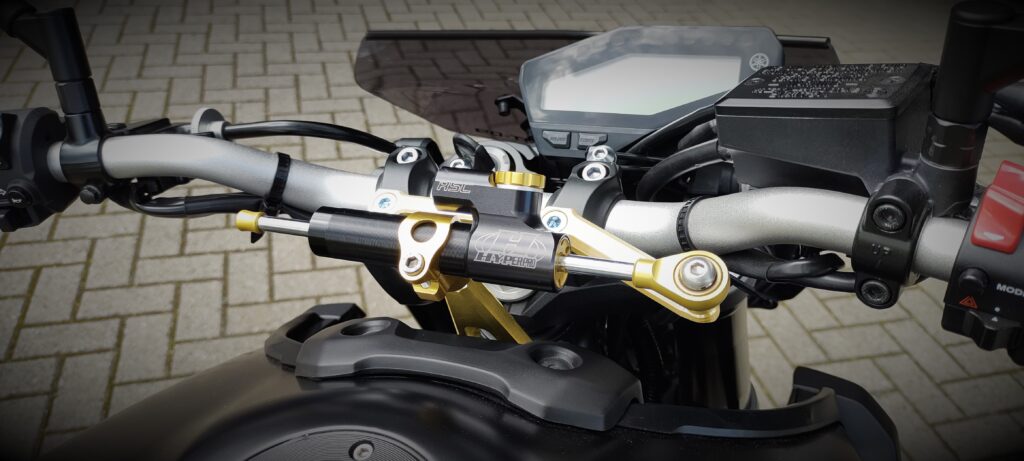
Yes, worn tires can make a steering damper less effective. A steering damper is designed to control unwanted handlebar movement caused by external forces, but when tire condition deteriorates, the nature and intensity of those forces change in ways the damper may not be calibrated to handle. The result is reduced steering stability even when the damper itself is functioning correctly. This article walks through exactly how tire wear interacts with damper performance, what warning signs to look for, and when replacement becomes unavoidable.
How does tire condition affect motorcycle handling dynamics?
Tire condition directly shapes how a motorcycle responds to the road. A tire in good condition maintains a consistent contact patch, predictable grip levels, and stable cornering geometry. As a tire wears, all three of these properties degrade, and the handling characteristics of the entire motorcycle shift with them. This affects not just grip but also the way steering forces are generated and transmitted through the front end.
The contact patch is the small area of rubber that connects the motorcycle to the road surface. When a tire is new, this patch is shaped correctly for the tire’s profile and load rating. Wear flattens the center of the tire, altering its cross-sectional shape and changing how the bike steers into and through corners. A flat-spotted or squared-off tire requires more input to initiate a lean and can feel vague or reluctant to hold a line.
Beyond geometry, worn rubber loses its ability to absorb micro-vibrations and small surface irregularities. These vibrations travel directly into the chassis and handlebars, increasing the workload on every component in the steering system, including the steering damper. A tire in good condition acts as a first layer of damping. A worn tire removes that layer entirely.
Can worn tires make a steering damper less effective?
Worn tires can reduce the effectiveness of a steering damper by changing the frequency, amplitude, and origin of the forces the damper is asked to control. A damper is tuned to manage a specific range of handlebar movement. When tire wear introduces new vibration patterns or instability that fall outside that range, the damper cannot fully compensate, even at maximum adjustment.
A steering damper works by resisting rapid rotational movement at the steering head. It is most effective when the instability it is managing comes from external inputs like road surface irregularities or speed-induced wobble, not from a fundamental change in how the tire interacts with the road. Worn tires alter that fundamental interaction, creating instability that originates lower in the system than the damper can address.
In practical terms, a rider might notice that a damper setting that previously felt stable now allows more movement at the bars, or that the bike develops a wobble at speeds where it was previously composed. These are signs that the tire, not the damper, has become the limiting factor in steering stability.
Hyperpro
Ride with confidence
Find the nearest Hyperpro dealer and start your motorcycle upgrade.
What types of tire wear cause the most steering instability?
Not all tire wear affects handling equally. Center wear, cupping, and flat spots are the three patterns that most directly compromise steering stability and place additional strain on a steering damper.
- Center wear (squaring off): Common on bikes ridden primarily in straight lines, this creates a flat section across the tire’s crown. The bike resists leaning, and when it does lean, it drops into the corner abruptly rather than rolling smoothly. This unpredictability generates erratic steering inputs that a damper struggles to filter consistently.
- Cupping or scalloping: This uneven wear pattern, often caused by suspension imbalance or aggressive braking, creates a bumpy contact surface that generates rhythmic vibrations at speed. These vibrations can excite handlebar oscillation at specific frequencies, which may overwhelm the damper’s ability to suppress them.
- Flat spots: Caused by locking a wheel during braking, flat spots create a hard, repeated impact with every wheel rotation. At higher speeds, this can trigger a tank-slapper or wobble that exceeds the damper’s effective range.
Of these, cupping tends to be the most insidious because it develops gradually, and riders often attribute the resulting instability to suspension settings rather than tire condition.
How do you tell if your steering issues are from tires or the damper?
You can distinguish between tire-related and damper-related steering issues by examining when and how the instability occurs and by inspecting both components directly. Tire problems tend to produce consistent, speed-sensitive symptoms tied to wheel rotation, while damper issues typically present as a general lack of resistance to handlebar movement regardless of speed.
Start with a visual and tactile inspection of both tires. Look for uneven wear, flat spots, cracking, or a visibly squared-off profile on the front tire. Run your hand across the surface to feel for cupping. If the tire shows any of these signs, address the tire before drawing conclusions about the damper.
Then consider the nature of the instability:
- If the wobble or vibration is rhythmic and tied to a specific speed range, the tire is the more likely cause.
- If the handlebar feels loose or unresponsive to damper adjustment across all speeds, the damper itself may need inspection or replacement.
- If the issue appeared gradually over time rather than after a specific event, progressive tire wear is the more probable explanation.
A simple test is to adjust the damper to its firmest setting and ride at the speed where the problem occurs. If the instability persists with the damper at maximum resistance, the tire is almost certainly the root cause.
Should you adjust your steering damper to compensate for worn tires?
Adjusting a steering damper to compensate for worn tires is not a reliable or safe solution. A damper can mask some symptoms of tire wear at certain speeds, but it cannot correct the underlying change in contact patch geometry or grip level that worn rubber creates. Increasing damper resistance to suppress instability caused by worn tires can also reduce the damper’s ability to respond naturally to legitimate steering inputs, making the bike feel wooden and less responsive.
There is also a safety dimension to consider. Worn tires reduce braking performance and cornering grip independently of steering behavior. No amount of damper adjustment addresses those risks. Treating the damper as a workaround for tire condition gives a false sense of security without resolving the actual hazard.
The correct approach is to replace the worn tire first, then reassess whether the steering damper needs recalibration once the tire is in good condition. In many cases, the instability disappears entirely once the tire is replaced, and the damper can return to its previous setting.
When should worn tires be replaced to restore steering performance?
Tires should be replaced before they reach the legal wear indicator depth, but steering performance typically degrades well before that point. For most motorcycle tires, noticeable handling changes begin when tread depth drops below 2 to 3 mm, even though the legal minimum in most markets is 1 mm. If you are experiencing steering instability, waiting until the wear indicators are reached is waiting too long.
Replace tires immediately if you observe any of the following:
- A visibly squared-off or flat profile on the front tire
- Cupping, scalloping, or uneven wear across the contact surface
- Any flat spot caused by wheel lock-up
- Cracking in the sidewall or tread area, regardless of remaining depth
- A new wobble or vibration that appeared without any change to the suspension setup
Replacing both tires at the same time is worth considering when the front tire is worn, because mismatched tire profiles between front and rear can create handling imbalances of their own. Once new tires are fitted, give the damper a fresh assessment under normal riding conditions before making any adjustments.
How Hyperpro helps with steering stability
Once your tires are in good condition, the right steering damper setup makes a meaningful difference to how confident and controlled your bike feels. Our steering damper systems are designed to give riders precise, adjustable control over handlebar stability without compromising natural steering feel.
- CSC (Constant Safety Control): A linear damping model that provides consistent resistance across all steering speeds, adjustable across 22 positions for fine-tuned control.
- RSC (Reactive Safety Control): A progressive damping model that responds proportionally to the intensity of handlebar movement, offering greater resistance during rapid oscillations while staying light during normal steering inputs.
- Model-specific mounting kits: CNC-milled kits designed as plug-and-play fitments for your specific motorcycle, requiring no drilling or cutting in 98% of applications. Available in Hyperpro Gold or Black.
If you want to explore the full range of Hyperpro suspension products or need guidance on which damper suits your bike, get in touch with us. Purchases are handled through our authorized distributor network, so you always get the right product with proper local support.