


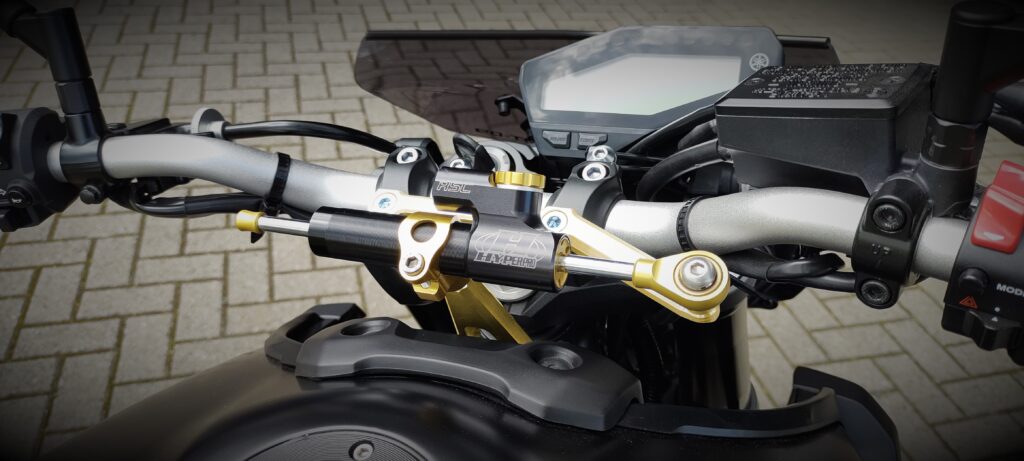
A steering damper works by using hydraulic resistance to slow down and smooth out unwanted, rapid steering inputs on a motorcycle. When the front wheel hits a bump or loses traction momentarily, the damper absorbs the resulting oscillation before it can escalate into a dangerous wobble or tank-slapper. The sections below break down exactly how that happens, what’s inside the unit, and when you actually need one.
What problems does a steering damper actually solve?
A steering damper solves the problem of uncontrolled, high-frequency steering oscillations that can develop when a motorcycle’s front wheel is disturbed. The most serious of these are tank-slappers, where the handlebars snap rapidly from side to side, and speed wobbles, where the front end shakes violently enough to destabilize the entire bike. Without damping, these events can escalate faster than a rider can physically react.
Beyond those extreme scenarios, a steering damper also reduces the everyday vibrations and twitchiness that come through the bars on rough road surfaces, at high speed, or when accelerating hard out of corners. Riders often describe the result as a front end that feels more planted and predictable, rather than nervous or vague. That added confidence directly affects how smoothly and safely you can push the bike.
The situations where these problems occur most often include:
- High-speed straight-line riding where aerodynamic instability builds
- Hitting mid-corner bumps or expansion joints that disturb wheel tracking
- Hard acceleration on sport or naked bikes with aggressive geometry
- Adventure riding on loose or broken surfaces where the front wheel deflects unpredictably
Hyperpro
Ride with confidence
Find the nearest Hyperpro dealer and start your motorcycle upgrade.
What are the main components inside a steering damper?
A steering damper contains a cylinder filled with hydraulic fluid, a piston that moves through that fluid, and a set of valves that control how quickly the fluid can pass from one side of the piston to the other. The housing, piston rod, and mounting brackets complete the assembly. Together, these parts convert mechanical steering movement into controlled hydraulic resistance.
Each component plays a specific role in how the damper performs:
- Cylinder and fluid chamber: The sealed body holds the hydraulic oil. The quality and viscosity of this fluid directly affect how the damper responds across different temperatures.
- Piston: As the steering moves, the piston travels through the fluid. The speed of that movement determines how much resistance is generated.
- Valving system: Small passages or shim stacks inside the piston regulate fluid flow. This is where damping characteristics are engineered, whether that means consistent resistance across all speeds or a progressive response that stiffens under fast inputs.
- Adjustment mechanism: Most quality dampers include an external adjuster, typically a numbered dial, that changes how restrictive the valve passages are without disassembling the unit.
- Mounting hardware: The damper connects at two points: one fixed to the frame or triple clamp, the other to the steering head. Model-specific mounting kits make this connection clean and secure without modification to the bike.
How does hydraulic resistance translate into steering control?
Hydraulic resistance translates into steering control by opposing the speed of steering movement rather than the direction of it. When you steer normally, the piston moves slowly and fluid passes through the valves with little resistance. When the wheel kicks suddenly, the piston moves fast, the valve passages restrict fluid flow, and the resulting pressure creates a force that slows the oscillation down before it amplifies.
This is an important distinction: a steering damper does not prevent you from steering. It only resists rapid, unintended movement. Deliberate, smooth inputs at normal riding speeds pass through with minimal interference. The damper becomes active precisely when the steering movement is too fast to be a conscious rider input, which is the same moment when control is most at risk.
The relationship between fluid speed and resistance is not always linear. Progressive dampers increase resistance more sharply as movement speed rises, which means they stay neutral during normal riding and become significantly stiffer during a genuine instability event. This is what separates a well-engineered motorcycle steering damper from a basic unit that either interferes with normal handling or provides too little resistance when it matters.
What’s the difference between rotary and linear steering dampers?
The key difference between rotary and linear steering dampers is the direction of movement. A linear damper uses a piston that moves in a straight line along a cylinder, while a rotary damper uses a rotating vane mechanism housed in a flat, disc-shaped unit. Both achieve hydraulic resistance, but they mount differently and suit different bike types and geometries.
Linear steering dampers
Linear dampers are the traditional design. They mount as a rod between two points, typically along the side of the triple clamp and the frame. Their longer physical profile makes them well suited to bikes where there is space to run the unit at an angle, including many sport bikes, adventure bikes, and naked motorcycles. The piston-and-cylinder design allows for a wide range of valving options and external adjustment.
Rotary steering dampers
Rotary dampers sit flat on top of the triple clamp and connect directly to the steering axis. Because they rotate with the steering rather than extending linearly, they take up much less space and work well on bikes where a linear unit would not fit cleanly. Their compact form has made them popular on modern sport bikes where the area around the headstock is tightly packaged.
In terms of performance, both types can be engineered to deliver excellent damping. The choice between them usually comes down to fitment requirements and the mounting kit available for your specific motorcycle model.
When should a motorcycle have a steering damper fitted?
A motorcycle should have a steering damper fitted when it shows signs of front-end instability, when it is ridden at sustained high speeds, or when it is used in conditions where the front wheel regularly encounters unpredictable surfaces. Many factory bikes do not include a damper as standard, even when the riding style or power output of the machine would benefit from one.
Specific situations where fitting a steering damper is worth considering include:
- You have experienced a wobble or head shake at speed, even a mild one
- Your bike is a high-powered sport or naked motorcycle without a factory damper
- You ride on track days or at motorway speeds regularly
- You use an adventure bike on gravel, sand, or rutted trails where the front wheel deflects frequently
- You have changed tyres, suspension setup, or geometry and noticed increased front-end sensitivity
It is also worth noting that a steering damper is not a substitute for correctly set-up suspension. If your forks or rear shock are poorly adjusted, sorting the suspension first will give you the biggest improvement. A damper then works on top of a solid foundation rather than masking an underlying problem.
How do you adjust a steering damper for different riding conditions?
You adjust a steering damper by increasing resistance for high-speed or aggressive riding and reducing it for slower, technical riding where natural steering feel matters more. Most adjustable dampers use a numbered dial that changes how restrictive the internal valving is. A higher setting adds more resistance; a lower setting allows freer movement through the bars.
As a practical starting point for adjustment:
- Start in the middle of the adjustment range and ride on a familiar road to establish a baseline feel.
- Increase the setting gradually if you notice any front-end nervousness at speed or on rough surfaces.
- Reduce the setting if the steering feels heavy or slow to respond during low-speed manoeuvres or tight corners.
- Test at the speeds and conditions you actually ride in rather than in a car park or on a short test loop.
Both the CSC and RSC models we offer come with 22 adjustment positions, which gives you enough range to dial in the right balance whether you are commuting, touring, or riding on track. The RSC model uses progressive damping, meaning the resistance curve changes automatically with steering speed, so it requires less manual adjustment across different conditions compared to a constant-rate unit.
One thing to avoid is setting the damper too stiff as a default. Excessive resistance can slow your steering response in situations where you need to make a quick avoidance manoeuvre. The goal is a setting that eliminates instability without making the bike feel like it is fighting your inputs.
How Hyperpro helps you control your steering
We design our steering dampers specifically to give riders a measurable improvement in safety and confidence, without compromising the natural feel of the bike. Here is what that looks like in practice:
- Two damper models to match your riding: The CSC delivers consistent linear damping across all steering speeds. The RSC uses progressive damping that responds more aggressively as steering speed increases, making it ideal for sport and high-performance use.
- 22 adjustment positions: Both models give you precise control over damping strength so you can fine-tune the setup to your bike, your tyres, and your riding style.
- Model-specific mounting kits: We develop CNC-milled brackets for each motorcycle application. In 98% of cases these are true plug-and-play fitments that require no drilling, cutting, or modification to your bike. Kits are available in Hyperpro Gold or Black to suit different aesthetics.
- Full product range in one place: You can browse our complete suspension product range to find the right combination of damper and mounting kit for your specific model.
Purchases are made through our authorised distributor network. Contact us if you have questions about fitment or which model suits your motorcycle best, and we will point you in the right direction.