


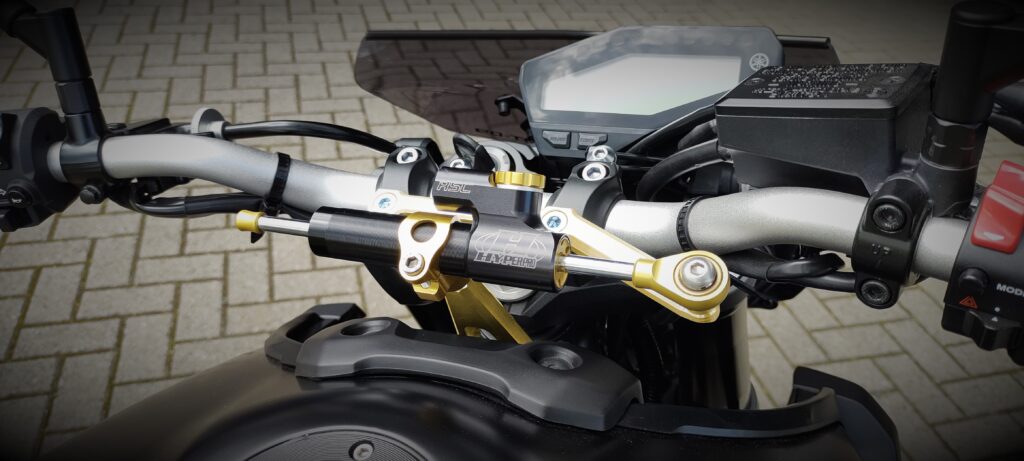
A tank slapper is a sudden, violent oscillation of the front wheel that causes the handlebars to swing rapidly from side to side. It happens when the front wheel loses traction or lifts off the ground and then reconnects with the road at an angle, sending the steering into a self-reinforcing wobble. The sections below break down what triggers it, how dangerous it really is, and what you can do about it.
What causes a tank slapper to happen?
A tank slapper is caused by a sudden loss of front wheel contact with the road, followed by the wheel reconnecting at an angle. When the front wheel returns to the surface out of alignment with the direction of travel, the steering overcorrects, the wheel swings the other way, and a rapid back-and-forth oscillation builds faster than most riders can physically respond to.
Several situations can trigger this sequence:
- Wheelies or front wheel lift: Hard acceleration, especially on sport bikes, can lift the front wheel. When it comes back down off-centre, the tank slapper begins.
- Hitting a bump or road imperfection at speed: A pothole, expansion joint, or mid-corner bump can knock the front wheel sideways just enough to start the oscillation.
- Worn or poorly set up suspension: Suspension that is too soft, too stiff, or incorrectly damped cannot absorb road inputs cleanly. This leaves the front wheel more vulnerable to losing and regaining contact in an uncontrolled way.
- Incorrect tyre pressure or worn tyres: Both reduce the contact patch and make the front end less stable under load.
- High speed combined with any of the above: The faster you are going, the less time there is for the system to self-correct before the wobble amplifies.
In most cases, a tank slapper is not caused by a single factor but by a combination of speed, road surface, and a front end that is not properly set up to handle the situation.
Hyperpro
Ride with confidence
Find the nearest Hyperpro dealer and start your motorcycle upgrade.
How dangerous is a tank slapper on a motorcycle?
A tank slapper is one of the most dangerous events a rider can experience on a motorcycle. The oscillation can escalate from a minor wobble to a full loss of control within fractions of a second, and at high speed there is very little time to react. Riders who grip the bars tightly and try to fight the movement often make the situation worse by feeding energy back into the wobble.
The physical risk is significant. The handlebars can slam into your hands, arms, and knees with considerable force, which is where the name comes from. At the same time, the bike’s trajectory becomes unpredictable, making it extremely difficult to stay on your intended line. At motorway speeds or on a racetrack, a tank slapper that is not resolved quickly can result in a high-side or a complete loss of control.
The danger level depends on several factors: your speed at the time, the road surface, the severity of the initial trigger, and whether your bike has any mechanical assistance such as a steering damper. A low-speed tank slapper on a smooth road is a very different event from one that begins at 150 km/h on a bumpy straight.
What’s the difference between a tank slapper and a speed wobble?
A tank slapper and a speed wobble are closely related but differ in their origin and behaviour. A tank slapper is typically triggered by a sudden, external event such as a wheelie landing or a road impact that causes the front wheel to reconnect with the road at an angle. A speed wobble, by contrast, tends to develop more gradually from instability in the steering geometry, often building from a low-frequency oscillation at a specific speed threshold.
In practical terms:
- Tank slapper: Sudden onset, usually triggered by a discrete event, high-frequency oscillation, often violent from the start.
- Speed wobble: Can build gradually, often linked to a resonant speed, may start as a mild shimmy before escalating, and is frequently connected to tyre balance, wheel alignment, or steering head bearing wear.
Both events involve the front end oscillating side to side, and both can escalate to a crash if not managed. The distinction matters because the root cause points to a different solution. A tank slapper often points to suspension setup or riding technique, while a speed wobble more commonly points to tyre condition, wheel balance, or steering geometry.
How does motorcycle suspension affect tank slappers?
Motorcycle suspension plays a direct role in how likely a tank slapper is to occur and how severe it becomes. A well-set-up suspension system keeps the front wheel in contact with the road surface consistently, reducing the chance that a bump or landing will send the wheel off at an angle. Poor suspension setup does the opposite: it allows the front end to bounce, skip, or deflect in ways that create the conditions for a wobble to begin.
Specifically, front fork springs that are too soft will allow the front end to compress too far under braking or on landing, reducing stability. Springs that are too stiff will cause the wheel to skip over road imperfections rather than tracking through them. Damping that is incorrectly set will either allow the suspension to rebound too quickly, which can flick the wheel off course, or too slowly, which causes the fork to pack down and lose responsiveness.
Upgrading to bike-specific suspension components with progressive spring rates gives the front end a more controlled response across a wider range of inputs. This does not eliminate all risk, but it significantly reduces the frequency and severity of the front-end instability that leads to tank slappers.
What should you do if your bike starts tank slapping?
If your bike starts tank slapping, the most important action is to avoid gripping the handlebars tightly and fighting the movement. Counterintuitively, a relaxed grip allows the steering to self-correct more effectively. Tightening your grip and trying to force the bars still transfers your body’s inertia into the oscillation and makes it worse.
Follow these steps if a tank slapper begins:
- Relax your grip: Keep your hands on the bars but stop resisting the movement. Let the steering move.
- Keep your body still: Avoid leaning aggressively or shifting your weight, which can add to the instability.
- Reduce speed smoothly: Close the throttle gradually. Avoid sharp braking, which can load the front end further and worsen the oscillation.
- Hold your line: Try to maintain a straight path while the bike settles. Steering inputs during a tank slapper are rarely helpful.
- Move your body weight rearward slightly: Shifting weight toward the rear reduces load on the front wheel and can help the oscillation die out.
Once the bike has stabilised, pull over safely and inspect the front end for any obvious issues before continuing your ride.
Can a steering damper prevent a tank slapper?
A steering damper significantly reduces the risk of a tank slapper and can prevent a minor wobble from escalating into a full oscillation. It works by adding resistance to rapid steering movement, which slows down the side-to-side swinging motion at the handlebars. This gives the rider more time to respond and allows the bike’s geometry to self-stabilise before the wobble builds momentum.
A steering damper does not eliminate the root cause of a tank slapper. If your suspension is poorly set up, your tyres are worn, or you are regularly landing wheelies at high speed, a damper alone is not a complete solution. It is best understood as an important safety layer that works alongside proper suspension setup and good riding technique.
How Hyperpro helps you avoid tank slappers
We develop steering damper systems and suspension components specifically designed to reduce the risk of tank slappers and front-end instability. Our approach combines mechanical damping with bike-specific engineering so that every component works with your motorcycle’s geometry rather than against it.
- CSC (Constant Safety Control): A linear damping model with 22 adjustable positions, designed to reduce wobbles and vibrations across a consistent range of steering inputs.
- RSC (Reactive Safety Control): A progressive damping model that adjusts its resistance based on the speed of the steering movement, providing lighter feel in normal riding and stronger resistance when a tank slapper begins.
- Model-specific mounting kits: CNC-milled brackets in Hyperpro Gold or Black, designed as plug-and-play fitments for your specific bike. In 98% of applications, no drilling or cutting is required.
- Suspension upgrades: Our steering damper systems work alongside progressive-rate fork springs and shock absorbers to give your front end a stable, controlled response across all riding conditions.
If you want to find out which products fit your bike, visit our full product range or get in touch via our contact page. Purchases are always made through one of our authorised distributors, who can advise you on the right setup for your riding style and motorcycle.