


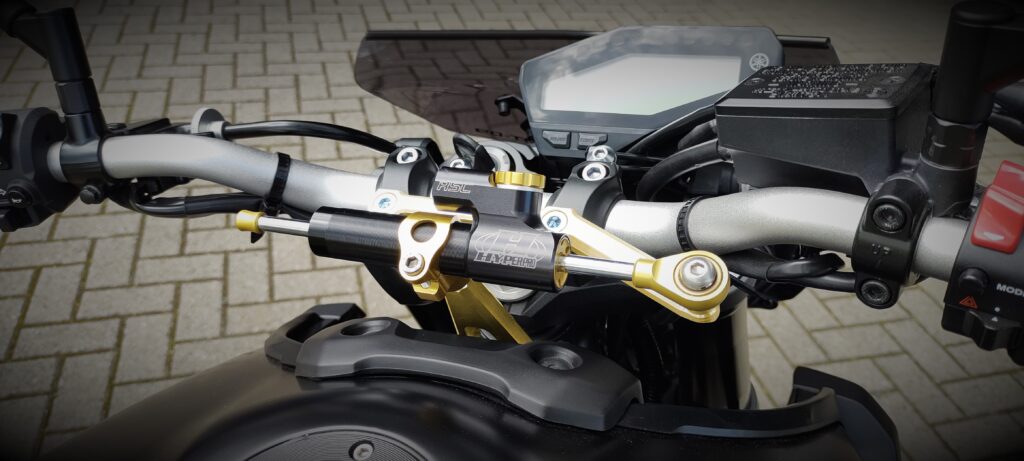
For track days, the best steering damper is one that offers progressive damping, wide adjustability, and a model-specific mounting solution. A progressive damper responds differently at low speeds versus high speeds, giving you light, natural steering in slow corners while automatically resisting the violent handlebar movements that cause tank-slappers at speed. The sections below break down everything you need to choose the right damper for your track setup.
What makes a steering damper suitable for track use?
A steering damper is suitable for track use when it can handle rapid, high-force inputs without restricting normal steering. On a circuit, speeds are higher, surfaces can be unpredictable, and the consequences of a tank-slapper or wobble are far more serious than on the road. A track-ready damper needs a wide adjustment range, heat resistance, and precise, consistent damping across the full range of riding conditions you encounter during a session.
Several qualities separate a track-capable steering damper from a basic road unit:
- Adjustability: At least 20 positions of damping adjustment let you fine-tune response to suit different circuits, tyre compounds, and riding styles
- Progressive response: Damping that scales with input speed protects against sudden instability without making the bike feel sluggish in technical sections
- Heat stability: Sustained high-speed riding generates heat in the damper; quality internals maintain consistent performance throughout a full track day
- Secure mounting: A model-specific, CNC-milled mounting kit prevents movement under load and eliminates the need for improvised brackets that can shift or fail
- Low weight: Unnecessary mass at the front of the bike affects handling; compact damper designs keep unsprung weight to a minimum
A damper that ticks all of these boxes gives you a safety net during hard acceleration out of corners and on high-speed straights, without compromising the precise steering feel that fast circuit riding demands.
Hyperpro
Ride with confidence
Find the nearest Hyperpro dealer and start your motorcycle upgrade.
What’s the difference between rotary and linear steering dampers?
The main difference between rotary and linear steering dampers is the mechanism and mounting position. A linear damper uses a piston moving through fluid inside a cylinder, mounted horizontally between the frame and the steering head. A rotary damper uses a rotating vane mechanism mounted directly on top of the steering head, keeping the design compact and centralised. Both types reduce unwanted handlebar movement, but they differ in feel, fitment, and how they respond to input speed.
Linear steering dampers
Linear dampers are the traditional design and remain widely used across a broad range of motorcycles. The cylinder extends horizontally, which means they require clearance along the frame. Because the damping force is generated by fluid passing through a piston, linear dampers deliver consistent resistance across the stroke. Hyperpro’s linear CSC damper uses constant damping with 22 positions of adjustment, making it straightforward to set up and reliable under sustained track use.
Rotary steering dampers
Rotary dampers sit flush on the steering head, which makes them a cleaner solution for bikes with limited frame clearance. The rotating vane design allows for progressive damping, meaning resistance increases as the speed of the steering input increases. This is a significant advantage on track: at low speed the steering remains light and responsive, while at high speed the damper automatically provides stronger resistance against sudden instability. The Hyperpro RSC damper uses this progressive rotary mechanism with the same 22-position adjustability as the linear model.
For track days, many riders prefer the rotary progressive design because it adapts automatically to changing conditions rather than applying a fixed level of resistance throughout every corner and straight.
How does a steering damper improve lap times and confidence?
A steering damper improves lap times and confidence by eliminating the instability that forces riders to back off. Tank-slappers, wobbles, and high-speed vibrations are not just dangerous; they cause riders to reduce corner exit speed, apply the throttle more cautiously, and carry less speed onto straights. By controlling these events before they develop into a full wobble, a steering damper lets you commit more fully to the throttle earlier and with greater consistency.
The confidence benefit is as important as the mechanical one. When you know the front end is protected against sudden instability, you ride closer to the limit for longer. This is particularly relevant during the later stages of a track day when tyre grip changes and fatigue sets in. A damper does not replace good technique or proper suspension setup, but it adds a layer of protection that directly supports more aggressive, consistent riding.
On circuits with long straights or fast, open corners where the front wheel can become light, the damper’s effect is most noticeable. It also helps when riding over kerbs or patches of surface change mid-corner, where an undamped front end can twitch unpredictably.
What damping settings should you use on a track?
On a track, start with a mid-range damping setting and adjust from there based on circuit characteristics and your riding style. A setting that is too soft provides little protection against high-speed instability, while a setting that is too firm makes the steering feel heavy and unresponsive in slow corners. Most riders find the right balance somewhere between 10 and 16 on a 22-position damper, adjusted up for faster circuits and down for tighter, more technical layouts.
A useful approach to finding your setting:
- Set the damper to the middle of its adjustment range before your first session
- Complete a few warm-up laps to get a feel for the steering weight and front-end behaviour
- If the steering feels heavy or slow to respond in slow corners, reduce damping by two or three positions
- If you experience any wobble or instability at speed, increase damping incrementally
- Make one adjustment at a time and complete at least one full session before changing again
Track surface, tyre type, and motorcycle geometry all influence the ideal setting. A bike running slick tyres with a more aggressive geometry will generally tolerate and benefit from higher damping than a road-legal setup. Suspension changes, such as adjusting fork preload or compression, can also affect how the damper behaves, so revisit your damping setting any time you make other changes to the front end.
Which motorcycles benefit most from a steering damper on track?
Motorcycles that benefit most from a steering damper on track are sport bikes, superbikes, and lightweight machines with high power-to-weight ratios. These bikes generate the conditions where instability is most likely: high cornering speeds, aggressive acceleration, and front wheels that spend time in the air. Naked bikes ridden on track also benefit significantly, particularly those with more upright geometry that can be susceptible to wobble under hard acceleration.
Specific categories where a steering damper makes a meaningful difference include:
- Supersport and superbike class machines: High-speed instability is a real risk at full throttle, and the margin for error is small
- Lightweight 300cc to 600cc sport bikes: These bikes are often ridden very close to their limits on track days, and their lighter weight makes them more susceptible to front-end movement
- Naked bikes used on circuit: Their geometry and riding position can amplify wobble under hard acceleration out of slow corners
- Adventure bikes on track days: Less common but increasingly popular; their higher centre of gravity and longer wheelbase make damping control particularly useful
Bikes that already have factory-fitted steering dampers can still benefit from an upgrade. Factory units are often calibrated conservatively to suit a wide range of riders, and an adjustable aftermarket damper gives you the ability to tailor the response to your specific track use. You can browse model-specific fitment options to find what is available for your motorcycle.
How Hyperpro helps you ride faster and safer on track
We design our steering dampers specifically to address the instability that limits track performance. Both our CSC and RSC models offer 22 positions of adjustment, so you can dial in the exact level of damping your bike and circuit require. Here is what sets our approach apart:
- Two damper types for different needs: The CSC provides consistent linear damping; the RSC uses a progressive rotary mechanism that automatically scales resistance with input speed
- Model-specific mounting kits: Our CNC-milled brackets are designed as plug-and-play fitments for your exact bike, with no drilling or cutting required in 98% of applications
- Available in Hyperpro Gold or Black: Both finish options are built to the same performance standard, so you can match your bike’s aesthetic without compromising function
- Engineered for real riding conditions: Our dampers are built to maintain consistent performance under the heat and sustained stress of a full track day
Purchases are made through our authorised distributor network. Contact us if you need guidance on which damper suits your motorcycle, or find your nearest stockist to get set up before your next track day.