


A tank slapper happens when the front wheel loses traction briefly during hard acceleration, causing the handlebars to snap violently from side to side. The sudden unloading of the front wheel allows small steering inputs or road imperfections to trigger a self-amplifying oscillation. Understanding why this happens and how to manage it can genuinely save your life.
What actually happens to the front wheel during a tank slapper?
During a tank slapper, the front wheel enters a rapid side-to-side oscillation that the rider struggles to counteract. When you accelerate hard, weight transfers to the rear wheel, which significantly reduces the load on the front. With less contact patch pressure, the front tyre loses its self-centering ability and begins to oscillate. Each swing of the bars amplifies the next, and the frequency can exceed what human reflexes can correct in time.
This oscillation is not random. It follows a mechanical pattern tied to the bike’s steering geometry, the stiffness of the fork internals, and the rotational inertia of the front wheel. Once the wobble starts, the handlebars can move fast enough to strike the rider’s thighs, which is exactly where the name “tank slapper” comes from. The event can develop from a minor shimmy to a full wobble in under a second, which is why prevention matters far more than reaction.
Why does hard acceleration trigger handlebar wobble?
Hard acceleration triggers handlebar wobble because it shifts the bike’s weight distribution dramatically rearward, unloading the front wheel and reducing its gyroscopic stability. A front tyre that carries less weight has a narrower effective contact patch and less resistance to lateral movement. Any small disturbance, whether a road seam, a slight bump, or an uneven throttle input, can then initiate the oscillation cycle that becomes a tank slapper.
The problem is compounded when the front wheel lifts slightly or skims the surface rather than pressing firmly into it. At that point, the tyre is no longer generating meaningful cornering or stabilizing force. The fork internals, if they are soft or poorly damped, cannot absorb the lateral energy fast enough to prevent the oscillation from building. Riders on bikes with stock suspension that is tuned for comfort rather than performance are particularly exposed to this risk during aggressive acceleration.
Hyperpro
Ride with confidence
Find the nearest Hyperpro dealer and start your motorcycle upgrade.
What suspension and geometry factors make a bike more prone to tank slappers?
Several suspension and geometry factors increase a bike’s vulnerability to tank slappers. The most significant are insufficient fork spring rate, poor fork damping, excessive trail, and a high center of gravity. Together, these characteristics reduce the front end’s ability to self-correct when steering inputs become unstable under acceleration.
Here is a breakdown of the main contributing factors:
- Soft fork springs: Springs that are too soft for the rider’s weight allow excessive fork dive and rebound, which destabilizes the front end when weight shifts rearward suddenly.
- Inadequate damping: Without sufficient rebound damping, the forks react to disturbances too quickly and fail to absorb oscillation energy before it builds.
- Worn steering head bearings: Play in the steering head removes precision from the steering geometry and allows unwanted movement to initiate a wobble.
- Tyre condition and pressure: An underinflated or worn front tyre has a larger, less consistent contact patch that responds unpredictably when the wheel is unloaded.
- Wheelbase and trail: Bikes with shorter wheelbases or reduced trail are inherently quicker to steer but also quicker to enter instability under hard acceleration.
Factory suspension setups are typically tuned for an average rider weight and a moderate riding style. If you ride aggressively or carry more weight than the default setup accounts for, the stock components may not provide the stability margin you need during hard acceleration.
Can a steering damper prevent a tank slapper?
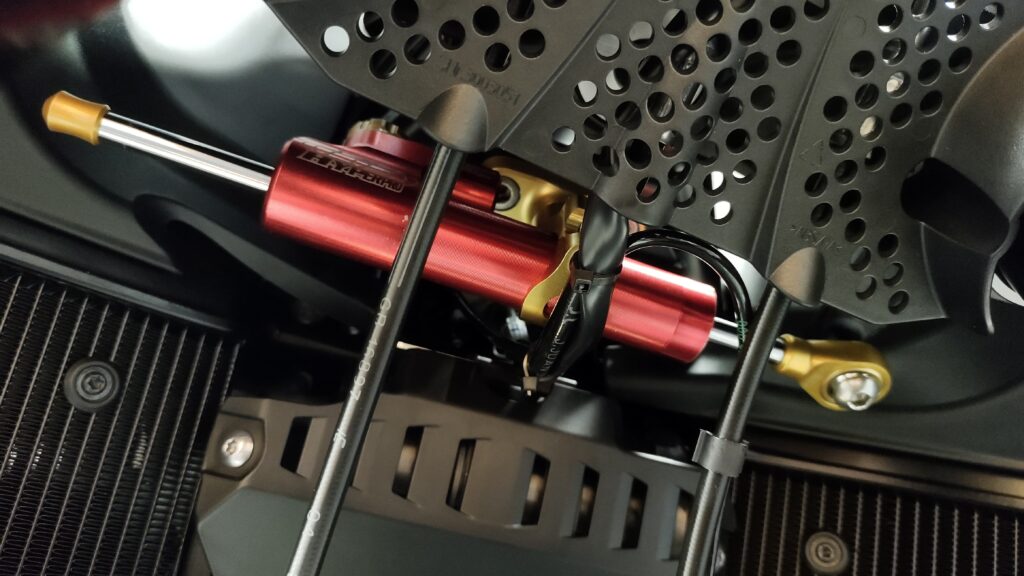
A steering damper significantly reduces the risk of a tank slapper and can prevent one from developing into a dangerous situation, but it does not eliminate the underlying cause. A steering damper works by adding resistance to rapid steering head movement, absorbing the oscillation energy before it can build into a full wobble. It is one of the most direct and effective tools for managing tank slapper risk.
The key is choosing a damper that responds proportionally to the speed of steering movement. A linear damper applies consistent resistance regardless of how fast the bars move, which works well in most situations. A progressive damper increases resistance as the movement speed increases, meaning it stays unobtrusive during normal riding but reacts forcefully when a wobble begins to develop. Both approaches reduce tank slapper risk; the progressive model simply does so with a more refined response curve.
It is worth noting that a steering damper is a safety supplement, not a substitute for correct suspension setup. If the root cause of instability is severely worn forks, incorrect spring rates, or damaged tyres, a damper alone will not fully solve the problem.
How does upgrading fork springs reduce tank slapper risk?
Upgrading to correctly rated fork springs reduces tank slapper risk by keeping the front wheel properly loaded and the fork geometry stable under hard acceleration. When fork springs are too soft, the front end rises excessively as weight transfers rearward, reducing front tyre contact and increasing the likelihood of oscillation. A stiffer, correctly matched spring rate maintains the front tyre’s contact patch and the fork’s position in its travel, giving the steering geometry the stability it needs.
Progressive-rate fork springs offer an additional advantage. They provide a softer initial response for comfort over small bumps, then progressively increase in stiffness as the fork compresses further. This means the fork resists bottoming out during hard acceleration while still absorbing minor road imperfections at lower compression depths. The result is a front end that feels planted and predictable rather than vague and reactive when you open the throttle hard.
Selecting the right spring rate requires matching it to your actual rider weight, riding gear weight, and riding style. A spring that is correct for one rider may be too soft or too stiff for another. Bike-specific fitment guides help narrow this down, and you can browse the full range of suspension components to find the right match for your model.
What should you do if a tank slapper happens while riding?
If a tank slapper happens while riding, the most important actions are to relax your grip on the handlebars, close the throttle smoothly, and avoid braking sharply. Tensing up and fighting the bars is the instinctive response, but it makes the oscillation worse by adding energy to the system rather than allowing it to damp out. A relaxed grip lets the steering self-correct as the oscillation loses energy.
Follow these steps if a tank slapper develops:
- Relax your arms: Loosen your grip immediately. Do not try to hold the bars still. Let them move while maintaining light contact.
- Roll off the throttle smoothly: Closing the throttle gradually shifts weight back to the front wheel and restores tyre contact. Snapping the throttle shut can cause a rear wheel lock-up that worsens the situation.
- Avoid braking: Hard braking during a wobble transfers weight abruptly and can amplify the oscillation or cause a crash. Wait until the bike has stabilized before applying brakes.
- Shift your weight forward slightly: If the riding position allows it, moving your body weight forward helps reload the front tyre and restore stability faster.
- Pull over safely: Once the bike stabilizes, find a safe place to stop and inspect the front end for obvious issues such as tyre pressure or loose components.
Surviving a tank slapper is possible with the right response, but experiencing one is a clear signal that your bike’s suspension setup deserves attention before your next ride.
How Hyperpro helps you ride without tank slappers
We design and manufacture suspension components specifically to address the causes of front-end instability, including tank slappers. Our product range gives you targeted solutions at every level of the problem:
- Progressive fork springs: Bike-specific spring rates that keep the front wheel loaded and the fork geometry stable under hard acceleration, reducing the conditions that trigger handlebar wobble.
- CSC steering damper (Constant Safety Control): A linear damping model adjustable in 22 positions, designed to absorb oscillation energy and prevent wobbles from developing into tank slappers.
- RSC steering damper (Reactive Safety Control): A progressive damping model that stays unobtrusive during normal steering but reacts with increasing resistance as movement speed rises, offering a more refined safety response.
- CNC-milled mounting kits: Model-specific, plug-and-play brackets in Hyperpro Gold or Black that require no drilling or cutting in 98% of applications, making installation straightforward.
Every product we make is developed to improve rider safety and confidence, not just performance numbers. If you want to find the right components for your bike or have questions about which setup suits your riding style, get in touch with us. To purchase, visit your nearest authorized Hyperpro distributor.