


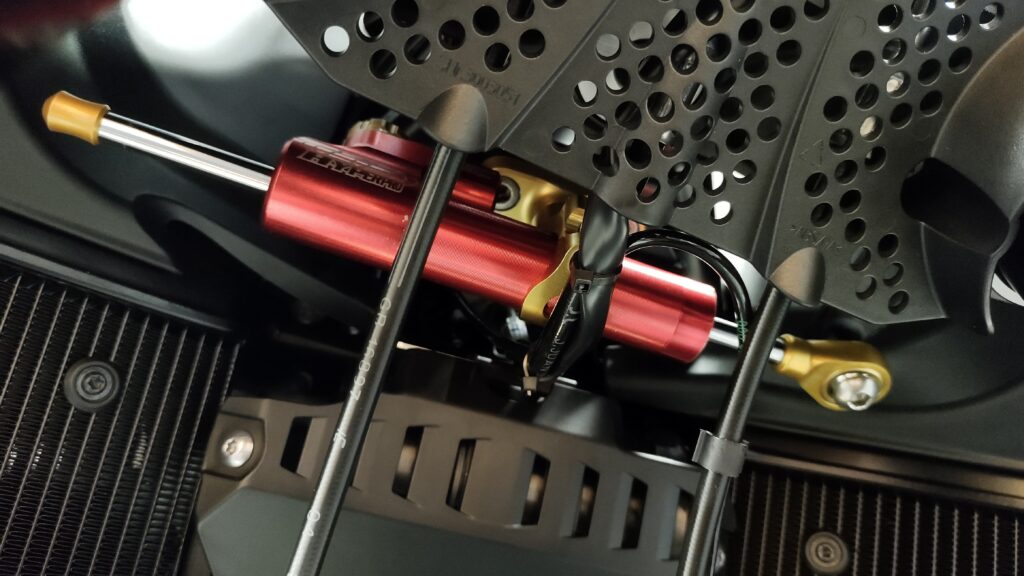
A reactive steering damper is more effective than a constant one because it automatically adjusts its resistance based on how fast the steering moves. At low speeds and during normal cornering, it stays light and unobtrusive. Under sudden, high-speed instability like a tank slapper, it stiffens instantly to protect you. A constant damper applies the same resistance regardless of the situation, which forces you to compromise between safety and feel. The sections below break down exactly how each type performs across real riding scenarios.
How does a reactive steering damper actually work?
A reactive steering damper works by using a progressive, speed-sensitive valve system that increases resistance in direct proportion to how fast the handlebar moves. Slow, deliberate steering inputs meet very little resistance. Rapid, uncontrolled movements trigger a much higher damping force automatically, without any manual adjustment from the rider.
The mechanism behind this is a fluid-filled cylinder with an internal valve designed to respond to flow rate rather than position. When you steer slowly through a corner, the fluid moves through the valve with minimal restriction. When the handlebar snaps violently, the fluid is forced through the valve at high speed, and the resistance rises sharply to absorb that energy before it can escalate into a full wobble or tank slapper.
This is what separates reactive damping from a simple hydraulic buffer. The damper is not set to a fixed resistance level. Instead, it reads the situation in real time and responds accordingly. The result is a system that effectively disappears during normal riding and activates precisely when you need it most.
You can explore the full range of Hyperpro steering dampers to see how this progressive damping principle is applied across different models and mounting configurations.
Hyperpro
Ride with confidence
Find the nearest Hyperpro dealer and start your motorcycle upgrade.
What are the main drawbacks of a constant steering damper?
The main drawback of a constant steering damper is that any setting you choose involves a trade-off. Set it firm enough to handle high-speed instability, and it makes the steering heavy and unresponsive at low speeds. Set it light enough for comfortable everyday riding, and it may not provide enough resistance when a tank slapper develops.
This compromise becomes most obvious in mixed riding conditions. A rider who commutes through town in the morning and hits a motorway in the afternoon is effectively using the wrong damper setting for at least half of the ride. Adjusting manually before each type of riding is impractical and something most riders simply do not do.
There are two specific problems that arise from running a constant damper at the wrong setting:
- Too much damping: The handlebar resists your steering inputs, which slows down your reactions in corners and makes the bike feel sluggish and unnatural to manoeuvre.
- Too little damping: The damper does not intervene quickly enough when a wobble starts, allowing instability to grow before the resistance builds.
A reactive damper eliminates this problem entirely because it does not require you to predict what kind of riding you will be doing. The response is automatic and proportional to the actual demand at any given moment.
What riding situations benefit most from reactive damping?
Reactive damping delivers the most noticeable benefit in situations where steering speed changes rapidly and unpredictably. High-speed riding on motorways, track days, and roads with surface imperfections all create conditions where instability can develop faster than a rider can react manually.
The following situations are where reactive damping provides a clear advantage over constant damping:
- Tank slappers at speed: When the front wheel loses grip briefly and the handlebar begins oscillating, the reactive damper stiffens immediately to absorb the energy before the oscillation amplifies.
- Sudden road surface changes: Hitting a pothole, a patch of gravel, or a bridge expansion joint at speed can send a sharp shock through the front end. Reactive damping absorbs the resulting steering disturbance without affecting the approach.
- Wheelie landings: When the front wheel returns to the ground after a wheelie, the steering can load up unevenly. A reactive damper manages that transition automatically.
- High-speed lane changes: Quick directional changes at motorway speeds involve fast handlebar movement, which the reactive system manages without making the bike feel stiff during the manoeuvre itself.
At the same time, reactive damping stays completely transparent during slow-speed manoeuvres like parking, U-turns, and low-speed cornering, where a constant damper set to a firm level would create noticeable resistance.
Does a reactive damper affect normal steering feel?
No, a reactive steering damper does not affect normal steering feel under ordinary riding conditions. Because the damping force only rises in response to fast handlebar movement, slow and deliberate steering inputs, which cover the vast majority of everyday riding, pass through the damper with minimal resistance.
This is one of the most important practical advantages of reactive over constant damping. Riders who switch from a constant damper often report that the reactive version feels as though it is not there at all during normal riding, which is exactly the intended behavior. You get the protection without the penalty.
The adjustability of the damper also plays a role here. Both the CSC and RSC models in our range offer 22 positions of adjustment, so you can fine-tune the baseline feel to suit your riding style and your specific motorcycle. Even at higher adjustment settings, the reactive system keeps low-speed steering light because the valve response is tied to movement speed, not to a fixed resistance level.
If you have previously avoided a steering damper because you were concerned about losing steering precision or natural feel, a reactive damper addresses that concern directly.
Which motorcycles are best suited to a reactive steering damper?
Reactive steering dampers are best suited to motorcycles that are ridden at higher speeds, carry a lighter front end, or are used in conditions where front-end instability is a realistic risk. Sport bikes, naked bikes, adventure bikes, and supermotards are the categories that benefit most, though the advantages apply to a wide range of machines.
The characteristics that make a motorcycle a strong candidate for a reactive damper include:
- High power-to-weight ratio: More powerful bikes are more likely to experience front-end lift and instability at speed, which reactive damping is specifically designed to manage.
- Sporty or aggressive geometry: Bikes with shorter wheelbases and steeper rake angles are inherently more sensitive to steering disturbances.
- Track or spirited road use: Any motorcycle used at or near its performance limits benefits from the additional safety margin a reactive damper provides.
- Adventure and dual-sport bikes: These bikes encounter unpredictable surfaces regularly, and reactive damping handles the resulting steering disturbances without interfering with the slower, deliberate steering needed off-road.
Cruisers and touring bikes with long wheelbases and relaxed geometry are less likely to experience acute instability, though they can still benefit from the vibration reduction a steering damper provides.
Fitment is straightforward for most models. Our CNC-milled mounting kits are designed for specific motorcycle models and require no drilling or cutting in 98% of applications, making the installation a plug-and-play process. You can browse the full range of motorcycle products to find the right fitment for your bike.
How we approach reactive steering control
Our RSC (Reactive Safety Control) steering damper is built around the progressive damping principle described throughout this article. It stays light and transparent during normal riding, then stiffens automatically when the handlebar moves at the speed associated with instability. Here is what makes it a practical upgrade for most riders:
- 22 positions of adjustment so you can dial in the baseline feel for your riding style
- Progressive valve technology that responds to steering speed, not position
- Model-specific CNC-milled mounting kits that fit without drilling or cutting in 98% of applications
- Available in Hyperpro Gold or Black to suit different aesthetics
- Designed to reduce tank slappers, wobbles, and handlebar vibration without compromising normal steering feel
If you want to know which steering damper fits your motorcycle or have questions about the right adjustment level for your riding, get in touch with us directly. Purchases are available through our authorised distributor network.