


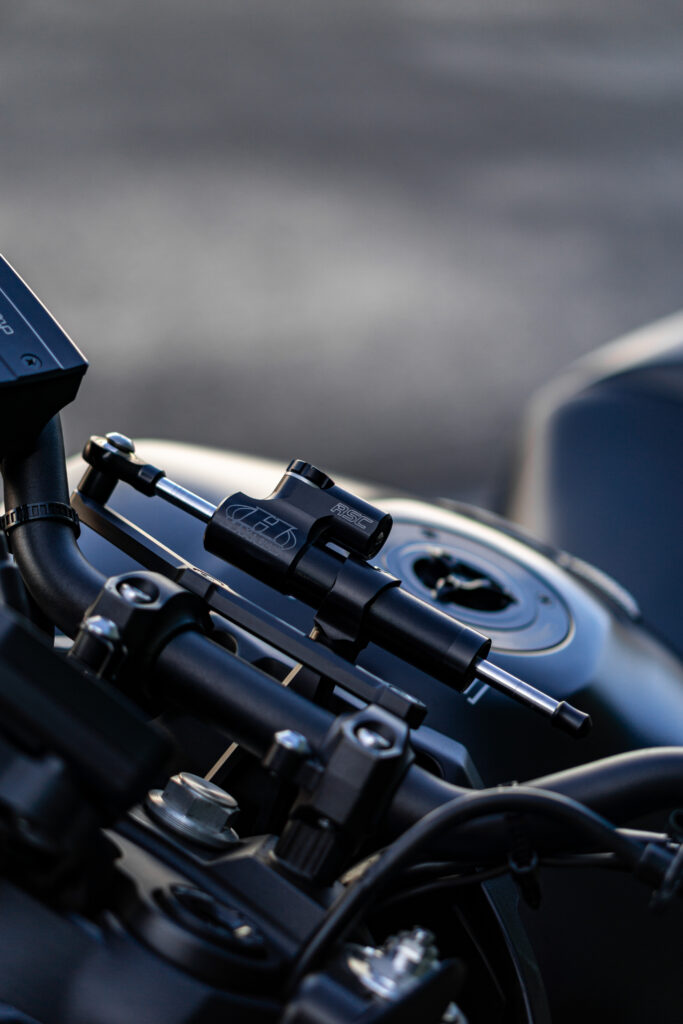
Not every touring motorcycle needs a steering damper, but many benefit significantly from one. Factory suspension setups on touring bikes are designed for average conditions and average loads, which means they often fall short when you add luggage, a passenger, or push into higher speeds on varied road surfaces. The sections below break down how steering dampers work, when they matter most, and what to look for when choosing one for your touring setup.
What does a steering damper actually do on a motorcycle?
A steering damper is a hydraulic device that resists sudden, uncontrolled movements of the handlebar without interfering with normal steering input. It absorbs the energy generated by rapid, unwanted oscillations in the front end, preventing those movements from amplifying into a full wobble or tank-slapper. It does not steer the bike for you; it simply filters out the harmful frequencies while leaving intentional steering input unaffected.
The damper connects between the steering head and the frame or between the fork and the frame, depending on the design. When the front wheel hits a bump, a rut, or a patch of uneven tarmac, the handlebar naturally wants to twitch. Without a damper, that twitch can feed back into the bars, the rider tenses up, and the oscillation grows. With a damper in place, the hydraulic resistance absorbs that initial impulse before it has the chance to develop into something dangerous.
Steering dampers are particularly relevant on heavier motorcycles because more mass means more momentum behind any unwanted movement. A touring bike loaded for a two-week trip is a very different machine from the same bike rolling out of the showroom, and a steering damper is one of the most direct ways to manage that difference.
Hyperpro
Ride with confidence
Find the nearest Hyperpro dealer and start your motorcycle upgrade.
Why are touring motorcycles more prone to steering instability?
Touring motorcycles are more prone to steering instability because they carry more weight, have a longer wheelbase, and are regularly ridden at sustained highway speeds with significant cargo. These factors combine to create conditions where the front end is more sensitive to road imperfections, crosswinds, and load shifts than a lighter, unloaded motorcycle would be.
The physics are straightforward. A heavier bike builds up more rotational momentum in the front wheel. When that wheel is deflected by a surface irregularity, the gyroscopic forces involved are greater, and the handlebar oscillation that follows carries more energy. A longer wheelbase also changes how weight is distributed between the axles, which affects how quickly and how severely the front end responds to disturbances.
Add a top box, two full panniers, and a passenger, and the bike’s center of gravity shifts. The suspension geometry the manufacturer engineered for a solo, unladen rider is now working outside its intended parameters. This is not a design flaw; it is simply a consequence of what touring motorcycles are built to do. The challenge is managing the stability implications that come with that versatility.
What causes speed wobble on a loaded touring bike?
Speed wobble on a loaded touring bike is caused by a self-reinforcing oscillation in the steering axis, where the front wheel steers slightly left, then corrects right, then overcorrects left again, with each cycle amplifying the last. On a loaded touring bike, this happens more easily because added weight reduces the damping effect of the front suspension and changes how quickly the steering head responds to disturbances.
Several specific factors can trigger or worsen speed wobble on a touring motorcycle:
- Uneven load distribution: Weight packed high or toward the rear shifts more load off the front wheel, reducing its contact patch and making it easier for the front end to oscillate.
- Worn or incorrectly inflated tyres: Tyres that are past their best or running at the wrong pressure respond unpredictably to road inputs, which can initiate wobble.
- Road surface irregularities: Expansion joints, rutted tarmac, and crosswind gusts can all provide the initial disturbance that sets off an oscillation cycle.
- Loose steering head bearings: Any mechanical play in the steering head gives the oscillation a starting point and reduces the natural damping the steering system provides.
- Speed: Wobble becomes more likely and more violent at higher speeds because there is more energy in the system when it starts.
A steering damper addresses the problem at its source by resisting the initial oscillation before it can build into something unmanageable. It does not fix underlying mechanical issues like worn bearings or poor tyre condition, but it provides a meaningful safety margin when road conditions or loading create instability.
Does every touring motorcycle come with a factory steering damper?
No, not every touring motorcycle comes with a factory steering damper. Some larger and more premium touring models include one as standard equipment, but many mid-range and entry-level touring bikes rely entirely on the geometry and weight of the steering system for stability. Whether a factory damper is fitted depends on the manufacturer’s assessment of the bike’s intended use and price positioning.
Even when a factory steering damper is present, it is often a fixed-rate unit with no adjustment. This means it is calibrated for a specific set of conditions, typically a solo rider at moderate load and speed. Riders who regularly carry a passenger, load the bike heavily for long tours, or ride at sustained motorway speeds may find that the factory unit does not provide enough resistance to be genuinely effective in all the situations they encounter.
Checking whether your specific model includes a factory damper is worth doing before assuming you are already protected. If your bike does not have one, or if the factory unit offers no adjustment, an aftermarket solution gives you far more control over how the front end behaves across different riding conditions.
When should a touring rider add an aftermarket steering damper?
A touring rider should consider adding an aftermarket steering damper when they regularly ride at highway speeds with a full load, have experienced front-end instability or wobble, or are riding a model that does not include a factory damper. It is also worth adding one if the factory unit fitted to the bike offers no adjustment and the rider frequently operates outside the conditions that unit was calibrated for.
Specific situations that make an aftermarket steering damper particularly relevant include:
- Two-up riding with luggage, where total weight is significantly higher than the solo unladen baseline
- Long motorway stages at consistent high speed, where sustained velocity increases the consequences of any front-end instability
- Riding on roads with poor or variable surface quality, where the frequency of disturbances to the front wheel is high
- Adventure touring that mixes tarmac with gravel or unpaved sections, where the front wheel encounters unpredictable inputs regularly
- After experiencing a tank-slapper or wobble, even a minor one, which indicates the current setup does not have sufficient margin for the conditions being ridden
An aftermarket damper with multiple adjustment positions lets you dial in the right level of resistance for the conditions rather than accepting a one-size compromise. This is particularly useful for touring riders whose daily riding environment changes significantly from one trip to the next.
What’s the difference between a rotary and a linear steering damper?
A rotary steering damper mounts at the steering head and works by rotating with the steering movement, using internal hydraulic resistance to control that rotation. A linear steering damper uses a rod-and-cylinder design, similar to a small shock absorber, and resists steering movement through linear compression and extension. Both reduce unwanted handlebar oscillation, but they differ in how they mount, how they feel, and how they respond across a range of steering inputs.
Rotary steering dampers
Rotary dampers sit compactly at the top of the steering head, which keeps them out of the way and makes them a clean fitment on many bikes. Because the damping force is applied directly at the axis of rotation, they respond consistently across the full range of steering movement. The trade-off is that a standard rotary unit applies the same level of resistance whether you are making a slow-speed U-turn or correcting a high-speed wobble, which can make low-speed manoeuvring feel slightly heavy if the damping is set high.
Linear steering dampers
Linear dampers use a cylinder mounted between the steering head and the frame or fork. They are well proven and widely used, and they offer a familiar feel for riders who have experience with conventional damper technology. Progressive linear designs can vary their resistance depending on the speed and magnitude of the steering input, which means they can be set to allow easy low-speed steering while still providing firm resistance against the rapid, high-energy movements that cause wobble.
We offer both approaches across our damper range. The CSC (Constant Safety Control) model uses linear damping with 22 adjustment positions, while the RSC (Reactive Safety Control) model uses progressive damping that increases resistance proportionally to the speed of the steering input. Both are available with model-specific mounting kits that fit without drilling or cutting in the vast majority of applications, making installation straightforward for most touring models.
How we approach steering dampers for touring riders
We design our steering dampers specifically to address the real-world conditions that touring riders face: variable loads, sustained speeds, and roads that do not always cooperate. Here is what our damper systems offer:
- Two damping models: The CSC provides consistent linear damping across all steering inputs; the RSC uses progressive damping that scales its resistance to match the intensity of the movement, offering lighter steering at low speed and firmer control when it matters most.
- 22 adjustment positions: Both models allow precise tuning so you can match the damping level to your load, your route, and your riding style.
- Model-specific mounting kits: CNC-milled brackets designed for your exact bike, available in Hyperpro Gold or Black, with plug-and-play fitment that requires no drilling or cutting in 98% of applications.
- Broad model coverage: Our range covers a wide selection of touring and adventure touring motorcycles, with fitment guides to help you identify the right combination for your bike.
If you want to know which damper and mounting kit fits your touring motorcycle, get in touch with us and we will point you in the right direction. Purchases are handled through our authorised distributor network, so you get the right product with the right support from day one.