


A tank slapper and a speed wobble are not the same thing, though they are closely related. A tank slapper is a severe, rapid oscillation of the handlebars where the bars swing violently from side to side, sometimes striking the fuel tank. A speed wobble is a broader term for any self-sustaining oscillation in the steering, which can range from mild to severe. In short, every tank slapper is a speed wobble, but not every speed wobble becomes a tank slapper.
The distinction matters because the causes, severity, and recovery techniques differ. This article works through the key questions riders ask about both phenomena, from what triggers them to how suspension upgrades reduce the risk.
What actually happens during a tank slapper?
During a tank slapper, the front wheel loses traction or contact with the road surface briefly, and when it reconnects, the steering geometry cannot self-correct quickly enough. The handlebars begin oscillating left and right at high frequency, often fast enough that the bars physically strike the sides of the fuel tank. The rider’s arms are thrown around, making control extremely difficult to maintain.
The oscillation typically begins at the front wheel and feeds through the fork, headstock, and handlebars. Without intervention, each swing can amplify the next rather than damping out, which is what makes a tank slapper so dangerous. The event often happens in fractions of a second, and at speed, the rider has very little time to react before the bike becomes unmanageable.
Tank slappers most commonly occur after a jump, a wheelie landing, hitting a sharp bump at speed, or when the front wheel suddenly regains grip after a slide. Any situation that briefly unloads the front wheel and then reloads it abruptly creates the conditions for the handlebars to begin their violent swing.
What causes a speed wobble on a motorcycle?
A speed wobble on a motorcycle is caused by an imbalance between the forces that destabilize the steering and the forces that naturally return it to center. When the destabilizing forces win, the front end begins to oscillate. The most common triggers include uneven road surfaces, incorrect tire pressure, worn or mismatched tires, improper wheel alignment, and aerodynamic disturbances at high speed.
Hyperpro
Ride with confidence
Find the nearest Hyperpro dealer and start your motorcycle upgrade.
Rider input also plays a role. Gripping the bars too tightly can actually make a wobble worse by transferring tension into the steering rather than allowing the geometry to self-correct. Loose or worn steering head bearings, a bent fork leg, or an out-of-balance wheel can all lower the threshold at which a wobble starts.
Speed is a significant factor too. Many motorcycles have a natural resonance frequency in their steering geometry that aligns with a specific speed range. Riding through that range, particularly on a bumpy road or under acceleration, can trigger the oscillation. This is why speed wobbles often appear suddenly at a particular point in a straight-line run rather than building gradually.
What’s the difference between a tank slapper and a speed wobble?
The key difference between a tank slapper and a speed wobble is severity and cause. A speed wobble is a self-sustaining oscillation in the steering that can be mild or severe. A tank slapper is specifically the extreme version where the bars swing so violently they hit the tank, usually triggered by a sudden, sharp disturbance such as a front wheel lifting and landing rather than a gradual buildup of oscillation.
Think of it this way: a speed wobble can sometimes resolve itself or be managed by the rider before it escalates. A tank slapper typically arrives with full force almost immediately, giving the rider far less time to respond. The forces involved in a tank slapper are also greater, making it harder to maintain grip on the bars without being thrown off.
Another practical difference is the trigger. Speed wobbles often develop at a specific speed on a straight road and can be linked to tire or wheel issues. Tank slappers are more commonly associated with abrupt changes in front wheel load, such as landing from a jump, cresting a rise at speed, or hitting a pothole that momentarily lifts the front end. Both are dangerous, but the tank slapper is the more acute and immediately life-threatening event.
What suspension issues make wobbles more likely?
Worn or incorrectly set-up suspension makes speed wobbles and tank slappers significantly more likely because the fork and shock are responsible for keeping the tires in contact with the road and absorbing the inputs that trigger oscillation. When suspension cannot do that job properly, the front wheel is more likely to lose and regain grip in a way that starts the steering swinging.
Specific suspension problems that increase wobble risk include:
- Fork springs that are too soft: The front end dives under braking or over bumps, unloading the wheel unpredictably.
- Worn fork seals and low oil levels: Reduced damping means the fork cannot control rebound, allowing the wheel to bounce rather than track the surface.
- Incorrect preload settings: Too little preload causes excessive sag and poor geometry; too much makes the suspension harsh and unable to absorb small bumps.
- Mismatched spring rates front and rear: When the front and rear suspension are not balanced, weight transfer under braking or acceleration becomes unpredictable.
- Worn shock absorber internals: A rear shock that cannot control rebound allows the rear to step out, which can feed instability forward into the steering.
Factory suspension is often a compromise tuned for an average rider weight and riding style. Riders who are heavier, faster, or more aggressive than that average will frequently find the standard setup inadequate, which is one reason aftermarket suspension components are worth considering for anyone who rides hard.
How do you recover from a tank slapper while riding?
To recover from a tank slapper, the most important action is to avoid fighting the bars. Grip the tank firmly with your knees, keep your weight low and centered, and allow your arms to follow the bar movement rather than resist it. At the same time, smoothly reduce throttle to transfer weight back onto the front wheel, which helps restore traction and allows the steering geometry to self-correct.
Resisting the urge to grab the brakes hard is important. Sudden braking during a tank slapper can shift weight forward abruptly, changing the geometry in a way that worsens the oscillation. Smooth, progressive deceleration is far safer than an emergency stop mid-wobble.
If the bike has enough road ahead and the wobble does not escalate, many tank slappers will resolve themselves once the front wheel regains consistent grip and speed drops into a more stable range. The rider’s job is to stay as neutral as possible, keep knees on the tank for stability, and avoid any sudden inputs that could amplify the oscillation. Riding gear that allows freedom of movement in the upper body also helps, since a stiff jacket can restrict the natural arm movement that absorbs some of the bar swing.
Can suspension upgrades prevent tank slappers and speed wobbles?
Yes, the right suspension upgrades can significantly reduce the frequency and severity of tank slappers and speed wobbles. Upgraded fork springs, correctly rated for your weight and riding style, keep the front wheel in better contact with the road and reduce the sudden load changes that trigger oscillation. A quality rear shock with proper damping control keeps the chassis balanced, which lowers the overall instability that feeds into the steering.
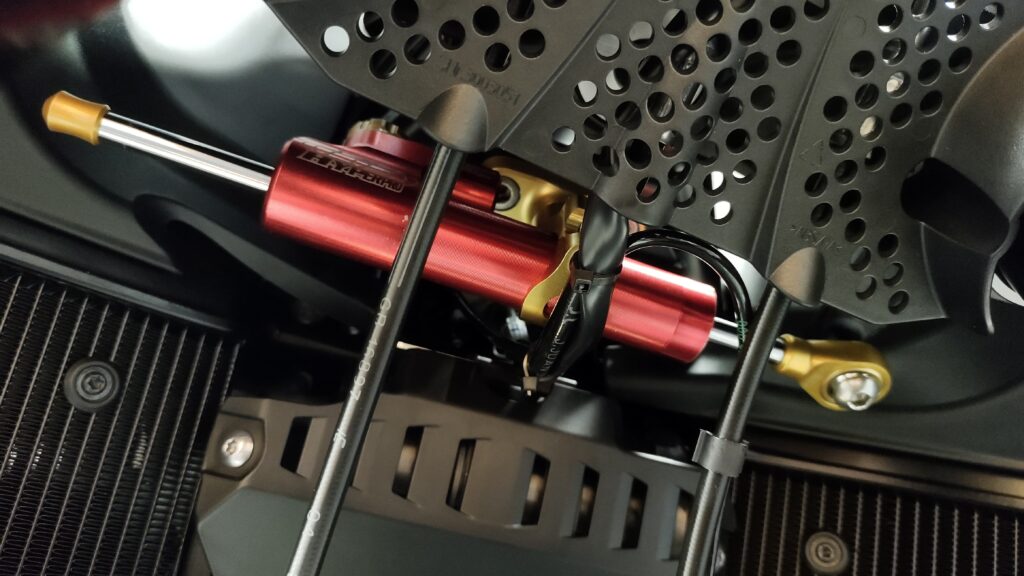
However, the single most direct upgrade for preventing tank slappers is a steering damper. A steering damper adds resistance to rapid steering movement without interfering with normal slow steering inputs. When the handlebars begin to oscillate rapidly, the damper absorbs that energy and prevents the oscillation from amplifying into a full tank slapper.
How Hyperpro helps you ride with more control
We design and manufacture suspension components and steering dampers specifically to address the instability problems described in this article. Our product range gives riders practical, bike-specific solutions rather than generic parts that require extensive modification.
- CSC Steering Damper (Constant Safety Control): A linear damping model adjustable in 22 positions, designed to reduce wobbles and vibrations across a wide range of riding conditions.
- RSC Steering Damper (Reactive Safety Control): A progressive damping model, also adjustable in 22 positions, that responds proportionally to the speed and force of steering movement, offering more natural feel during normal riding while providing stronger resistance during a wobble event.
- Model-specific mounting kits: CNC-milled, plug-and-play mounting kits available for a wide range of motorcycle models, requiring no drilling or cutting in 98% of applications.
- Fork springs and shock absorbers: Progressive-rate springs and shock absorbers matched to your bike model and rider weight, available through our full product catalog.
Purchases are made through our authorized distributor network. If you have questions about which products suit your bike and riding style, contact us and we will point you in the right direction.