


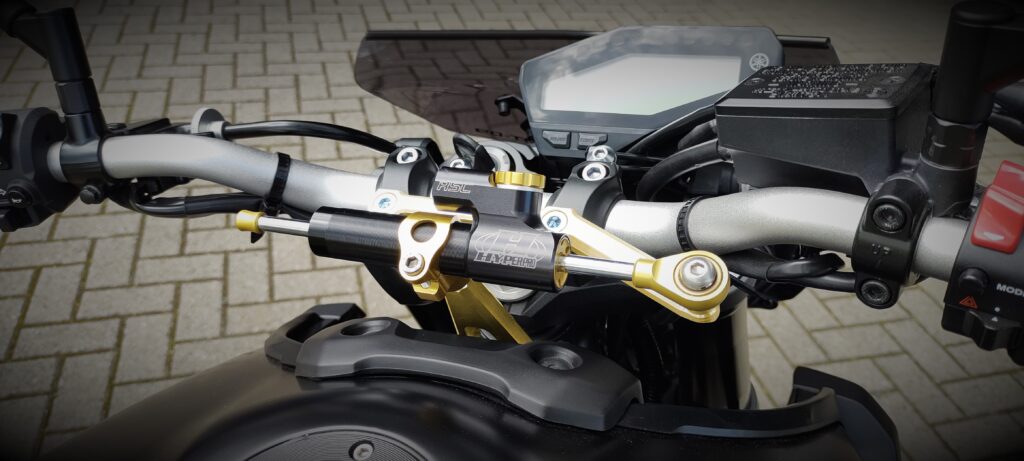
Yes, a steering damper can prevent handlebar shake on bumpy roads. It works by adding controlled resistance to the steering axis, absorbing the rapid oscillations that rough surfaces send through the front wheel before they can build into a full wobble. That said, a damper addresses the symptom of instability, not always the root cause, so understanding what triggers handlebar shake in the first place helps you make the right upgrade decision. The sections below walk through the mechanics, the limits, and the best situations to fit one.
What actually causes handlebar shake on bumpy roads?
Handlebar shake on bumpy roads happens when the front wheel deflects off an uneven surface and the steering geometry briefly loses its self-correcting balance. Instead of returning smoothly to centre, the wheel oscillates side to side in rapid, repeating movements. If those oscillations align with the natural frequency of the front end, they can amplify into a full tank-slapper within seconds.
Several factors make a motorcycle more vulnerable to this kind of instability. Worn or under-damped fork internals allow the front end to move too freely over rough surfaces. Tyre wear, incorrect tyre pressure, or a tyre that has developed a flat spot all reduce the contact patch’s ability to track consistently. Steering head bearing play, loose axle clamps, or misaligned wheels introduce mechanical slop that amplifies small deflections. Riding speed also matters: the faster you travel, the less time the geometry has to self-correct between bumps, and the more energy each deflection carries.
Understanding these causes matters because a steering damper targets the oscillation itself, but worn bearings or incorrect tyre pressure need to be resolved separately before any suspension upgrade delivers its full benefit.
Hyperpro
Ride with confidence
Find the nearest Hyperpro dealer and start your motorcycle upgrade.
How does a steering damper reduce handlebar oscillation?
A steering damper reduces handlebar oscillation by applying hydraulic resistance to rotational movement around the steering axis. When the front wheel deflects and begins to oscillate, the damper absorbs the energy of each swing before it can grow in amplitude. The result is that small wobbles are suppressed rather than allowed to build into dangerous handlebar shake.
The key is that the damper responds proportionally to the speed of movement, not to steering input itself. Slow, deliberate steering inputs, such as turning into a corner, meet very little resistance. Rapid, unintended oscillations, the kind that bumpy roads generate, encounter significantly more damping force. This distinction is what makes a well-designed damper safe to use without compromising everyday manoeuvrability.
Damping technology has developed considerably, and the difference between a basic linear model and a progressive damper is noticeable in real riding conditions. A linear damper applies the same resistance across all movement speeds, while a progressive damper increases its resistance as oscillation speed rises, offering a more nuanced response that adapts to the severity of the instability.
Does a steering damper fix all types of handlebar shake?
A steering damper does not fix all types of handlebar shake. It is effective against oscillation-driven wobbles where the steering axis is actively moving, such as tank-slappers triggered by bumps, surface irregularities, or speed. It is not a substitute for addressing mechanical faults that generate instability in the first place.
Handlebar vibration caused by engine harmonics, for example, transmits through the frame and bars rather than through steering movement, so a damper has little effect on it. Similarly, shimmy caused by severely worn steering head bearings, a badly balanced wheel, or a damaged tyre requires those components to be repaired or replaced. A damper fitted on top of a mechanical fault will reduce the visible symptom but will not resolve the underlying problem, which can still create dangerous handling at the wrong moment.
Think of a steering damper as a safety net for dynamic instability, not a diagnostic fix. Use it alongside properly maintained suspension, correctly inflated and undamaged tyres, and tight, play-free steering head bearings for the best result.
What’s the difference between a steering damper and upgraded fork springs?
A steering damper and upgraded fork springs address handlebar stability from different directions. Fork springs control how the front suspension compresses and rebounds under load, directly affecting ride quality and chassis attitude. A steering damper controls rotational movement at the steering axis, suppressing oscillations that the suspension geometry alone cannot eliminate. Both improve stability, but they do different jobs.
Upgraded fork springs, particularly progressive-rate springs, improve the front end’s ability to absorb bumps progressively, which reduces the severity of deflections that reach the steering geometry in the first place. If your forks bottom out, feel vague over mid-corner bumps, or dive heavily under braking, spring upgrades are the more direct solution. You can explore the full range of suspension upgrade options to find the right starting point for your bike.
A steering damper, by contrast, is the right tool when the suspension is functioning well but the bike still develops oscillations at speed or over rough surfaces. Many riders benefit from both: improved springs reduce the energy entering the system, and a damper handles any residual oscillation that gets through. The two upgrades complement each other rather than compete.
When should you fit a steering damper to your motorcycle?
You should fit a steering damper when your motorcycle develops handlebar oscillations or wobbles at speed, particularly over rough or uneven road surfaces, and when the bike’s mechanical components are already in good condition. It is also a sensible upgrade if you ride at higher speeds regularly, carry a pillion or luggage that shifts the weight distribution, or have modified the bike in ways that affect front-end geometry.
Certain motorcycle types benefit more than others. Naked bikes and streetfighters with wide handlebars are more exposed to oscillation forces than fully faired machines. Adventure bikes ridden on mixed surfaces encounter more frequent deflections. Sport bikes pushed hard on track days generate higher speeds where wobbles escalate faster. In all these cases, a steering damper adds a meaningful layer of control.
Before fitting one, confirm that your steering head bearings are tight, your tyres are in good condition and correctly inflated, and your wheels are properly balanced. A damper fitted to a mechanically sound motorcycle delivers its full benefit. Fitted to a neglected one, it masks problems that need attention.
How Hyperpro helps with steering stability
We design and manufacture steering dampers specifically to address the kind of handlebar instability described throughout this article. Our range includes two models built around different damping philosophies:
- CSC (Constant Safety Control): A linear damping model that applies consistent resistance across all steering movement speeds, adjustable across 22 positions to suit your riding style and road conditions.
- RSC (Reactive Safety Control): A progressive damping model that increases resistance as oscillation speed rises, delivering a more adaptive response to severe instability without interfering with normal steering at lower speeds.
Both dampers are paired with CNC-milled, model-specific mounting kits available in Hyperpro Gold or Black. These are plug-and-play fitments that require no drilling or cutting in 98% of applications, so installation is straightforward and reversible. If you want to know more about which setup suits your motorcycle, get in touch with us. Purchases are available through our authorised distributor network.