


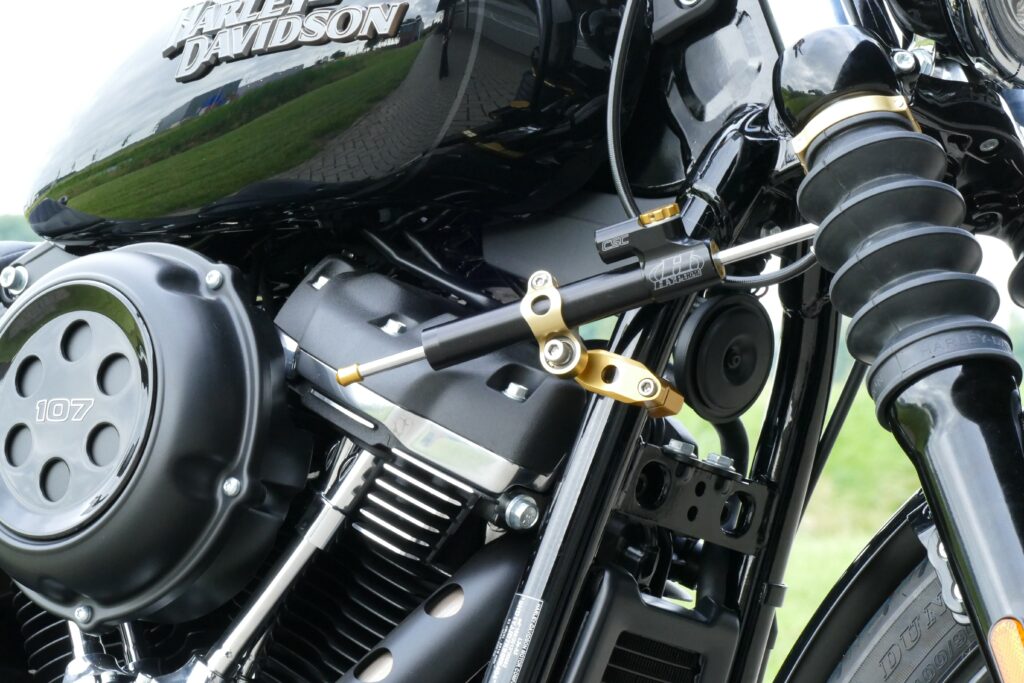
If your motorcycle starts to tank slap, stay calm, keep a firm but relaxed grip on the bars, and avoid braking or accelerating sharply. The worst thing you can do is fight the handlebar movement or panic-brake, as either reaction can amplify the oscillation rather than dampen it. Below, we unpack exactly what causes tank slappers, how to handle them in the moment, and what you can do to reduce the risk of it happening again.
What actually causes a motorcycle to tank slap?
A tank slap occurs when the front wheel loses contact with the road surface and then lands out of alignment, triggering a rapid side-to-side oscillation of the handlebars. The root cause is a momentary loss of front wheel traction or load, which removes the self-correcting force that normally keeps the steering stable. Once the oscillation begins, it can build in frequency and amplitude within fractions of a second.
The most common trigger is the front wheel lifting during hard acceleration, particularly out of corners or over crests and bumps. When the wheel comes back down at a slight angle, the geometry of the steering tries to self-correct, but if the speed and the bike’s geometry are not working in your favour, that correction overshoots and the bars snap the other way. This cycle repeats rapidly, which is why the phenomenon is also called a tank slapper or speed wobble.
Other contributing factors include uneven road surfaces at speed, a sudden weight shift, or aerodynamic disturbances such as crosswinds or the turbulence caused by overtaking a large vehicle. In all cases, the underlying mechanism is the same: the front end loses its stable feedback loop with the road.
Hyperpro
Ride with confidence
Find the nearest Hyperpro dealer and start your motorcycle upgrade.
How should you react when a tank slap starts?
When a tank slapper begins, grip the bars firmly but do not resist the movement, roll off the throttle smoothly, and let the bike settle without applying the brakes. Your instinct may be to fight the bars or grab a handful of brake, but both reactions inject additional forces into an already unstable system and can make the wobble worse or cause a crash.
Here is what to focus on in those critical seconds:
- Keep your grip firm but not rigid. A death grip transmits more of your body’s reaction forces into the bars. Firm pressure absorbs the movement without amplifying it.
- Roll off the throttle gradually. Reducing power shifts weight forward, reloading the front tyre and restoring traction. Do this smoothly, not abruptly.
- Keep your elbows slightly bent. Locked elbows make you a rigid part of the oscillating system. Bent elbows act as a natural damper.
- Do not brake hard. Hard braking, especially at the rear, can destabilise the bike further. If you need to slow down, do so gently and progressively after the wobble has settled.
- Look where you want to go. Keep your eyes focused on the road ahead, not on the handlebars. This helps your body make instinctive, balanced corrections.
In most cases, a tank slap resolves itself within one to two seconds if you do not interfere with it. The danger is almost always the rider’s reaction rather than the wobble itself.
Why do some motorcycles tank slap more than others?
Some motorcycles are more prone to tank slappers because of their geometry, weight distribution, and intended use. Bikes with a longer wheelbase, heavier front end, and lower centre of gravity are generally more stable at speed. Lightweight, high-powered sport bikes with aggressive geometry are more susceptible because the steering is designed for quick, responsive input rather than passive stability.
Several design factors influence how prone a particular model is to speed wobbles:
- Rake and trail: A steeper steering angle (less rake) makes a bike more agile but reduces straight-line stability. Reduced trail means the self-correcting force from the front tyre is weaker.
- Wheelbase length: A shorter wheelbase means the front and rear wheels are closer together, reducing the gyroscopic stability that helps resist oscillation.
- Weight distribution: Bikes that carry more weight over the rear have less natural load on the front tyre, which reduces front-end grip and stability.
- Tyre profile: A rounder tyre profile can make the bike feel more agile in corners but can also make it less stable in a straight line at high speed.
Factory suspension setup also plays a significant role. Many production bikes are tuned for a wide range of riders and road conditions, which means the suspension may not be optimally set up for your weight, riding style, or preferred roads.
Can worn or soft suspension cause tank slap?
Yes, worn or poorly set-up suspension is one of the most common contributing factors to tank slappers. When the front forks are too soft, have excessive play, or are worn beyond their effective service life, they cannot control the wheel’s movement quickly enough after it lands from a bump or wheelie. This delay in damping is exactly what allows an oscillation to build rather than dissipate.
Soft or worn suspension fails in two specific ways that directly increase tank slap risk:
- Insufficient damping: Damping controls how quickly the fork compresses and rebounds. When damping is worn or set too low, the fork rebounds too fast after a bump, momentarily unloading the front tyre and creating the conditions for a wobble to start.
- Weak spring rate: A spring that is too soft for the rider’s weight allows excessive fork dive under braking and insufficient resistance when the front wheel returns to the ground after lifting. This reduces the predictability of front-end behaviour at speed.
Checking your suspension for wear and ensuring it is correctly set up for your weight and riding style is one of the most effective steps you can take to reduce the likelihood of a tank slapper. If your forks feel vague, wallowy, or unpredictable at speed, that is a strong signal that an upgrade or service is overdue. Explore the full range of suspension components and upgrades to find the right fit for your bike.
What suspension upgrades reduce the risk of tank slap?
Upgrading to progressive-rate fork springs and a higher-quality rear shock absorber directly reduces the risk of tank slappers by improving the front end’s ability to maintain consistent tyre contact with the road. Progressive springs increase their resistance as they compress, which means the fork responds predictably to both small bumps and large impacts without bottoming out or rebounding uncontrollably.
The most effective suspension upgrades for tank slap prevention focus on the front end, since that is where the oscillation originates:
- Progressive-rate fork springs: These replace the standard linear springs with units that become progressively stiffer as they compress. This gives you a supple initial response over small bumps while preventing excessive dive under braking or after a wheelie landing.
- Upgraded fork oil: Changing to the correct viscosity fork oil restores damping performance that has degraded over time. This is often the cheapest and most immediate improvement you can make.
- Rear shock upgrade: A stiffer, better-damped rear shock keeps the chassis geometry more consistent under acceleration, which reduces the likelihood of the front wheel lifting in the first place.
- Correct setup for your weight: Even high-quality suspension components need to be set up correctly. Preload, compression, and rebound settings should reflect your body weight and riding style.
Should you fit a steering damper to prevent tank slap?
Fitting a steering damper is one of the most direct and effective ways to reduce the risk of tank slappers. A steering damper adds resistance to rapid, unintended handlebar movement without interfering with normal, intentional steering input. This means it allows you to steer the bike as usual but intervenes when the bars try to oscillate at speed.
Not all steering dampers work the same way. A linear damper applies a consistent level of resistance across all steering speeds, which is effective but can feel slightly heavy at low speed. A progressive damper, by contrast, applies light resistance during normal riding and significantly higher resistance during fast, unintended oscillations. This makes it more transparent in everyday use while still protecting you when a wobble starts.
A steering damper is particularly worth fitting if you ride at high speeds regularly, if your bike has geometry that makes it naturally more prone to wobbles, or if you have already experienced a tank slapper on your current machine. It is also a sensible addition after a suspension upgrade, as the two systems work together to give you the most stable and confidence-inspiring front end possible.
How Hyperpro helps you ride without fear of tank slappers
We design suspension systems and steering dampers specifically to address the conditions that lead to tank slappers. Our products give you the mechanical confidence to ride at the limit without worrying about instability taking over.
- CSC steering damper: Our Constant Safety Control model uses linear damping, adjustable across 22 positions, to reduce wobbles, vibrations, and tank slappers on a wide range of motorcycles.
- RSC steering damper: Our Reactive Safety Control model uses progressive damping, also adjustable in 22 positions, so the damper stays light during normal riding and reacts firmly when an oscillation begins.
- Model-specific mounting kits: We manufacture CNC-milled mounting kits designed for your exact bike. In 98% of applications, fitment requires no drilling or cutting, making installation straightforward.
- Progressive fork springs: Our bike-specific fork springs improve front-end control and reduce the conditions that allow a tank slap to develop in the first place.
If you want to find the right steering damper or suspension upgrade for your motorcycle, contact us via our contact page and we will point you in the right direction. To purchase, visit one of our authorised distributors, who can advise you on the correct specification for your bike and riding style.