


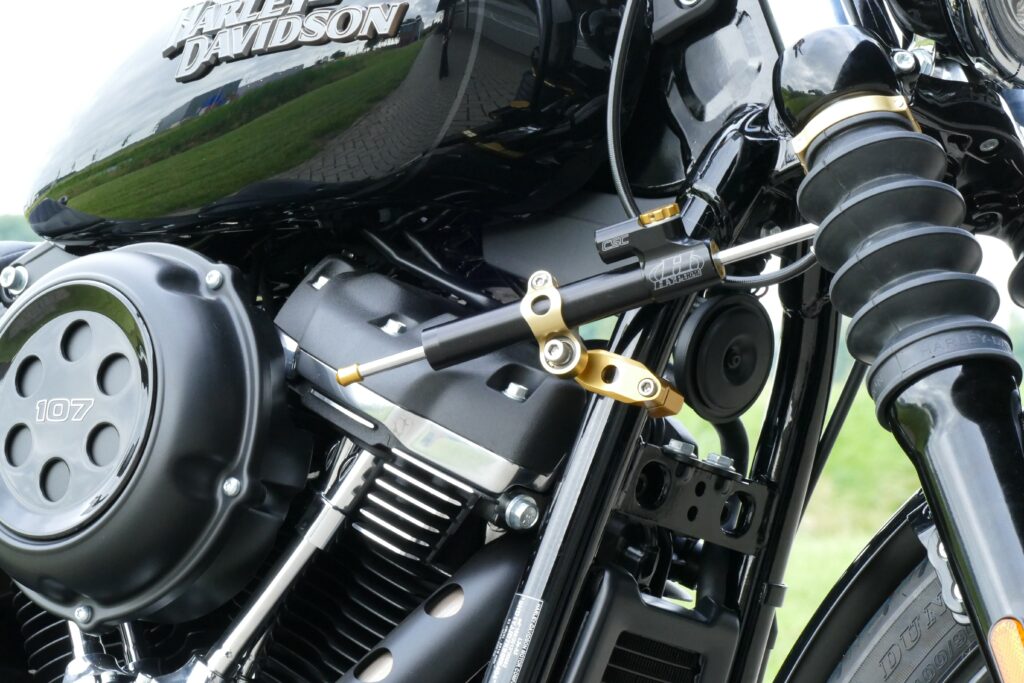
Yes, a tank slapper can damage your motorcycle. The violent, rapid oscillation of the handlebars places extreme stress on the front end, and if the wobble escalates rather than self-corrects, it can cause structural damage to the frame, forks, and steering components. In the worst cases, it leads to a crash that causes far more damage than the wobble itself. Below, we break down exactly what happens, what causes it, and how you can reduce the risk.
What actually happens to a motorcycle during a tank slapper?
During a tank slapper, the front wheel loses contact with or traction on the road surface and begins oscillating rapidly from side to side. The handlebars swing back and forth in violent, uncontrolled movements, sometimes fast enough to strike the rider’s thighs or tank. The entire front end of the motorcycle experiences repetitive, high-frequency stress loads that it is not designed to sustain for extended periods.
The oscillation is self-reinforcing in its early stages. Each swing of the wheel shifts weight and geometry slightly, which feeds the next swing. The frequency of a tank slapper typically falls in a range that can excite the natural resonance of the frame and steering assembly, meaning the wobble can amplify rather than decay if nothing interrupts it. Riders often describe the sensation as the bike trying to throw them off while simultaneously fighting every attempt to correct it.
The physical forces involved are significant. The handlebars, stem, fork tubes, wheel bearings, and headstock all absorb repeated lateral shock loads during the event. Even a tank slapper that lasts only a few seconds generates enough stress to accelerate wear on these components.
Hyperpro
Ride with confidence
Find the nearest Hyperpro dealer and start your motorcycle upgrade.
Can a tank slapper damage your motorcycle’s frame or components?
A tank slapper can damage several components on your motorcycle, particularly if the wobble is severe or prolonged. The most vulnerable parts are the steering head bearings, fork tubes, handlebar clamps, and the headstock area of the frame. Repeated lateral stress loads can crack or deform metal, loosen fasteners, and accelerate bearing wear in ways that are not always immediately visible after the event.
Frame damage from a single tank slapper is less common unless the bike makes contact with another surface during the wobble, but it is not impossible on motorcycles with lighter or older frames. More typically, the damage accumulates over time if a rider experiences repeated wobbles without addressing the underlying cause. Steering head bearings are particularly susceptible because they are designed to handle the smooth, controlled steering inputs of normal riding, not rapid lateral hammering.
After experiencing a significant tank slapper, it is worth inspecting the following:
- Steering head bearings for play or roughness
- Fork tubes for bending or seal damage
- Handlebar clamps and risers for loosening or cracking
- Wheel bearings for increased play
- Tyre condition, particularly for flat spots or sidewall stress
If any of these show signs of damage or unusual wear, have them inspected by a qualified mechanic before riding again. Riding on compromised steering components significantly raises the risk of a repeat incident.
What causes a tank slapper in the first place?
A tank slapper is caused by the front wheel losing its stable contact patch with the road, triggering an uncontrolled oscillation in the steering geometry. The most common trigger is the front wheel lifting off the ground, either from acceleration, a jump, or a bump, and then landing at a slight angle. When the wheel touches down misaligned, the steering geometry tries to self-correct but overshoots, starting the back-and-forth cycle.
Several factors make a tank slapper more likely to occur or harder to control once it starts:
- High speed: The faster you are travelling, the more energy is available to sustain and amplify the oscillation.
- Worn or incorrect tyres: Tyres that are worn unevenly, underinflated, or mismatched to the bike’s geometry reduce the front wheel’s ability to track straight.
- Incorrect suspension setup: Springs that are too soft, damping that is insufficient, or a suspension setup that does not match the rider’s weight all reduce the front end’s ability to recover from disturbances quickly.
- Loose steering head bearings: Even small amounts of play in the steering head allow the wheel to deviate more freely, making oscillation easier to initiate.
- Sudden throttle inputs: Aggressive acceleration shifts weight to the rear, unloading the front wheel and reducing its grip and stability.
- Road surface irregularities: Potholes, expansion joints, gravel, and road camber changes can all displace the front wheel enough to start the cycle.
Understanding the cause is important because most tank slappers are not random. They tend to happen to riders whose bikes have one or more of these risk factors already present, and the triggering event simply reveals the underlying instability.
How does a steering damper reduce tank slapper risk?
A steering damper reduces tank slapper risk by adding controlled resistance to the lateral movement of the steering assembly. When the front wheel begins to oscillate, the damper absorbs the energy of each swing and slows the rate at which the handlebars can move from side to side. This resistance interrupts the self-reinforcing cycle of the wobble before it can build into a full tank slapper.
The key distinction between a basic damper and a more sophisticated one lies in how that resistance is applied. A linear damper provides consistent resistance at all steering speeds, which works well under normal conditions but can feel stiff during low-speed manoeuvring. A progressive damper, by contrast, applies light resistance during slow, deliberate steering inputs and increases resistance sharply as the speed of the steering movement rises, which is exactly what happens during a wobble. This means the damper stays out of the way when you are parking or filtering, but intervenes effectively when a tank slapper begins.
Steering dampers do not prevent the conditions that cause a tank slapper. They do not fix worn tyres, loose bearings, or incorrect suspension setup. What they do is give the rider and the bike a better chance of recovering from a disturbance before it escalates into a dangerous event. On motorcycles prone to high-speed instability, or ridden at track speeds, a steering damper is one of the most directly effective safety additions available.
Can upgrading your suspension prevent a tank slapper?
Upgrading your suspension reduces the likelihood of a tank slapper by improving how quickly and accurately the front end responds to road disturbances. Better suspension keeps the front wheel in firmer contact with the road, reduces the chance of the wheel lifting or deflecting off course, and helps the bike recover from disturbances before they escalate. It does not make tank slappers impossible, but it meaningfully lowers the risk.
Factory suspension on most production motorcycles is a compromise. It is tuned to suit a broad range of riders and road conditions, which often means the spring rate and damping are not optimised for any specific rider’s weight, riding style, or the roads they actually use. A front end that is too soft will dive under braking, compress heavily over bumps, and give the wheel less geometric stability on landing. A rear end that is too stiff or too soft shifts weight distribution in ways that affect front wheel load and therefore steering stability.
Progressive-rate fork springs, for example, provide lighter resistance through the initial stroke for comfort, then increase in stiffness as compression deepens, maintaining better front wheel contact across a wider range of conditions. Upgraded shock absorbers with adjustable damping allow you to tune the rear of the bike to match your weight and riding style, which directly affects how the front end behaves. Together, these changes give the suspension system a better ability to absorb and recover from the kind of road inputs that trigger tank slappers.
Suspension upgrades and steering dampers work best in combination. The suspension reduces the frequency and severity of disturbances reaching the front wheel, while the damper handles any oscillation that does begin. Addressing both gives you a substantially more stable and confidence-inspiring front end than either solution alone.
How Hyperpro helps you ride with more confidence
We develop suspension and steering control products specifically designed to address the conditions that lead to tank slappers and front-end instability. Our approach combines proper suspension tuning with active steering protection, giving you two complementary layers of defence.
- CSC Steering Damper (Constant Safety Control): A linear damping model with 22 adjustable positions, designed to provide consistent resistance against wobbles and vibrations across all riding conditions.
- RSC Steering Damper (Reactive Safety Control): A progressive damping model, also with 22 positions, that applies light resistance during normal steering and increases resistance sharply when the steering movement accelerates, as it does during a tank slapper.
- Model-specific mounting kits: CNC-milled fitment kits in Hyperpro Gold or Black, designed as plug-and-play solutions for your specific motorcycle. In 98% of applications, no drilling or cutting is required.
- Progressive-rate fork springs and shock absorbers: Bike-specific suspension upgrades that improve front wheel contact, reduce unwanted movement, and help the bike recover from road disturbances before they escalate.
If you want to find out which of our products fit your motorcycle, or if you have questions about the right setup for your riding style, contact us directly. To purchase, reach out to your nearest authorised Hyperpro distributor.