


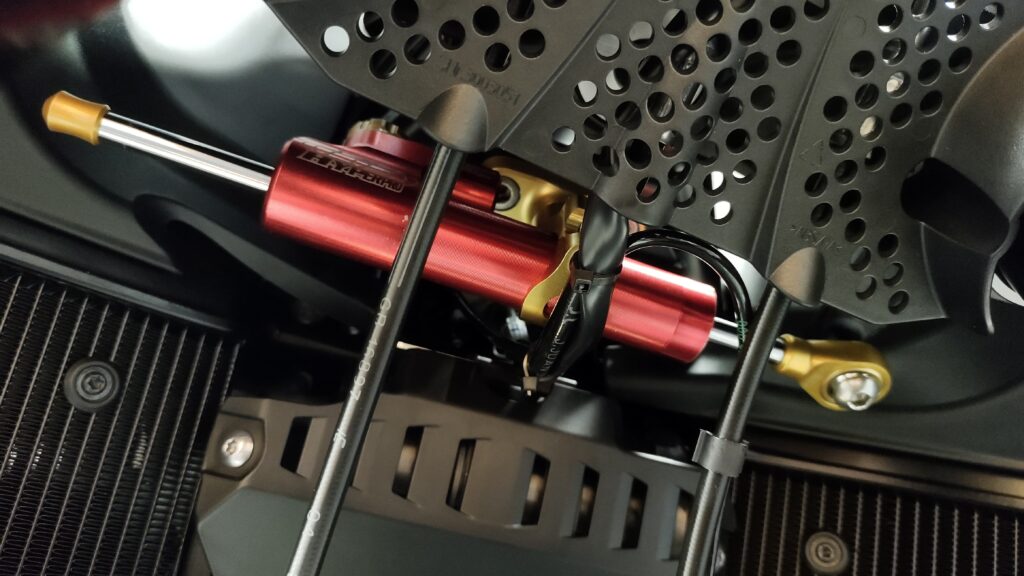
Yes, you should fix your suspension before adding a steering damper. A steering damper is a safety device designed to manage instability caused by external forces like road imperfections or high-speed wobbles. It is not a tool to compensate for a poorly set up or worn suspension system. Fitting one on top of bad suspension can mask real problems and, in some cases, make handling less predictable. This article walks through the key questions riders ask when deciding which to address first.
What problems does poor suspension cause before adding a steering damper?
Poor suspension creates handling instability that no steering damper is designed to correct. When fork springs are worn, incorrectly weighted for the rider, or improperly set up, the front end dives under braking, loses contact with the road mid-corner, or wallows through bumps. These conditions generate the kind of instability that riders sometimes mistake for a steering problem.
Common symptoms of poor suspension that are often confused with steering issues include:
- Headshake through corners when the front end loses grip momentarily
- Wobbling under braking caused by excessive fork dive
- Vague steering feedback that makes the bike feel unpredictable
- Bouncing or skipping over rough surfaces due to insufficient damping
- Uneven tyre wear resulting from incorrect spring preload or sag settings
Each of these problems originates in the suspension, not in the steering geometry. Addressing them with a damper treats the symptom while the underlying cause continues to affect how your bike handles.
Hyperpro
Ride with confidence
Find the nearest Hyperpro dealer and start your motorcycle upgrade.
What does a steering damper actually fix on a motorcycle?
A steering damper controls rapid, unwanted oscillations of the steering head. Its primary purpose is to absorb the energy of a tank-slapper, reduce high-frequency vibrations transmitted through the bars, and dampen wobbles triggered by road surface irregularities, crosswinds, or sudden weight shifts at speed. It does not correct slow, fundamental handling problems rooted in suspension setup.
Think of a steering damper as a reactive safety device. It responds to sudden, sharp inputs to the steering. When a wheel hits a pothole at motorway speed and the bars snap sideways, the damper absorbs that energy and prevents it from escalating into a full tank-slapper. That is the scenario it is built for.
What a steering damper does not fix is the slow, progressive instability that comes from worn fork seals, incorrect spring rates, or a rear shock that has lost its damping ability. These are mechanical problems that require mechanical solutions.
How do you know if your suspension needs attention first?
Your suspension needs attention first if the instability you experience is consistent, predictable, and linked to specific riding conditions rather than sudden external events. If your bike wobbles every time you brake hard, feels vague in every corner, or bounces repeatedly over the same type of road surface, the problem is in the suspension, not the steering geometry.
A practical way to assess this is to ask yourself a few direct questions:
- Does the front end dive noticeably under braking? This points to insufficient spring rate or damping.
- Does the bike feel unsettled at the same points in every corner? This suggests spring preload or sag is incorrectly set.
- Have you checked and set rider sag correctly for your weight? Many factory setups are calibrated for a rider significantly lighter or heavier than you.
- Are the fork seals leaking or is the fork oil degraded? Old or contaminated fork oil dramatically reduces damping performance.
- Does the rear shock feel soft or bouncy over repeated bumps? This is a sign the damping has faded.
If you answer yes to any of these, suspension work comes before a steering damper. If your bike handles well but you ride at high speeds, on track, or on roads where sudden instability is a real risk, a damper becomes a relevant addition.
Can a steering damper make bad suspension feel worse?
Yes, a steering damper can make bad suspension feel worse in specific situations. When suspension is too stiff, bottomed out, or incorrectly set up, the bike already struggles to absorb road inputs cleanly. Adding a steering damper that resists steering movement can compound this by reducing the rider’s ability to make small, instinctive corrections that compensate for the suspension’s shortcomings.
There is also a masking effect to consider. A damper set to a high resistance level can hide the feedback that tells you the front tyre is losing grip. In a bike with good suspension, that feedback is already well communicated. In a bike with poor suspension, the feedback is already degraded. Adding damping on top of that can leave you with less information about what the front end is doing at exactly the moment you need it most.
This does not mean steering dampers are dangerous. It means they work best when the foundation underneath them is solid.
What suspension components should be sorted before fitting a damper?
Before fitting a steering damper, you should address fork springs, fork oil, rear shock performance, and rider sag. These four areas cover the most common causes of handling instability and give you a reliable baseline from which a damper can then provide genuine additional benefit.
Fork springs and fork oil
Factory fork springs are often built to a single spring rate that suits a broad range of riders. If you are heavier, lighter, or ride more aggressively than the average, the spring rate will be wrong for you. Upgrading to progressive-rate fork springs matched to your weight and riding style transforms front-end feel. Alongside this, fresh fork oil at the correct viscosity restores damping performance that degrades over time.
Rear shock and sag settings
A worn rear shock loses its ability to control rebound, which causes the rear of the bike to bounce and push the front out of line mid-corner. Checking and replacing a faded shock is a high-impact change. Once that is done, setting rider sag correctly at both ends of the bike ensures the geometry is working as intended. Sag is the starting point for all other suspension adjustments and takes less than thirty minutes to check with a helper and a tape measure.
Once these components are in good condition and correctly set up, you have a suspension system that communicates clearly and handles predictably. That is when a steering damper adds genuine value rather than layering complexity over a flawed foundation.
When is it acceptable to add a steering damper without upgrading suspension?
It is acceptable to add a steering damper without upgrading suspension when your suspension is already in good working order and correctly set up for your weight and riding style. Riders who have recently serviced their forks, set sag correctly, and confirmed their rear shock is performing well can fit a steering damper as a direct safety addition without needing to do any suspension work first.
There are also specific use cases where a steering damper is a high-priority fitment regardless of suspension condition:
- Track riding, where speeds are higher and the consequences of a tank-slapper are more severe
- Long-distance touring on motorways, where sustained high-speed stability matters
- Adventure riding on loose or unpredictable surfaces where sudden steering inputs from the terrain are common
- Bikes that have a known tendency towards high-speed wobble from the factory
In these situations, the suspension may be performing well, but the risk profile of the riding justifies adding a damper as an additional layer of control. The key distinction is that the damper complements a solid setup rather than attempting to substitute for one.
How Hyperpro helps you get the sequence right
We design suspension and steering damper systems that work together, which means we understand exactly how each component affects the other. If you are unsure where to start, our product range covers both sides of the equation:
- Progressive-rate fork springs matched to your specific bike model and rider weight, giving the front end a properly calibrated foundation
- Rear shock absorbers that restore or improve on factory damping performance
- CSC and RSC steering dampers with 22 adjustable positions, so you can dial in the right level of damping for your riding style once your suspension is sorted
- CNC-milled model-specific mounting kits in Hyperpro Gold or Black that fit without drilling or cutting in 98% of applications, making the fitment process straightforward
We recommend sorting your suspension first, then adding a steering damper to build on that stable foundation. Purchases are made through our authorised distributor network. Use the link below to find your nearest dealer, or contact us if you have questions about which components are right for your bike.