


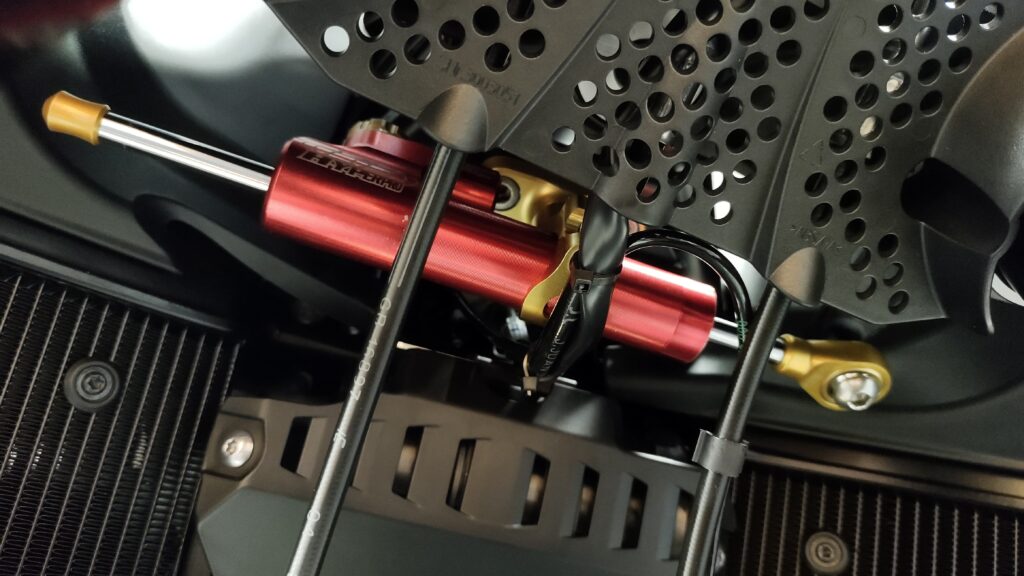
Yes, a steering damper can prevent a tank slapper in most real-world scenarios. By resisting sudden, uncontrolled handlebar oscillations, a steering damper gives the front wheel time to realign with the bike’s direction of travel before the wobble escalates into something dangerous. It does not eliminate every risk, but it significantly reduces the chance that a minor instability turns into a crash.
Tank slappers are among the most frightening events a rider can experience, and they happen fast. Understanding what triggers them and how damping technology responds to them helps you make a more informed decision about your setup. The sections below work through the key questions riders ask about steering dampers and tank slappers.
What actually causes a tank slapper on a motorcycle?
A tank slapper occurs when the front wheel loses traction momentarily and then regains it while pointing in the wrong direction, triggering a rapid side-to-side oscillation of the handlebars. The wheel snaps left, overcorrects right, and the cycle repeats faster than most riders can physically react. Without intervention, the oscillation can grow until the rider loses control.
Several situations can trigger this chain reaction:
- Wheelies and front-wheel landings: When the front wheel comes back down at speed, it can touch down at a slight angle, immediately starting the oscillation cycle.
- Mid-corner bumps: Hitting a raised manhole cover or a patch of broken tarmac while leaned over disrupts the contact patch and can unsettle the steering geometry.
- Sudden front-wheel traction loss: Hitting a patch of gravel, diesel, or water at speed causes the tyre to slip and then grip again unpredictably.
- Aggressive acceleration out of a corner: Weight transfer to the rear unloads the front, reducing the tyre’s ability to damp natural steering movement.
The underlying physics is straightforward: the front tyre and the steering geometry want to self-correct, but without any resistance in the steering system, that self-correction overshoots and the oscillation builds on itself. Speed amplifies everything. At higher road speeds, the same initial disturbance produces a much more violent wobble than it would at lower speeds.
Hyperpro
Ride with confidence
Find the nearest Hyperpro dealer and start your motorcycle upgrade.
How does a steering damper reduce handlebar oscillation?
A steering damper reduces handlebar oscillation by adding hydraulic resistance to the rotational movement of the steering head. When the handlebars try to snap violently from side to side, the damper slows that movement down, giving the tyre and the bike’s geometry time to self-correct without overshooting. The result is a wobble that dampens out rather than one that builds.
The damper works in both directions simultaneously. It resists leftward and rightward movement proportionally, so it does not interfere with normal, deliberate steering inputs. When you turn into a corner at a normal pace, the resistance is barely noticeable. When the bars snap suddenly, the damper engages meaningfully and absorbs the energy of that snap.
Adjustability matters here. A damper set too stiff will make the steering feel heavy and unresponsive, which creates its own safety risks. A damper set too light provides little protection against a fast oscillation. Quality motorcycle steering dampers offer multiple adjustment positions so you can tune the resistance to your riding style, your bike’s weight, and the type of roads you ride.
Can a steering damper fully prevent a tank slapper?
A steering damper cannot fully prevent every tank slapper under every condition, but it dramatically reduces both the frequency and the severity of handlebar oscillations in the situations where they are most likely to occur. In most real-world scenarios, a well-set damper will stop a developing wobble before it becomes unmanageable.
The limitation is one of physics. If the initial disturbance is extreme enough, such as a very high-speed front-wheel landing after a large jump, the forces involved can exceed what any damper can fully absorb. In those edge cases, the damper still helps by reducing the peak amplitude of the oscillation, giving the rider a better chance of recovering control.
For the vast majority of street and sport riders, a steering damper provides a meaningful safety margin in the scenarios that actually cause tank slappers: unexpected surface changes, mid-corner bumps, and aggressive acceleration. It is not a substitute for tyre condition, suspension setup, or riding skill, but it adds a layer of protection that factory steering geometry alone does not provide.
What’s the difference between a steering damper and a steering stabiliser?
The terms steering damper and steering stabiliser are often used interchangeably, and in most practical contexts they refer to the same type of device. Both describe a hydraulic component that resists unwanted steering movement to improve stability. The distinction, where one exists, is usually about damping characteristics rather than fundamentally different technology.
Some manufacturers use the term stabiliser to describe a unit with a fixed or linear damping rate, while damper can refer to units with progressive or reactive damping that responds differently depending on how fast the steering moves. A progressive damper applies less resistance during slow, deliberate steering inputs and significantly more resistance during fast, sudden oscillations.
This distinction matters practically. A linear unit applies the same resistance regardless of how fast the bars move, which means either the steering feels heavy during normal riding or it provides insufficient resistance during a fast wobble. A progressive or reactive unit solves this trade-off by scaling its response to the speed of the movement.
When should you fit a steering damper to your motorcycle?
You should fit a steering damper if your motorcycle is prone to front-end instability, if you ride at speeds where a tank slapper would be dangerous to recover from, or if you have already experienced handlebar wobble and want to reduce the risk of it happening again. Certain bike types and riding styles benefit more than others.
Consider fitting a steering damper if any of the following apply to your situation:
- You ride a sport or naked bike at high speeds where the consequences of a tank slapper are severe.
- Your bike has long-travel or soft suspension that allows greater front-end movement, which increases the risk of oscillation after a disturbance.
- You have experienced a mild wobble that resolved itself but left you unsettled about what might have happened at higher speed.
- You ride on roads with variable surfaces such as patchy tarmac, rural roads, or routes with frequent drainage covers and expansion joints.
- You carry a pillion or luggage regularly, which shifts weight distribution and can make the front end more susceptible to instability.
Fitting is straightforward on most modern motorcycles. Model-specific mounting kits are designed as plug-and-play solutions that require no cutting or drilling in the vast majority of applications, meaning you can add meaningful protection without modifying your frame or forks.
How Hyperpro helps you ride with more confidence
We design and manufacture steering dampers specifically to address the kind of handlebar instability described throughout this article. Our range gives you a choice of damping technology to match your riding needs:
- CSC (Constant Safety Control): A linear damping model with 22 adjustment positions, offering consistent resistance across all steering speeds. Well-suited to riders who want straightforward, predictable damping.
- RSC (Reactive Safety Control): A progressive damping model that applies minimal resistance during normal steering and significantly more resistance when the bars move suddenly. This means your steering stays light and natural until instability develops, at which point the damper responds proportionally.
- CNC-milled model-specific mounting kits: Available in Hyperpro Gold or Black, these kits are engineered for your exact motorcycle model. In 98% of applications, no drilling or cutting is required. You bolt it on and ride.
You can explore the full range of suspension and damping products to find what fits your bike and your riding style. Purchases are made through our authorised distributor network. Contact us if you have questions about which damper suits your motorcycle, and we will point you in the right direction.