


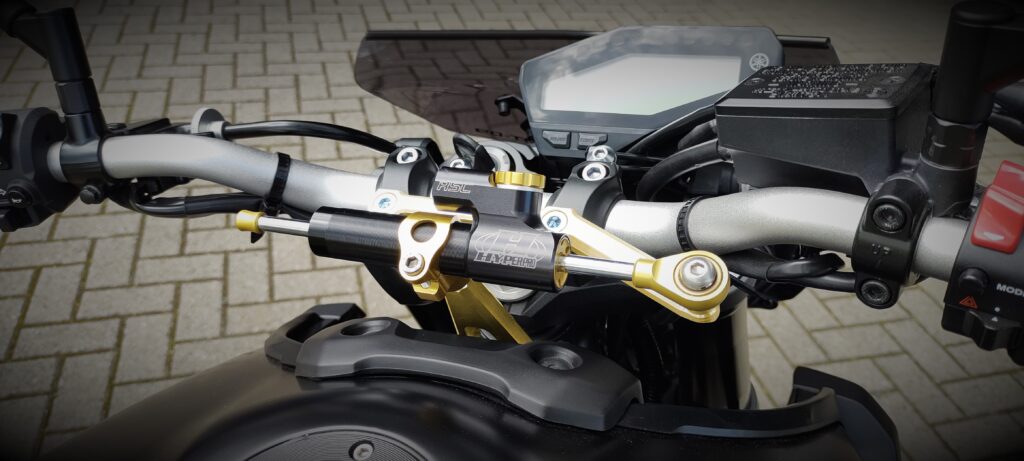
A motorcycle that shakes over bumps at speed is usually reacting to suspension that cannot absorb road impacts quickly enough or cannot return to its neutral position in a controlled way. The most common causes are worn damping components, incorrect spring preload, or a steering geometry problem that amplifies instability at higher speeds. This article works through each of the related questions riders ask most often, from identifying the root cause to choosing the right fix.
What causes a motorcycle to shake over bumps at speed?
A motorcycle shakes over bumps at speed because the suspension system is failing to absorb and dissipate energy fast enough. When a wheel hits a bump, the spring compresses to absorb the impact, and the damper controls how quickly the suspension returns. If damping is insufficient, the wheel bounces repeatedly instead of settling, and that oscillation travels through the frame as a shake or wobble.
Several factors can trigger or worsen this behaviour:
- Worn fork seals or shock internals that have lost damping fluid or developed internal wear, reducing their ability to control spring rebound
- Incorrect spring preload that leaves the suspension too soft or too stiff for the rider’s weight and riding style
- Unbalanced or worn tyres that create a rotational force which amplifies at higher speeds
- Loose or worn steering head bearings that allow the front end to oscillate rather than track straight
- A missing or inadequate steering damper, which is particularly relevant at speed when small front-end disturbances can escalate into a tank-slapper or high-speed wobble
Speed matters because instability compounds. A small wobble at 50 km/h may feel manageable, but the same mechanical issue at 100 km/h can escalate rapidly. The faster you ride, the more important it is that every component in the suspension system is doing its job correctly.
Is a shaking motorcycle dangerous to ride?
Yes, a shaking motorcycle is dangerous to ride, especially at higher speeds. Shaking is a symptom of reduced control, meaning the tyres are not maintaining consistent contact with the road surface. When grip becomes intermittent, braking distances increase, cornering becomes unpredictable, and the risk of a high-speed wobble or tank-slapper rises significantly.
The level of danger depends on what is causing the shake. A mild vibration from an unbalanced tyre is a different risk level from a rebound-induced wobble from blown fork internals. However, both conditions deserve immediate attention. Riding on a shaking motorcycle and assuming it will “settle down” is a mistake that experienced riders avoid. The underlying issue almost never resolves itself and typically worsens as components wear further.
If the shaking appears suddenly at speed, particularly in the front end, pull over safely and inspect the bike before continuing. A high-speed wobble that is left unaddressed can become uncontrollable within seconds.
Hyperpro
Ride with confidence
Find the nearest Hyperpro dealer and start your motorcycle upgrade.
How do I know if my suspension is worn out or just incorrectly set up?
You can distinguish between worn suspension and incorrect setup by testing whether adjustments change the behaviour. If adjusting preload, rebound, or compression damping produces a noticeable improvement, the components still have life in them and the issue is setup. If you have exhausted the adjustment range and the shaking, wallowing, or bouncing persists, the internals are likely worn past the point where settings alone can compensate.
Here are the signs that point specifically to worn components rather than a setup issue:
- Oil staining or visible leaks around fork seals or shock bodies
- A “clunking” sensation when the suspension bottoms out, even on modest bumps
- Rebound that feels uncontrolled regardless of the damping setting
- A front end that dives sharply under braking and takes a long time to recover
- A rear shock that feels vague and disconnected from the road rather than planted
Incorrect setup, by contrast, tends to produce more specific symptoms. A spring that is too soft for your weight will cause the bike to sit too low in its travel, making it wallow through corners. A spring that is too stiff will make the ride harsh and cause the wheel to skip over bumps rather than follow the road surface. Both are correctable without replacing parts, provided the components themselves are still functioning.
What’s the difference between progressive and linear spring rates for handling bumps?
A linear spring applies the same resistance throughout its travel, while a progressive spring increases its resistance the further it is compressed. For bump absorption, this difference is meaningful: a progressive spring can feel compliant over small surface irregularities and firm up automatically when the suspension is pushed harder by larger impacts or aggressive riding inputs.
Linear springs are predictable and consistent, which suits riders who have already dialled in their setup precisely and want the same response every time. They are common in racing applications where the rider knows exactly what the track demands.
Progressive springs are better suited to street and adventure riding, where road conditions vary constantly. A single progressive spring rate can handle a pothole, a motorway expansion joint, and a fast sweeping corner without requiring the rider to stop and adjust settings. This is why Hyperpro builds its fork springs and shock springs with a progressive rate: real-world roads do not present uniform inputs, and the suspension should adapt to that variation automatically.
If your motorcycle shakes over bumps at speed and you are running factory linear springs, switching to progressive aftermarket springs is often one of the most effective ways to calm that behaviour across a wider range of riding conditions.
When should I upgrade my suspension instead of adjusting it?
You should upgrade your suspension when the factory components cannot be adjusted to match your riding weight, style, or road conditions, or when the components are worn to the point where adjustment no longer produces meaningful change. Most factory suspension is designed for an average rider under average conditions, which means it is a compromise that suits nobody perfectly.
Upgrading makes sense in these situations:
- You are significantly lighter or heavier than the average rider the bike was designed for, and the spring rate cannot be corrected through preload alone
- The factory shock has no rebound adjustment and the bike continues to bounce after bumps regardless of tyre pressure or preload settings
- You have changed your riding style, added luggage or a passenger, or switched to a different type of road regularly
- The fork internals are worn and a rebuild or spring replacement is already needed, making an upgrade the logical next step
- You experience front-end instability or high-speed wobble that adjustment cannot resolve, in which case a steering damper may be the targeted solution
Adjustment and maintenance are always the first steps. But when those steps are exhausted and the problem remains, upgrading to components that are matched to your specific bike and riding profile delivers a more lasting and noticeable improvement than continuing to work around the limitations of factory parts.
Which suspension components should I replace first to stop the shaking?
Start with the component most likely to be causing the specific type of shake you are experiencing. For high-speed wobble or front-end instability over bumps, a steering damper is often the most direct and immediate solution. For general bounce, wallowing, or poor bump absorption, fork springs and the rear shock absorber are the primary targets.
A practical order of priority looks like this:
- Tyres and wheel balance: Rule out the simplest causes first. An unbalanced or worn tyre can mimic suspension problems at speed.
- Steering head bearings: Check for play or roughness. A worn steering head allows the front end to oscillate and amplifies any instability from bumps.
- Steering damper: If the shaking manifests as a high-speed wobble or tank-slapper tendency, fitting a quality steering damper directly addresses that instability. A progressive damper adjusts its resistance based on the speed and severity of the steering input, providing light resistance during normal riding and firm resistance when the front end tries to oscillate.
- Fork springs: If the front end dives, bounces, or feels vague over bumps, replacing the factory springs with progressive-rate alternatives improves both comfort and control.
- Rear shock absorber: A worn or inadequate rear shock causes the back of the bike to wallow and can shift weight distribution in ways that destabilise the front end too.
Addressing components in this order keeps costs manageable and helps you identify which change produces the most improvement before committing to a full suspension overhaul.
How Hyperpro helps you stop the shake
We design suspension components specifically to address the instability and shaking that factory setups cannot always prevent. Our product range gives you targeted solutions at each level of the problem:
- Steering dampers in two versions: the CSC (Constant Safety Control) linear model and the RSC (Reactive Safety Control) progressive model, both adjustable across 22 positions. The RSC responds to the speed and intensity of the steering input, providing minimal resistance during normal cornering and firm resistance when a wobble or tank-slapper starts to develop.
- Model-specific mounting kits: CNC-milled brackets designed for your exact bike, available in Hyperpro Gold or Black. In 98% of applications, fitting requires no drilling or cutting.
- Progressive-rate fork springs and shock absorbers: matched to your bike model and rider weight, so the suspension responds correctly across the full range of road conditions you actually encounter.
Every product in our range is designed to be a direct, practical upgrade rather than a complex custom build. If you want to find the right components for your bike or have a question about which solution fits your situation best, get in touch with us. To purchase, visit an authorised Hyperpro distributor in your region.