


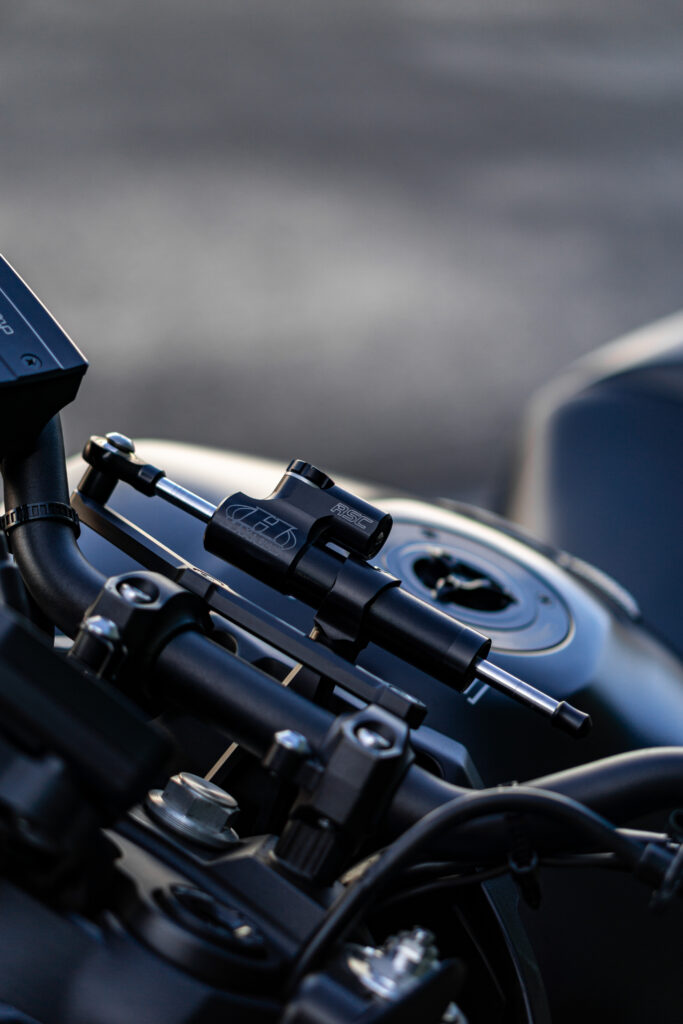
Yes, a steering damper improves cornering stability by reducing unwanted handlebar oscillations that can occur mid-corner or at speed. It works by adding controlled resistance to the steering head, smoothing out sudden inputs without interfering with intentional steering. For riders who push their bikes hard or ride at higher speeds, the difference in confidence and control is noticeable. Below, we answer the most common questions about how steering dampers work, when you need one, and how to choose the right model for your bike.
How does a steering damper actually work?
A steering damper is a hydraulic device mounted between the frame and the front fork or handlebar assembly. It uses oil flowing through internal valves to resist rapid, uncontrolled steering movements. The damper allows slow, deliberate steering inputs to pass through freely while absorbing sudden, high-frequency oscillations before they escalate into a wobble.
Think of it as a buffer between the road and your hands. When your front wheel hits a bump, a pothole, or an uneven surface mid-corner, the impact tries to deflect the steering. Without damping, that energy travels directly into the bars. With a steering damper fitted, the hydraulic resistance absorbs that energy and prevents it from amplifying into a dangerous oscillation.
Modern steering dampers are adjustable, meaning you can tune the level of resistance to suit your riding style, speed range, and bike setup. A well-adjusted damper adds resistance only where it is needed, leaving normal cornering feel intact.
Hyperpro
Ride with confidence
Find the nearest Hyperpro dealer and start your motorcycle upgrade.
What causes tank slappers and speed wobbles on motorcycles?
Tank slappers and speed wobbles are caused by uncontrolled oscillation of the front wheel and steering assembly. When the front wheel loses traction momentarily or receives a sharp lateral input, the steering can begin to swing rapidly from side to side. Without enough damping to interrupt this cycle, each swing amplifies the next, creating a violent wobble that can cause a crash.
Several factors increase the risk of speed wobbles:
- High speed: The faster you travel, the more energy a wobble carries and the harder it becomes to control manually.
- Worn or soft suspension: Forks and shocks that are underdamped allow more wheel movement, giving oscillations room to develop.
- Tyre condition and pressure: Incorrect tyre pressure or uneven wear changes how the front wheel tracks, making instability more likely.
- Rough or uneven road surfaces: Bumps, expansion joints, and surface changes can trigger the initial deflection that starts a wobble.
- Sudden weight shifts: Hard braking, hitting a bump mid-corner, or a passenger shifting position can all upset front wheel tracking.
A steering damper does not eliminate the root cause of wobbles, but it interrupts the oscillation cycle early, before the motion can build into something unmanageable.
Does a steering damper improve cornering stability?
Yes, a steering damper improves cornering stability by preventing small steering disturbances from growing into larger oscillations mid-corner. When you lean into a bend and the front tyre encounters a bump or a change in road texture, a damper absorbs the resulting steering deflection and keeps the bars tracking smoothly. This translates directly into more confident, controlled cornering.
The improvement is most noticeable in situations where the front end is loaded and the bike is already committed to a line. In these moments, any sudden steering disturbance has the potential to unsettle the bike significantly. A damper keeps those disturbances contained, which means you can hold your line with less physical effort and greater predictability.
It is worth noting that a steering damper is not a substitute for good suspension setup. If your fork springs are too soft or your shock absorber is worn, the front end will still move excessively through corners. The damper controls steering oscillation specifically, not overall chassis movement. When combined with well-tuned suspension, however, the stability benefit is substantial.
When do you actually need a steering damper?
You need a steering damper when your bike shows signs of steering instability, particularly at speed or over rough surfaces. If you have experienced a tank slapper, noticed the bars vibrating through fast corners, or felt the front end feel vague and nervous at highway speeds, a steering damper is a relevant and practical upgrade.
Specific situations where a steering damper makes a meaningful difference include:
- Sport and track riding: Higher speeds and harder braking increase the forces acting on the steering, making wobbles more likely and more severe.
- Adventure touring on mixed surfaces: Gravel, dirt, and broken tarmac create unpredictable front wheel inputs that a damper helps absorb.
- Long-distance highway riding: Sustained high-speed cruising exposes any tendency towards speed wobble, especially under load with luggage or a passenger.
- Bikes with known instability characteristics: Some models are more prone to wobbles due to geometry or suspension limitations, and a damper is a well-established solution for these.
If your bike feels stable and predictable in all conditions you ride in, a steering damper is a lower priority. But for riders who regularly push into any of the above scenarios, it is a worthwhile addition to your setup.
What’s the difference between a steering damper and a suspension upgrade?
A steering damper controls the rotational movement of the steering head, specifically resisting rapid oscillations in the handlebar assembly. A suspension upgrade, such as new fork springs or a replacement shock absorber, controls how the chassis absorbs vertical and lateral forces from the road. They address different types of instability and work best when combined.
Here is how the two differ in practice:
- Steering damper: Targets wobbles, tank slappers, and handlebar vibration. Improves steering precision and confidence without changing how the bike absorbs bumps.
- Fork springs and shock absorbers: Improve how the chassis handles road inputs, body movement, and load changes. Better spring rates and damping keep the tyres in contact with the road more consistently.
A rider with soft, worn suspension and no steering damper may find that upgrading the suspension reduces wobble tendency on its own, because the front end is better controlled overall. But a rider who already has good suspension and still experiences steering instability at speed will benefit most from adding a damper. The two upgrades complement each other rather than compete, and together they deliver the most complete improvement in handling. You can explore the full range of motorcycle suspension products to understand how the components work alongside each other.
How do you choose the right steering damper for your bike?
Choosing the right steering damper comes down to three factors: compatibility with your bike’s mounting points, the type of damping technology that suits your riding, and the adjustability range the damper offers. A model-specific fitment is always preferable to a universal solution, as it ensures correct geometry and mounting without requiring modifications.
Linear versus progressive damping
Linear dampers provide consistent resistance across all steering speeds. They work well for riders who want a straightforward, predictable feel. Progressive dampers increase resistance as steering speed rises, meaning they are more responsive to sudden, high-speed oscillations while remaining light and natural during slow-speed manoeuvring. For riders who cover a wide range of conditions and speeds, progressive damping generally provides better overall performance.
Adjustability and mounting
A damper with multiple adjustment positions lets you fine-tune resistance to match your riding conditions, your bike’s weight, and your personal preference. More adjustment positions give you greater flexibility without needing to swap components. On the mounting side, look for a kit designed specifically for your bike model. Properly engineered mounting kits fit without drilling, cutting, or compromising existing frame or fork components, which keeps installation clean and reversible.
Once you have identified the right specification, purchase through an authorised distributor to ensure you receive a genuine product with the correct fitment documentation for your specific model.
How Hyperpro helps with steering stability
We design and manufacture steering dampers built specifically to address the instability issues described throughout this article. Our range covers two damping technologies to match different riding needs:
- CSC (Constant Safety Control): A linear damping model that delivers consistent, predictable resistance across all steering speeds, adjustable across 22 positions.
- RSC (Reactive Safety Control): A progressive damping model that responds more strongly to rapid oscillations while remaining light during normal steering, also adjustable in 22 positions.
Both models reduce tank slappers, speed wobbles, and handlebar vibration, giving you more control and confidence in the situations where instability is most likely to occur. We also develop CNC-milled, model-specific mounting kits available in Hyperpro Gold or Black. In 98% of applications, these kits are plug-and-play and require no drilling or cutting, keeping installation straightforward and your bike’s frame untouched.
To find the right steering damper for your bike and get it fitted through a professional near you, contact us or locate your nearest authorised dealer to make your purchase.