


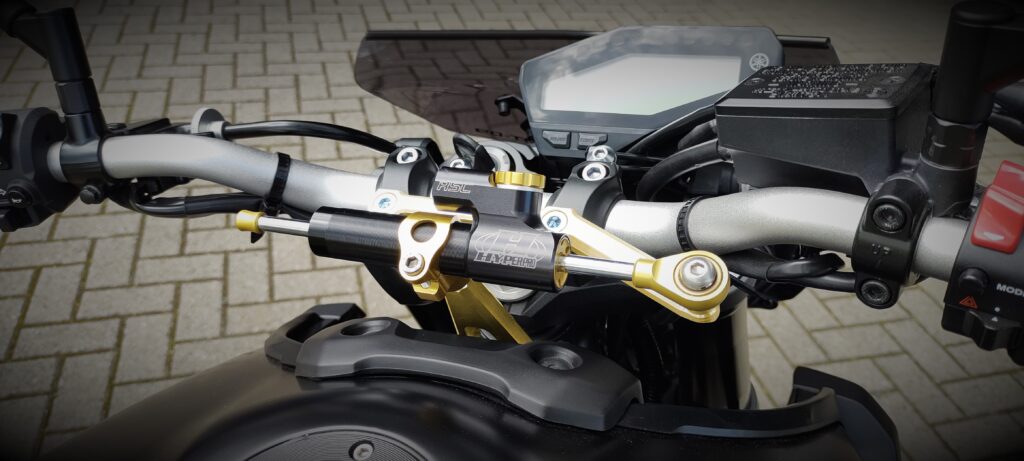
Yes, a steering damper helps significantly on uneven and unpaved roads. By resisting sudden, uncontrolled handlebar movements caused by surface irregularities, a steering damper keeps your front end tracking predictably rather than reacting violently to every rut, rock, or loose patch. It is a practical safety upgrade for any rider who regularly encounters rough terrain.
The benefit is not limited to off-road or adventure riding. Even on damaged tarmac, cobblestones, or gravel-covered bends, the damper reduces the physical effort required to maintain a straight line and prevents the kind of handlebar snap that catches riders off guard. The sections below cover how dampers work, what triggers instability on rough roads, and how to get the most from yours before heading off the beaten track.
What does a steering damper actually do to your handlebar movement?
A steering damper is a hydraulic device mounted between the frame and the steering head that resists rapid, uncontrolled rotation of the handlebars. It does not prevent steering; it slows down unwanted, high-speed handlebar movement while still allowing deliberate, rider-initiated input to pass through normally. The result is a front end that feels composed rather than nervous.
The damper works through controlled oil flow. When the bars move slowly and intentionally, the hydraulic resistance is low enough that you barely notice it. When an external force tries to snap the bars sideways quickly, the damper absorbs that energy and spreads the movement over a longer time window, giving you the fraction of a second you need to respond or for the tire to reestablish grip.
There are two main approaches to damping. A linear damper applies consistent resistance across all handlebar speeds. A progressive damper increases resistance as the speed of handlebar movement increases, so gentle maneuvering feels natural while violent deflections are heavily controlled. Our RSC steering damper uses progressive damping for exactly this reason: it stays out of the way during normal riding and activates firmly when the front end genuinely needs restraint.
How does rough terrain trigger tank slappers and speed wobbles?
Tank slappers and speed wobbles occur when the front wheel loses its self-centering stability and begins oscillating rapidly from side to side. Rough terrain triggers this by momentarily breaking traction, deflecting the wheel off its intended path, or sending an impulse through the forks that the tire cannot immediately absorb. Once the oscillation starts, it can amplify within a fraction of a second.
On smooth roads, a tire naturally wants to track straight due to the geometry of the steering head and the gyroscopic effect of the spinning wheel. On unpaved or broken surfaces, that geometry is constantly being disturbed. A pothole can kick the front wheel sideways. Loose gravel can cause a brief slide. Corrugations can set up a resonance frequency that matches the natural wobble frequency of the front end. Any of these inputs can initiate an instability that the rider then has to fight to correct.
Speed plays a significant role. At low speeds, a deflection tends to damp out on its own. At higher speeds, the same deflection can escalate quickly because there is more energy in the system and less time to respond. This is why rough roads at touring or trail speeds feel manageable, but hitting unexpected loose gravel at pace can feel genuinely dangerous. A steering damper interrupts the feedback loop before the oscillation builds momentum.
Hyperpro
Ride with confidence
Find the nearest Hyperpro dealer and start your motorcycle upgrade.
Does a steering damper help on gravel and unpaved roads?
Yes, a steering damper is genuinely helpful on gravel and unpaved roads. These surfaces constantly deflect the front wheel in unpredictable directions, and the damper reduces how violently those deflections translate into handlebar movement. Riders consistently report that the front end feels more planted and controllable on loose or broken surfaces when a damper is fitted.
On gravel, the main challenge is that the tire is never fully committed to a single direction. Small stones redirect the wheel constantly, and without a damper, every deflection feeds directly into the handlebars. With a damper in place, minor deflections are absorbed hydraulically before they reach your hands, and only the larger movements come through with reduced intensity. This reduces arm fatigue significantly over longer distances and gives you more confidence to maintain speed through loose sections.
Unpaved roads also tend to include surface irregularities like embedded rocks, tree roots, and compacted ruts that create sharp, single-event impacts. These are the inputs most likely to trigger a tank slapper, particularly on a loaded adventure bike or a street bike with stiff, sport-oriented suspension. A steering damper does not eliminate the impact, but it controls the handlebar response so the bike recovers its line rather than chasing the deflection.
What’s the difference between a steering damper and progressive fork springs for rough roads?
A steering damper controls how fast the handlebars can rotate, while progressive fork springs control how the forks compress and absorb vertical impacts. They address different aspects of rough-road performance and work best when used together rather than as alternatives to each other.
Progressive fork springs change the rate at which your forks resist compression. Early in the travel, they compress relatively easily to absorb small bumps and vibrations. As the fork compresses further into larger impacts, the spring rate increases to prevent bottoming out. This improves the quality of the ride by managing what reaches the frame and the rider from below. However, fork springs do not directly influence how the handlebars behave when the front wheel is deflected sideways.
A steering damper operates in the horizontal plane of handlebar rotation. It does not change how the forks absorb a bump, but it does control what happens to the bars after the wheel has been deflected by one. The two components address the same general problem of rough-road instability from different directions. If you ride on unpaved surfaces regularly, upgrading both gives you a more complete solution: the springs manage the vertical input from the surface, and the damper manages the lateral consequence at the handlebars. You can browse our full range of suspension products to see how the two systems complement each other for your specific bike.
Should you adjust damper settings before riding on unpaved surfaces?
Yes, adjusting your steering damper before riding on unpaved surfaces is a worthwhile step. Most adjustable dampers, including both linear and progressive models, allow you to increase damping force for conditions where the front end will face more frequent and severe deflections. A higher setting on gravel or dirt gives the damper more authority to resist sudden handlebar movement without making the bike feel heavy to steer at low speeds.
The right adjustment depends on your speed and the type of surface. For slow, technical off-road riding where you need to make quick steering corrections around obstacles, a moderate setting works better than the maximum. Too much damping at low speeds makes the bike feel reluctant to turn and can actually reduce control. For faster gravel roads or corrugated tracks where speed wobbles are the primary risk, increasing the damping toward the higher end of the adjustment range makes more sense.
Our CSC and RSC dampers both offer 22 positions of adjustment, which gives you enough range to dial in the right feel for your terrain without needing tools or specialist knowledge. A practical approach is to set the damper one or two positions firmer than your normal road setting before heading off-road, then adjust from there based on how the front end feels in the first few kilometres. If the steering feels heavy or slow to respond, back it off slightly. If the bars still feel active over rough patches, add a position or two more.
How Hyperpro helps you ride with more control on any surface
We design our steering dampers specifically to address the instability that riders encounter on both paved and unpaved roads. Whether you are dealing with speed wobbles on a fast gravel track or handlebar snap on a potholed road, our damper range gives you a practical, bike-specific solution that fits without drilling or cutting in 98% of applications.
Here is what our steering damper systems offer:
- CSC (Constant Safety Control): A linear damping model with 22 adjustable positions, suited to riders who want consistent resistance across all handlebar speeds
- RSC (Reactive Safety Control): A progressive damping model that increases resistance as handlebar speed increases, providing natural steering feel during normal riding and firm control when the front end is destabilised
- CNC-milled model-specific mounting kits: Available in Hyperpro Gold or Black, designed as plug-and-play fitments for your specific motorcycle so installation is straightforward
- 22-position adjustability: Fine-tune damping force to match your terrain, speed, and riding style without specialist tools
Purchases are made through our authorized distributor network. Contact us if you have questions about fitment or which model suits your bike, and we will point you in the right direction.