


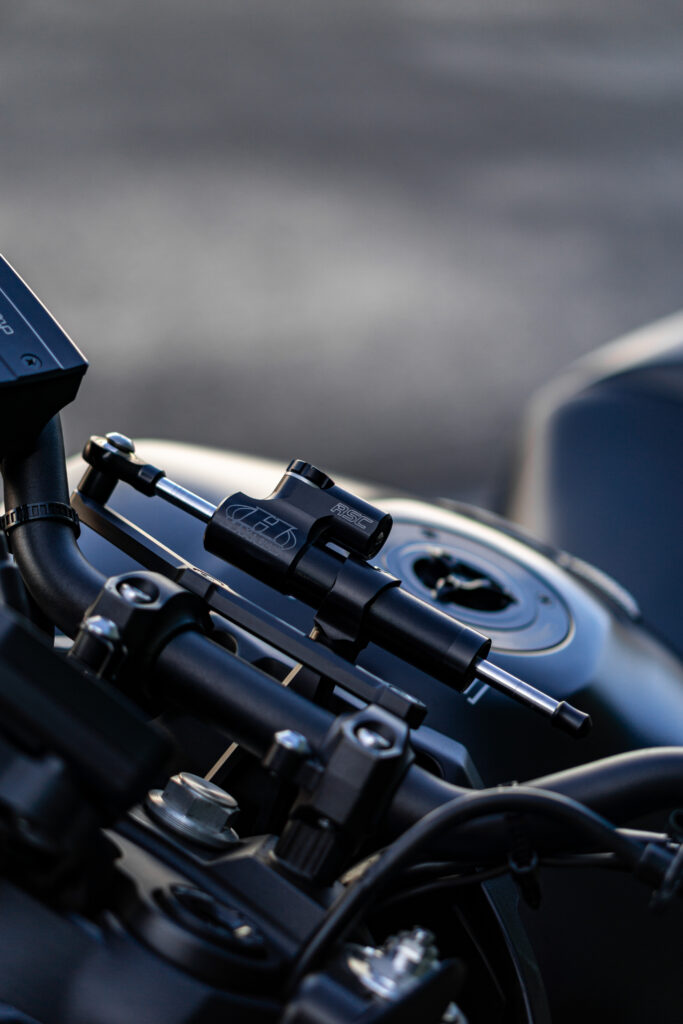
Naked bikes can benefit from a steering damper, but they do not always require one as standard equipment. Because naked motorcycles combine an upright riding position with lightweight, responsive steering geometry, they are more exposed to high-speed wobbles and tank-slappers than fully faired bikes. Whether you actually need one depends on how you ride, how fast you go, and what your suspension setup looks like.
What makes naked bikes more prone to steering instability?
Naked bikes are more prone to steering instability because their geometry prioritizes agility over high-speed composure. Shorter wheelbases, steeper rake angles, and lighter front ends make the steering quick and rewarding in corners, but those same characteristics reduce stability at speed. Without a fairing to manage airflow, the front end is also more exposed to wind disturbance at motorway speeds.
The upright riding position shifts more of the rider’s weight toward the rear, which can unload the front wheel under hard acceleration. When the front wheel lifts slightly and then reconnects with the road, the handlebars can oscillate rapidly. This is what riders call a tank-slapper or speed wobble, and it can escalate quickly if the rider tenses up or if the road surface is uneven.
Factory suspension settings on many naked bikes are tuned for a broad range of riders and road conditions. This compromise often means the damping is too soft for spirited riding or too firm for everyday comfort, neither of which helps front-end stability when it matters most.
Hyperpro
Ride with confidence
Find the nearest Hyperpro dealer and start your motorcycle upgrade.
What does a steering damper actually do on a motorcycle?
A steering damper resists sudden, unwanted rotational movement of the handlebars without interfering with deliberate steering input. It acts as a buffer between the front wheel and the rider’s hands, absorbing the rapid oscillations that cause wobbles and tank-slappers. A well-set damper lets you steer freely through corners while preventing the handlebars from snapping side to side under stress.
There are two main damping approaches used in modern motorcycle steering dampers. Linear dampers apply consistent resistance across all steering speeds, which works well as a baseline solution. Progressive dampers increase their resistance in proportion to how fast the handlebars are moving, meaning they stay light and unobtrusive during normal riding but firm up instantly when a wobble begins.
The practical result is a more composed front end, particularly during hard acceleration out of corners, when hitting a bump mid-corner, or when riding at sustained high speeds. Riders often describe the difference as the bike feeling more planted and predictable, rather than nervous or reactive.
You can explore the full range of motorcycle steering dampers to understand which damping style suits your riding.
Which naked bike riders benefit most from a steering damper?
Naked bike riders who push their machines hard, ride at high speeds regularly, or have modified their bike’s power output benefit most from a steering damper. If you regularly accelerate hard out of corners, ride on motorways, or take your naked bike to track days, the risk of front-end instability is meaningfully higher than for a casual commuter.
Specific situations where a steering damper makes a noticeable difference include:
- Riding a high-powered naked bike with more torque than the stock chassis was originally designed for
- Fitting aftermarket tyres with a different profile that alters how the front wheel tracks
- Riding on roads with surface imperfections, expansion joints, or mid-corner bumps
- Returning from a front wheel lift during hard acceleration
- Track or spirited road riding where corner exit speeds are significantly higher than in everyday use
Riders on smaller-displacement naked bikes used primarily for urban commuting are less likely to experience the conditions that trigger instability. For them, a steering damper is a lower priority compared to other suspension improvements. But for anyone riding a mid-to-large displacement naked bike with performance intent, it is a worthwhile addition to consider.
Can suspension upgrades reduce the need for a steering damper?
Better suspension can reduce the frequency and severity of steering instability, but it does not replace a steering damper. Upgraded fork springs, a correctly set rear shock, and properly adjusted damping all help keep the chassis composed, which in turn reduces the conditions that lead to wobbles. However, a tank-slapper triggered by a sudden road disturbance or a wheel reconnecting after a lift is a mechanical event that suspension tuning alone cannot fully prevent.
That said, poor suspension is often a contributing factor to instability. A front end that dives too sharply under braking, or a rear that squats excessively under acceleration, creates the kind of geometry changes that make the bike more vulnerable. Improving your suspension components addresses these root causes and makes the whole chassis work better together.
The most complete approach combines both. Good suspension keeps the bike balanced and predictable in normal riding. A steering damper acts as a safety net for the moments when conditions go beyond what suspension tuning can manage. Treating them as alternatives rather than complements means accepting a gap in your setup.
How do you choose the right steering damper for a naked bike?
Choosing the right steering damper for a naked bike comes down to three factors: damping type, adjustability, and fitment compatibility. You want a damper that matches your riding style, allows you to fine-tune the response, and mounts securely to your specific bike model without modification.
Start by deciding between linear and progressive damping. Linear damping provides consistent resistance and suits riders who want a straightforward, predictable feel. Progressive damping adjusts its resistance based on steering speed, making it more transparent during normal riding while offering stronger protection when instability strikes. For naked bikes used in varied conditions, progressive damping is generally the more versatile choice.
Adjustability matters because the right setting depends on your weight, your tyres, and how you ride. A damper with multiple adjustment positions lets you dial in the response rather than accepting a fixed compromise. Look for a model that covers a wide enough range to go from relaxed touring to aggressive riding without needing a different unit.
Fitment is where many riders run into problems. A steering damper needs a model-specific mounting kit to sit correctly and function as intended. Kits that require drilling or cutting into the frame introduce risk and can affect resale value. Plug-and-play mounting solutions designed for your exact bike model are the cleaner and safer option.
How Hyperpro helps with steering stability on naked bikes
We design steering dampers and mounting systems specifically for motorcycle riders who want more control without compromising the feel of their bike. Our range addresses the instability challenges that naked bike riders face directly, with two distinct damper models and a full library of bike-specific mounting kits.
- CSC (Constant Safety Control): A linear damping model with 22 adjustment positions, suited to riders who want consistent, predictable resistance across all steering speeds
- RSC (Reactive Safety Control): A progressive damping model with 22 adjustment positions that stays light during normal steering and firms up automatically when a wobble begins
- Model-specific mounting kits: CNC-milled in Hyperpro Gold or Black, designed as plug-and-play fitments for your exact bike with no drilling or cutting required in 98% of applications
If you want to find out which damper and mounting kit fits your naked bike, get in touch with us or visit one of our authorised distributors to make your purchase.