


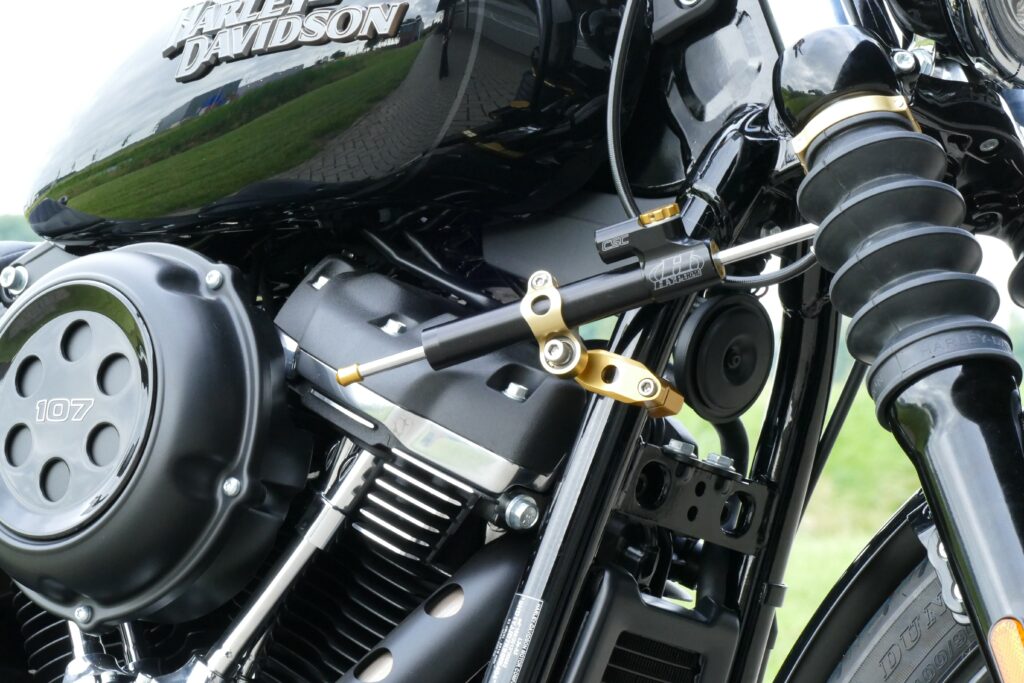
Yes, some steering dampers are adjustable while riding, but it depends entirely on the type of damper fitted to your motorcycle. Manual dampers require you to stop and turn a dial or knob to change the damping resistance, while electronic steering dampers adjust automatically in real time without any rider input. Understanding which type suits your riding style and conditions helps you get the most out of this safety-critical component.
Can you adjust a steering damper on the move?
Whether you can adjust a steering damper while riding depends on the type fitted to your bike. Manual or mechanical steering dampers require you to pull over and physically turn an adjustment knob to increase or decrease damping resistance. Electronic steering dampers, by contrast, adjust continuously and automatically while you ride, responding to speed and steering inputs without any intervention from you.
For most riders on road bikes, the inability to adjust a manual damper on the move is not a significant limitation. You set the damping level before a ride based on the conditions you expect, then leave it. The situation is different on track days or mixed-terrain adventure riding, where conditions change rapidly and a self-adjusting system offers a clear advantage.
It is worth noting that some high-end manual dampers include a remote adjuster mounted on the handlebar, allowing the rider to rotate a dial without stopping. These are relatively uncommon on standard road setups but do exist for riders who want manual control without dismounting.
Hyperpro
Ride with confidence
Find the nearest Hyperpro dealer and start your motorcycle upgrade.
What types of steering dampers are adjustable?
There are two main categories of adjustable steering dampers for motorcycles: manual dampers with fixed or user-set damping levels, and electronic dampers that self-adjust based on riding conditions. Both types offer meaningful control over steering stability, but they work in very different ways and suit different riders.
Manual adjustable dampers
Manual steering dampers use a hydraulic mechanism with an adjustment dial or screw that lets you set the resistance level before riding. Most quality manual dampers offer a range of adjustment positions, allowing you to fine-tune damping to suit your bike, load, and intended riding environment. They are straightforward, reliable, and widely compatible with a broad range of motorcycles.
Electronic and progressive dampers
Electronic steering dampers use sensors and a control unit to monitor speed and steering behaviour, then automatically vary damping force in real time. Progressive dampers offer a middle ground: they use a specially designed internal valve that increases resistance as steering inputs become more aggressive, without requiring electronics. This means they deliver lighter steering at low speeds and firmer control at higher speeds or during sudden wobbles, all passively.
If you want to explore the range of adjustable steering dampers available for specific motorcycle models, fitment and technical specifications vary by bike, so checking model-specific options is always a good starting point.
How does an electronic steering damper adjust itself?
An electronic steering damper adjusts itself by continuously reading data from sensors that monitor vehicle speed, steering angle, and sometimes lean angle, then using a solenoid or motorised valve to change the hydraulic resistance inside the damper body in real time. The result is damping that is always matched to the current riding situation without any manual input from the rider.
At low speeds, the system reduces damping resistance so the steering remains light and easy to manoeuvre, which is important in parking lots, slow corners, and urban traffic. As speed increases, the system progressively stiffens the damping to improve stability and reduce the risk of a tank-slapper or speed wobble. If the sensors detect a sudden, rapid steering oscillation, the system can react within milliseconds to suppress it before it becomes dangerous.
Electronic systems are typically integrated with the motorcycle’s existing electronics network on factory-fitted bikes, but aftermarket versions can also be fitted independently. The trade-off compared to a manual or progressive damper is added complexity and the need for a power source, which can be a consideration on older or simpler motorcycles.
When should you increase or decrease steering damper stiffness?
You should increase steering damper stiffness when riding at higher speeds, on motorways, or in conditions where stability is the priority. You should decrease stiffness for low-speed manoeuvring, technical off-road riding, or tight urban environments where light, responsive steering is more important than damping heavy oscillations.
Here are the most common situations and the recommended direction of adjustment:
- High-speed motorway riding: Increase stiffness to reduce the risk of wobbles caused by crosswinds, road imperfections, or buffeting from other vehicles.
- Track days or spirited road riding: A moderate to firm setting improves confidence during fast direction changes and reduces the chance of a tank-slapper under hard acceleration.
- Adventure or off-road riding: Reduce stiffness so the front wheel can move freely over uneven terrain without fighting the damper.
- City and low-speed manoeuvring: A softer setting keeps steering effort manageable and prevents the damper from making slow-speed turns feel heavy or unnatural.
- Carrying a passenger or luggage: Additional weight changes the bike’s handling dynamics, often making a slightly stiffer setting beneficial for stability.
The right setting is always a balance. Too much stiffness at low speeds makes the bike feel sluggish and tiring to ride. Too little at high speeds leaves you exposed to the kind of oscillations a steering damper is designed to prevent.
Does adjusting a steering damper affect handling and safety?
Yes, adjusting a steering damper directly affects both handling feel and safety. The correct setting improves stability and reduces the risk of dangerous wobbles, while an incorrectly set damper, either too stiff or too soft, can compromise steering response or leave the rider unprotected from oscillations. Getting the adjustment right for your speed and conditions genuinely matters.
A damper set too stiff for the conditions makes the steering heavy and slow to respond. This is uncomfortable in everyday riding and can actually reduce safety in situations where quick steering input is needed to avoid an obstacle. It also places extra load on the front end, which can cause fatigue over longer rides.
A damper set too soft provides little resistance to the kind of rapid, uncontrolled steering oscillations that cause tank-slappers. These oscillations can develop very quickly at speed and are one of the more dangerous handling events a rider can experience. A properly adjusted steering damper suppresses these movements before they escalate.
The relationship between damper adjustment and safety is why progressive damping technology is a meaningful advancement. Rather than relying on the rider to always have the correct setting dialled in, a progressive system automatically provides appropriate resistance across a wide range of speeds and conditions.
How Hyperpro helps you ride with better steering control
We design our steering damper systems to give every rider access to meaningful, reliable damping control without unnecessary complexity. Our range addresses the core challenge this article covers: getting the right damping level for your riding conditions, whether you adjust it manually or want a system that handles it for you.
- CSC (Constant Safety Control): A linear damping model with 22 adjustment positions, giving you precise manual control over steering resistance.
- RSC (Reactive Safety Control): A progressive damping model with 22 positions that automatically increases resistance as steering inputs become more aggressive, providing light steering at low speeds and firm control when it matters most.
- Model-specific mounting kits: CNC-milled fitment brackets in Hyperpro Gold or Black, designed as plug-and-play installations for specific motorcycle models. In 98% of applications, no drilling or cutting is required.
If you want to find out which steering damper fits your motorcycle and where to purchase one through an authorised distributor, browse our full product range or contact us directly with your bike details.