


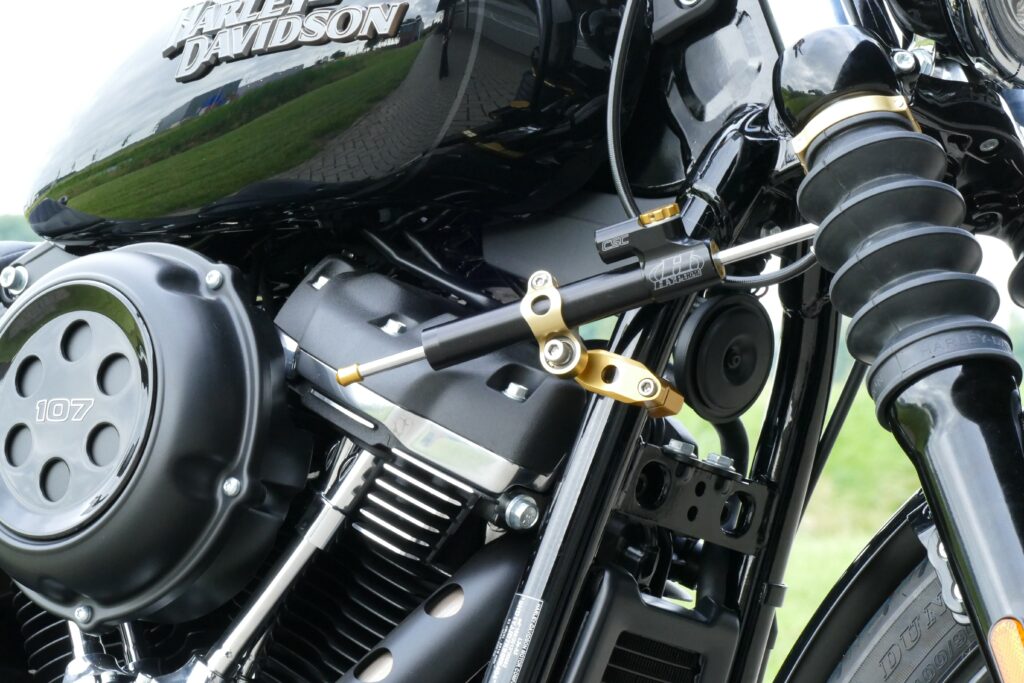
Yes, steering dampers need maintenance. Like any hydraulic component on your motorcycle, a steering damper relies on internal fluid and seals to function correctly, and these wear down over time. Neglecting maintenance leads to reduced damping performance, which can compromise your steering control and safety. Below, we cover everything you need to know about keeping your steering damper in good working order.
How often should a steering damper be serviced?
A steering damper should generally be inspected every 10,000 to 15,000 kilometres and serviced every two to three years, depending on riding conditions and usage intensity. Riders who frequently tackle rough roads, track days, or off-road terrain should lean toward the shorter end of that range, as these conditions accelerate wear on internal seals and fluid.
In practice, the best approach is to combine mileage-based checks with condition-based monitoring. Even if your damper has not hit the mileage threshold, a visual inspection at every major service interval is a smart habit. Look for oil residue around the body, changes in resistance, or unusual handling behaviour. These are early indicators that the damper deserves closer attention before the next scheduled service window.
Hyperpro
Ride with confidence
Find the nearest Hyperpro dealer and start your motorcycle upgrade.
What happens if a steering damper is not maintained?
If a steering damper is not maintained, its internal fluid degrades and seals begin to fail, causing the unit to lose its ability to control oscillation. The result is unpredictable steering behaviour, including increased sensitivity to tank-slappers, wobbles at speed, and vibrations through the handlebars. These are not just comfort issues; they are safety risks.
A damper that has gone too long without service can fail in one of two ways. It may become too soft, offering almost no resistance, which leaves the front end feeling vague and nervous. Alternatively, it can seize or become overly stiff, restricting natural steering movement and making the bike harder to manoeuvre, particularly at low speeds or through tight corners. Either failure mode reduces rider confidence and control.
Beyond the immediate handling impact, a neglected damper can also cause secondary damage. Leaking fluid can contaminate nearby components, and a damper that moves incorrectly under load puts extra stress on its mounting hardware. Catching problems early through regular servicing is far less costly than dealing with the downstream consequences.
What does steering damper maintenance actually involve?
Steering damper maintenance involves inspecting the unit for leaks, checking the damping adjustment, cleaning external surfaces, and refreshing or replacing the internal hydraulic fluid and seals when needed. The scope of work depends on the damper’s condition and whether it is a basic linear model or a more sophisticated progressive-rate unit.
A typical maintenance routine covers the following steps:
- Visual inspection: Check for oil seepage around the body, shaft, and end fittings. Any visible fluid residue suggests a seal is starting to fail.
- Damping function check: Manually move the damper through its range of motion and verify that resistance feels consistent and appropriate across all adjustment positions.
- Mounting hardware check: Inspect bolts, brackets, and pivot points for play, corrosion, or wear. Loose mounting hardware affects damper accuracy and can damage the unit over time.
- Fluid and seal replacement: During a full service, the internal fluid is drained and replaced with fresh hydraulic fluid, and worn seals are swapped out to restore proper function.
- Cleaning and lubrication: External surfaces and pivot points are cleaned and lightly lubricated to prevent corrosion and ensure smooth operation.
The frequency and depth of each step vary depending on riding conditions. A damper used primarily on smooth tarmac will need less frequent full services than one exposed to vibration-heavy terrain on a regular basis.
Can you service a steering damper yourself or does it need a professional?
Basic steering damper maintenance, such as visual inspection, cleaning, and checking mounting hardware, is something most mechanically confident riders can handle at home. However, internal servicing that involves disassembling the damper, replacing seals, and refreshing hydraulic fluid is more complex and generally benefits from professional attention, particularly if you want to preserve damping performance accurately.
The challenge with DIY internal servicing is that reassembly must be precise. If seals are not seated correctly or the fluid fill level is off, the damper will not perform as intended, and in some cases it may be worse than before the service. For riders who are comfortable working on suspension components and have access to the right tools, it is achievable. For everyone else, a qualified suspension technician or motorcycle workshop is the safer choice.
One area where self-service is straightforward is adjustment. Many quality steering dampers offer external adjustment settings that allow you to tune damping resistance without opening the unit. Learning how to set these correctly for your riding style and conditions is a practical skill that does not require professional help and can make a noticeable difference to how the bike handles.
What are the signs that a steering damper needs replacing?
A steering damper needs replacing when it shows visible fluid leaks, delivers inconsistent or no damping resistance, or cannot be restored to proper function through servicing. At that point, the internal components are too worn to reliably control steering oscillation, and continuing to ride with a failed damper creates a genuine safety risk.
Watch for these specific warning signs:
- Oil leaks: Fluid on the damper body or shaft is a clear sign that seals have failed. A leaking damper is losing its working fluid and will progressively lose function.
- No resistance: If the damper moves freely with little or no resistance across all adjustment positions, the internal mechanism is no longer working.
- Excessive stiffness: A damper that feels locked or overly resistant can restrict steering input and indicates internal damage or severe fluid degradation.
- Tank-slappers or wobbles returning: If you start experiencing the oscillation the damper was installed to prevent, this is a strong functional indicator that it is no longer doing its job.
- Physical damage: Bent shafts, cracked bodies, or damaged mounting points mean the unit should be replaced rather than repaired.
If a service does not resolve these symptoms, replacement is the right call. Continuing to ride with a non-functional damper puts you at unnecessary risk, especially at higher speeds where steering instability becomes most dangerous.
How Hyperpro helps you maintain steering control
We design our steering dampers to be reliable, long-lasting, and easy to maintain, but we also make sure that when replacement is needed, the upgrade process is straightforward. Our range includes two damper systems built for different riding needs:
- CSC (Constant Safety Control): A linear damping model with 22 adjustment positions, suited to riders who want consistent, predictable resistance across all steering inputs.
- RSC (Reactive Safety Control): A progressive damping model with 22 adjustment positions that responds differently to slow and fast steering inputs, offering more natural handling in everyday riding while providing strong resistance during sudden instability.
Both systems are paired with CNC-milled, model-specific mounting kits available in Hyperpro Gold or Black. These are plug-and-play fitments that require no drilling or cutting in 98% of applications, making installation and replacement clean and simple. You can browse our full suspension product range to find the right fit for your motorcycle.
If you have questions about which damper suits your bike or want advice on servicing, get in touch with us directly. For purchases, we work through our authorised distributor network to make sure you get the right product with proper support.