


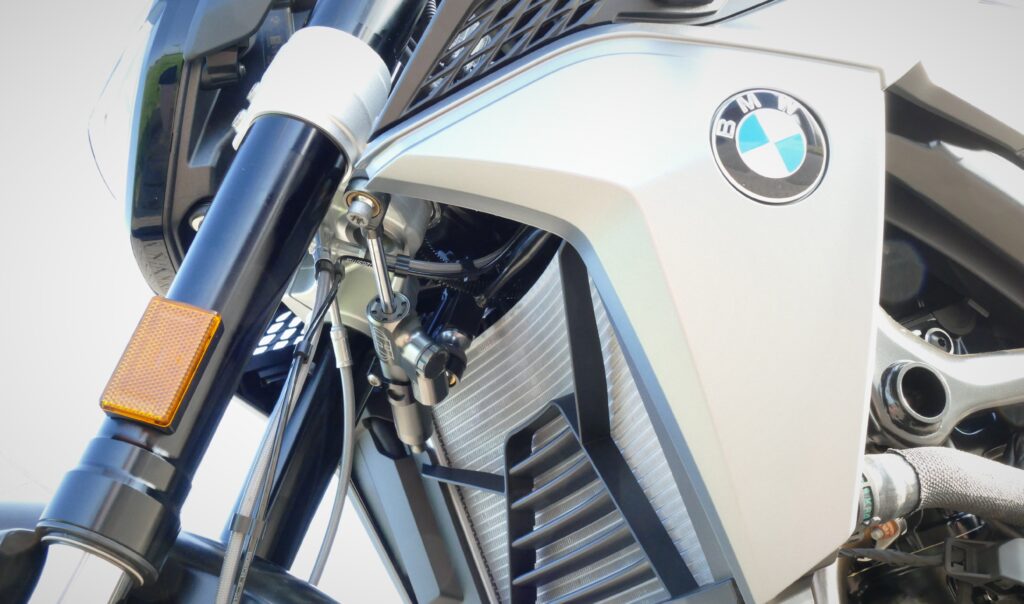
A linear steering damper is a hydraulic device that mounts between the motorcycle’s frame and steering head to resist sudden, uncontrolled handlebar movements. It works by using a piston moving through oil inside a cylindrical housing, converting unwanted steering energy into heat and preventing dangerous wobbles or tank-slappers before they escalate.
Unlike rotary dampers, which use a rotating mechanism, the linear design operates in a straight push-pull motion, making it compact, predictable, and well-suited to a wide range of motorcycle types. Understanding how it functions and when you need one helps you make a more informed decision about your suspension setup.
How does a linear steering damper work?
A linear steering damper works by using a hydraulic piston inside a cylinder filled with oil. When the handlebars move rapidly, the piston is pushed through the oil, which creates resistance proportional to the speed of that movement. Slow, deliberate steering inputs pass through with minimal resistance, while fast, uncontrolled movements are absorbed and damped.
The damper is mounted in a straight line, typically running from a fixed point on the frame to a bracket on the steering head. As the bars turn, the cylinder extends or compresses, and the oil inside controls how freely that movement occurs. Most quality units are adjustable, allowing you to dial in more or less resistance depending on your riding style and conditions.
The key advantage of a linear design is its simplicity and consistency. The resistance is applied in a direct, mechanical relationship with the handlebar movement, which gives riders a predictable and confidence-inspiring feel across a broad range of speeds and road surfaces.
Hyperpro
Ride with confidence
Find the nearest Hyperpro dealer and start your motorcycle upgrade.
What’s the difference between a linear and rotary steering damper?
The main difference between a linear and rotary steering damper is the direction of movement. A linear damper uses a piston that moves back and forth in a straight line, while a rotary damper uses a rotating vane mechanism housed in a compact disc-shaped unit that mounts directly on top of the steering head.
Each design has its own strengths. Linear dampers tend to offer a more straightforward and consistent damping feel, and they are often easier to service. Rotary units are more compact and sit closer to the steering axis, which can make them better suited to motorcycles with limited frame space or a sportier riding position.
From a performance standpoint, the difference comes down to how damping force is generated and applied. A linear damper provides resistance that scales directly with the speed of the piston stroke. A rotary damper can be engineered to vary its resistance based on the angle of rotation, which allows for more progressive behavior in some designs.
For riders looking at motorcycle steering dampers, the choice between linear and rotary often comes down to bike fitment, personal preference, and the specific handling challenge you are trying to solve. Both types, when properly set up, deliver a meaningful improvement in stability and control.
What causes a motorcycle to need a steering damper?
A motorcycle needs a steering damper when the front wheel loses contact with the road surface or encounters sudden, sharp inputs that cause the handlebars to oscillate rapidly. This can happen during high-speed riding, braking over bumps, accelerating hard out of corners, or crossing uneven road surfaces where the front end becomes momentarily light.
The most well-known scenario is a tank-slapper, where the handlebars swing violently from side to side after a front wheel wobble. This typically occurs when the front tyre briefly lifts and then reconnects with the road at speed, causing a rapid and uncontrolled oscillation. Without a steering damper, this can escalate within fractions of a second to a point where the rider loses control.
Other contributing factors include:
- Worn or incorrectly set up fork springs that allow excessive front-end dive
- Tyre imbalance or irregular wear patterns
- High-speed riding on roads with surface changes, expansion joints, or gravel
- Aggressive riding styles that push the limits of the stock suspension setup
- Adventure or off-road riding where the terrain is unpredictable
Some motorcycles are more prone to these issues than others due to their geometry, weight distribution, or the limitations of their factory suspension components. A steering damper does not fix underlying suspension problems, but it adds an important layer of protection when conditions push the bike beyond its stable handling range.
Does a steering damper affect everyday handling?
A well-set-up steering damper has minimal impact on everyday handling. When adjusted correctly, it only resists sudden, high-speed handlebar movements, not the slow and deliberate inputs you use for normal cornering, lane changes, or low-speed manoeuvring. You should not notice it during routine riding.
The key is proper adjustment. If a steering damper is set too stiff, it can make the steering feel heavy and slow to respond, which reduces confidence rather than building it. This is why adjustability matters. A quality unit with multiple damping positions lets you find the right setting for your riding style, whether you are commuting, touring, or pushing harder on a track day.
Some riders worry that adding a damper will make their bike feel different or less agile. In practice, the opposite is often true. By removing the nervous, twitchy feeling that comes from minor road surface imperfections, a steering damper can actually make the bike feel more composed and easier to ride with confidence at any speed.
When should you upgrade to an aftermarket linear steering damper?
You should consider upgrading to an aftermarket linear steering damper if your motorcycle does not come with one from the factory, if you have experienced handlebar wobble or instability at speed, or if your riding has evolved beyond what the stock setup was designed to handle. Performance-oriented riders, frequent highway riders, and those who have modified their bikes are all strong candidates.
Specific situations that point toward an upgrade include:
- You have experienced a tank-slapper, even a minor one
- Your bike feels nervous or twitchy at motorway speeds
- You regularly ride on poor road surfaces or off-road terrain
- You have increased the power output of your engine
- You have changed your tyres to a sportier compound with a different profile
- Your existing steering damper is worn, leaking, or no longer adjustable
An aftermarket unit typically offers better adjustability, higher build quality, and a wider damping range than a factory-fitted damper. If your bike has no damper at all, adding one is a straightforward and worthwhile safety improvement. If it has a basic OEM unit, upgrading gives you more control over how the damping behaves across different riding conditions.
How Hyperpro helps with steering control
We design and manufacture steering dampers specifically to address the handling challenges described throughout this article. Our range includes two models: the CSC (Constant Safety Control), a linear damping unit, and the RSC (Reactive Safety Control), which uses progressive damping to respond differently depending on the speed and severity of the steering input. Both are adjustable across 22 positions, giving you precise control over how the damper behaves.
What makes our approach practical is the fitment system. We develop CNC-milled, model-specific mounting kits for our steering dampers, available in Hyperpro Gold or Black. These kits are designed as plug-and-play installations that require no drilling or cutting in 98% of applications, which means you get a clean, secure fit without modifying your bike.
- Two damper types to match your riding style and bike category
- 22-position adjustment for precise damping control
- Model-specific mounting kits for a clean, bolt-on installation
- Designed to reduce tank-slappers, wobbles, and high-speed vibrations
You can browse our full range of motorcycle suspension products to find the right fit for your bike. Purchases are made through our authorised distributor network. If you have questions about which damper suits your motorcycle, contact us and we will point you in the right direction.