


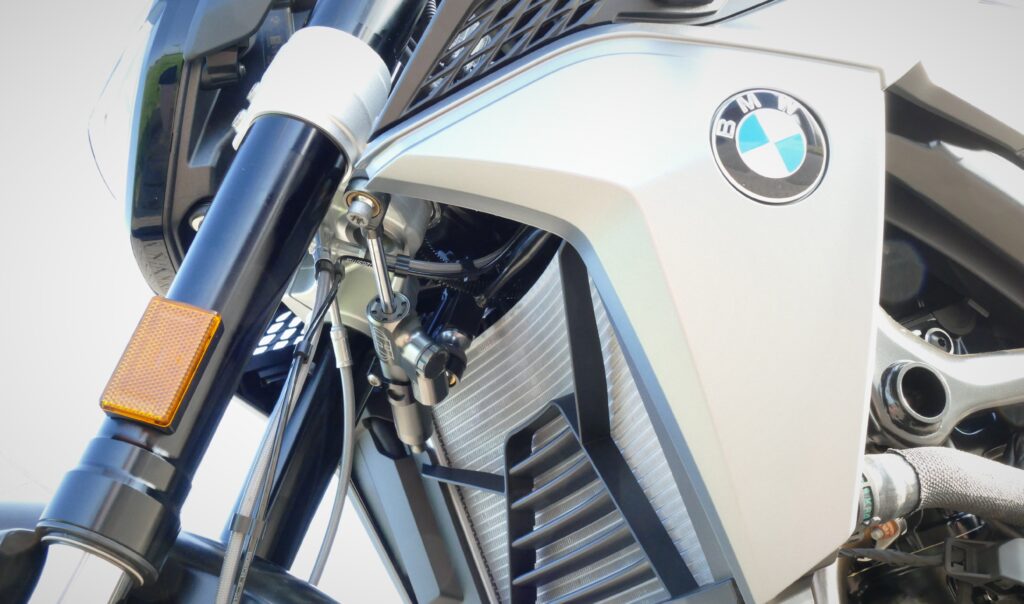
Some motorcycles come with a steering damper as standard because their design, geometry, or intended use makes them more susceptible to high-speed instability. Manufacturers fit these devices from the factory on bikes where the risk of a tank slapper or wobble is high enough that leaving it to the rider to manage would compromise safety. This article unpacks exactly how steering dampers work, which bikes need them, and whether your motorcycle should have one.
What types of motorcycles are most likely to come with a steering damper fitted?
Motorcycles most likely to come with a factory-fitted steering damper are sportbikes, superbikes, and high-performance naked bikes. These machines combine powerful engines with lightweight frames and aggressive geometry, which create the conditions where steering instability is most likely to occur at speed. Adventure bikes and motocross-derived machines also frequently include them due to off-road terrain demands.
The common thread across all these categories is speed and instability risk. A litre-class superbike generating significant wheelie force on corner exits, a large adventure bike crossing rutted tracks at 100 km/h, or a motocross bike landing a jump all place extreme, sudden forces through the front wheel. Without a damper managing those forces, the handlebar can oscillate rapidly and dangerously.
Smaller displacement commuter bikes and cruisers rarely come with steering dampers from the factory. Their lower speeds, heavier frames, and relaxed geometry make spontaneous instability far less likely. When manufacturers do fit a damper as standard equipment, it is a clear signal that the bike’s performance envelope demands it.
Hyperpro
Ride with confidence
Find the nearest Hyperpro dealer and start your motorcycle upgrade.
What does a steering damper actually do on a motorcycle?
A steering damper resists sudden, rapid movements of the handlebar without interfering with normal, deliberate steering inputs. It does this by using hydraulic fluid forced through a controlled orifice to absorb and dissipate the energy of unwanted oscillations. The result is a handlebar that responds normally to rider input but resists the kind of violent, self-reinforcing wobble that can develop at speed.
The key distinction is between slow and fast inputs. When you turn into a corner, you apply a steady, intentional force to the bars. A correctly set steering damper offers very little resistance to this kind of movement. But when the front wheel kicks sideways from a bump, a wheelie landing, or a patch of gravel, the resulting handlebar movement is sudden and rapid. That is exactly the type of input a damper is designed to absorb.
Damping level matters significantly. A damper set too soft provides little protection against genuine instability. One set too firm can make the bike feel heavy to steer and, in extreme cases, can prevent the rider from making quick avoidance manoeuvres. Quality adjustable steering dampers allow riders to dial in the right level of resistance for their riding style and conditions.
What causes a tank slapper and how does a steering damper prevent it?
A tank slapper is caused by the front wheel losing traction or contact with the road and then reconnecting suddenly, sending a rapid oscillation through the forks and handlebar. The wheel kicks to one side, the rider’s hands resist, the wheel overcorrects to the other side, and the cycle repeats and amplifies. Without intervention, the oscillation can escalate fast enough to throw the rider or cause a crash.
Common triggers for tank slappers include:
- A wheelie that drops the front wheel back down at speed with the bars slightly off-centre
- Hitting a pothole, expansion joint, or road irregularity at high speed
- Accelerating hard over a bump mid-corner
- Sudden loss of front traction on a slippery surface
A steering damper interrupts this cycle at the point where the oscillation is still small. Because it resists rapid handlebar movement, it absorbs the initial kick before the self-reinforcing wobble can build momentum. The damper does not eliminate the triggering event, but it prevents the handlebar from swinging freely enough to enter the amplifying oscillation pattern. This is why the device is genuinely effective at preventing tank slappers rather than just reducing their severity.
What’s the difference between a rotary and a linear steering damper?
A rotary steering damper mounts centrally and works by rotating around a fixed axis, while a linear steering damper uses a piston moving back and forth inside a cylinder mounted between the frame and the steering head. The core functional difference is how each type responds to steering movement and how the damping force changes as the bars turn further from centre.
Rotary steering dampers
Rotary dampers are compact and sit neatly on top of the triple clamp. Because they rotate with the steering, they tend to offer more consistent damping across the full range of steering movement. Many factory-fitted dampers on sportbikes use a rotary design because the packaging is cleaner and the mounting is more direct. The damping characteristic can be constant or progressive depending on the internal design.
Linear steering dampers
Linear dampers use a cylinder and piston arrangement, similar in principle to a fork cartridge or shock absorber. They are mounted at an angle between the frame and a bracket on the steering head. As the bars move, the cylinder extends or compresses. Linear dampers are well understood, relatively simple to service, and can offer very precise, adjustable damping. Hyperpro produces both a constant-rate linear model (the CSC) and a progressive-rate linear model (the RSC), each adjustable across 22 positions, giving riders meaningful control over how the damping responds at different speeds and inputs.
Should you add a steering damper if your motorcycle doesn’t have one?
Adding a steering damper to a motorcycle that does not have one is worth considering if you ride at higher speeds, have upgraded your suspension or tyres, or regularly encounter road surfaces that can unsettle the front end. It is not a modification every rider needs, but for those pushing their bike’s performance limits, it adds a meaningful layer of safety and control.
Riders who benefit most from adding an aftermarket steering damper include:
- Sport and naked bike riders who frequently ride at motorway speeds or on track days
- Adventure riders tackling rough terrain where front-end disturbances are common
- Riders who have fitted higher-performance tyres that generate more feedback through the bars
- Anyone who has already experienced a wobble or mild tank slapper and wants to reduce the risk of a repeat
One practical consideration is fitment. A steering damper needs a mounting kit designed for your specific bike to work correctly. A poorly fitted or generic bracket can introduce its own problems. It is worth checking whether a model-specific kit exists for your motorcycle before committing to an aftermarket damper.
If you are unsure whether your bike would benefit, looking at your full suspension setup is a good starting point. Steering stability is closely connected to fork spring rate, shock performance, and overall geometry. A steering damper works best as part of a well-balanced suspension system rather than as a standalone fix for deeper handling issues.
How Hyperpro helps you ride with more confidence
We design and manufacture steering dampers specifically to address the wobbles, vibrations, and tank slappers that riders encounter in real-world conditions. Our range gives you practical options regardless of your bike or riding style:
- CSC (Constant Safety Control): A linear damper with consistent damping response, adjustable across 22 positions, suited to riders who want reliable, predictable performance
- RSC (Reactive Safety Control): A progressive linear damper that responds more dynamically to the severity of the input, also adjustable across 22 positions, designed for riders who want the damper to react proportionally to what the front end is doing
- Model-specific mounting kits: CNC-milled brackets available in Hyperpro Gold or Black, designed as plug-and-play fitments that require no drilling or cutting in 98% of applications
Every damper we produce is built to work as part of a complete suspension system, not as a standalone bolt-on. If you have questions about which damper suits your motorcycle, get in touch with us directly. To purchase, visit one of our authorised distributors, who can guide you through the right choice for your bike and riding conditions.