


After a tank slapper, you should stop riding immediately and inspect your motorcycle before continuing. Even if the wobble corrected itself and you feel physically fine, the event can leave hidden damage to your steering components, tyres, or frame that makes further riding genuinely dangerous. Once you have checked the bike and confirmed everything is intact, riding again is generally safe, but the root cause needs to be addressed before your next serious ride.
A tank slapper is one of the most alarming things a rider can experience, and the instinct to either shake it off or pull over and never ride again is both understandable. The sections below walk through the practical questions every rider should answer after one happens.
What damage can a tank slapper cause to your motorcycle?
A tank slapper can cause damage to your steering head bearings, handlebar grips, fork seals, and in severe cases the frame itself. The rapid, uncontrolled oscillation puts extreme lateral stress on components that are normally loaded in a single direction. The faster the wobble and the longer it lasts, the greater the potential for structural damage.
The most common damage points include:
- Steering head bearings: The violent back-and-forth motion can batter the bearing races, creating notchiness or play that you may not immediately notice but will worsen over time.
- Fork seals and tubes: If the front end dipped or the forks twisted under load, seals can be compromised, leading to oil leaks that reduce damping performance.
- Handlebar and grip damage: Riders gripping the bars during a tank slapper often inadvertently fight the oscillation, which can bend handlebars or strip grip compound.
- Tyre integrity: A severe wobble can scrub or deform a tyre, particularly if it was already at the edge of its wear limit or operating temperature range.
- Frame and subframe stress: In extreme cases, repeated or prolonged oscillation creates micro-stress in welds and joints that is invisible to the naked eye but measurable under load.
The absence of visible damage does not mean the bike is safe. Bearing damage in particular is notorious for feeling subtle at low speeds and becoming dangerous at highway speeds.
Hyperpro
Ride with confidence
Find the nearest Hyperpro dealer and start your motorcycle upgrade.
How do you inspect a motorcycle after a tank slapper?
To inspect your motorcycle after a tank slapper, work through a systematic check of the steering system, front suspension, tyres, and frame before riding again. Pull over somewhere safe, give yourself a moment to settle, and then go through each area methodically rather than relying on a quick visual scan.
Here is a practical inspection sequence:
- Steering head check: With the bike on the centre stand or paddock stand, move the handlebars slowly from lock to lock. Feel for notchiness, grinding, or any point where the steering sticks. Any roughness signals bearing damage.
- Fork tubes and seals: Look along the length of both fork legs for oil weeping around the seals. Run your hand along the tubes to feel for bends or flat spots that would indicate a twisted fork.
- Tyre inspection: Check both tyres for flat spots, visible deformation, or any debris that may have caused the wobble in the first place. Squeeze the tyre and check the pressure if you have a gauge available.
- Handlebar and controls: Confirm the bars are straight and that both brake and clutch levers operate smoothly without binding.
- Frame and swingarm: Look for any fresh cracks in paint around welds, particularly near the steering head and swingarm pivot. Paint cracking in these areas is a warning sign worth taking seriously.
If anything feels or looks wrong during this check, do not ride the bike. Arrange transport and have a qualified mechanic inspect it before you ride again.
When is it safe to keep riding after a tank slapper?
It is safe to keep riding after a tank slapper when your inspection confirms no damage to the steering, suspension, or tyres, and when you have identified and resolved the condition that caused the wobble. If the bike checks out clean and the trigger was a one-off event like a gust of wind or a brief moment of throttle imbalance, continuing your ride is reasonable.
There are situations where you should not ride regardless of how the bike looks:
- The wobble was severe or lasted more than a second or two
- You felt the front end lift or the bike nearly went down
- You cannot identify what caused it
- The steering feels different in any way after the event
- You are physically shaken to the point where your concentration is compromised
Your mental state matters as much as the bike’s condition. Riding while anxious or with elevated adrenaline increases reaction time and reduces decision quality. There is no shame in ending a ride after a tank slapper. The goal is to arrive home safely, not to prove a point.
What causes a tank slapper in the first place?
A tank slapper is caused when the front wheel loses traction or contact with the road surface and then regains it suddenly, sending the steering into a self-reinforcing oscillation. The front end effectively overshoots its correction with each swing, and if the frequency of the wobble matches the natural resonance of the steering geometry, it can escalate rapidly.
The most common triggers include:
- Wheelies and front wheel lift: When the front wheel returns to the ground after lifting under acceleration, it can land at a slight angle that starts the oscillation.
- Hitting a bump or pothole at speed: A sharp impact can momentarily unload the front tyre, creating the same loss-of-contact scenario.
- Crosswinds: A strong gust can push the front of the bike sideways faster than the rider can compensate.
- Worn or mismatched tyres: A tyre that is past its wear limit or inflated incorrectly has reduced self-correcting properties and is more prone to instability.
- Loose or worn steering head bearings: Play in the steering head removes the precise feedback that allows the geometry to self-stabilise.
- Suspension that is too soft or poorly set up: Insufficient damping means the front end cannot absorb inputs quickly enough to prevent oscillation from developing.
Understanding the specific cause of your tank slapper is not just useful for preventing the next one. It tells you whether your bike has an underlying mechanical issue that needs attention or whether the event was circumstantial.
Can upgrading suspension prevent future tank slappers?
Yes, upgrading your suspension can significantly reduce the risk of future tank slappers, particularly when the cause is related to inadequate damping, worn fork springs, or a shock absorber that cannot keep the tyres in firm contact with the road. Better suspension keeps the front wheel planted and responding predictably, which directly reduces the conditions that allow a wobble to develop.
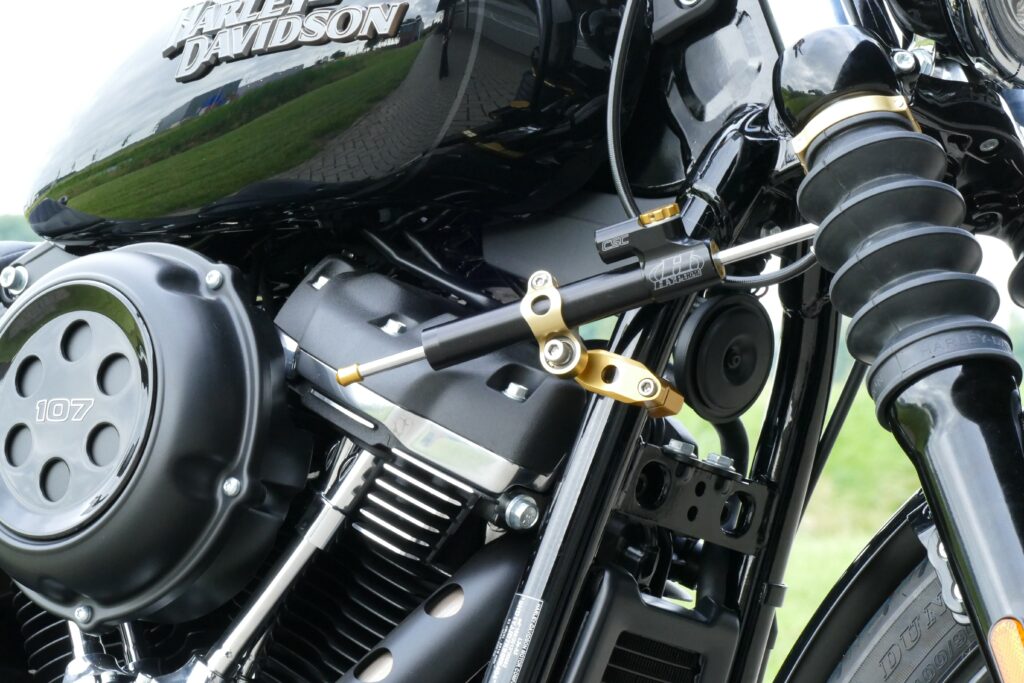
However, suspension upgrades work best when combined with a steering damper, which addresses the oscillation mechanism directly. A steering damper adds resistance to rapid lateral steering movement without interfering with normal cornering input. This means that even if the front wheel does lose contact momentarily, the damper slows the onset of the wobble and gives the rider time to react or the geometry time to self-correct.
Upgraded fork springs with appropriate progressive rates also play a role. Stiffer, better-matched springs reduce fork dive under braking and keep the front geometry in its designed range, which is where the steering is most stable. Combined with quality shock absorbers that maintain rear ride height consistently, the whole chassis behaves more predictably under the kind of inputs that typically trigger a tank slapper.
If you ride at higher speeds, carry a pillion, or regularly encounter challenging road surfaces, these upgrades are worth taking seriously. You can browse suspension components to find options matched to your specific model.
How Hyperpro helps you ride without the risk of tank slappers
We develop suspension and steering control products specifically designed to prevent the conditions that lead to tank slappers. Our approach combines spring technology with active damping solutions that work together to keep your bike stable and predictable.
Here is what we offer to address this directly:
- CSC Steering Damper (Constant Safety Control): A linear damping model with 22 adjustable positions that reduces wobbles and vibrations across a consistent range of steering speeds. Well suited to road riders who want straightforward, reliable protection.
- RSC Steering Damper (Reactive Safety Control): A progressive damping model that responds more aggressively as steering speed increases. This means minimal resistance during normal cornering but strong resistance exactly when a tank slapper begins to develop.
- Model-specific mounting kits: CNC-milled brackets designed as plug-and-play fitments for your specific motorcycle. In 98% of applications, no drilling or cutting is required.
- Progressive-rate fork springs and shock absorbers: Designed to keep both wheels in contact with the road surface under the varied loads that real-world riding produces.
All purchases are made through our authorised distributor network. To find the right products for your bike or to ask a technical question, contact us directly and we will point you in the right direction.