


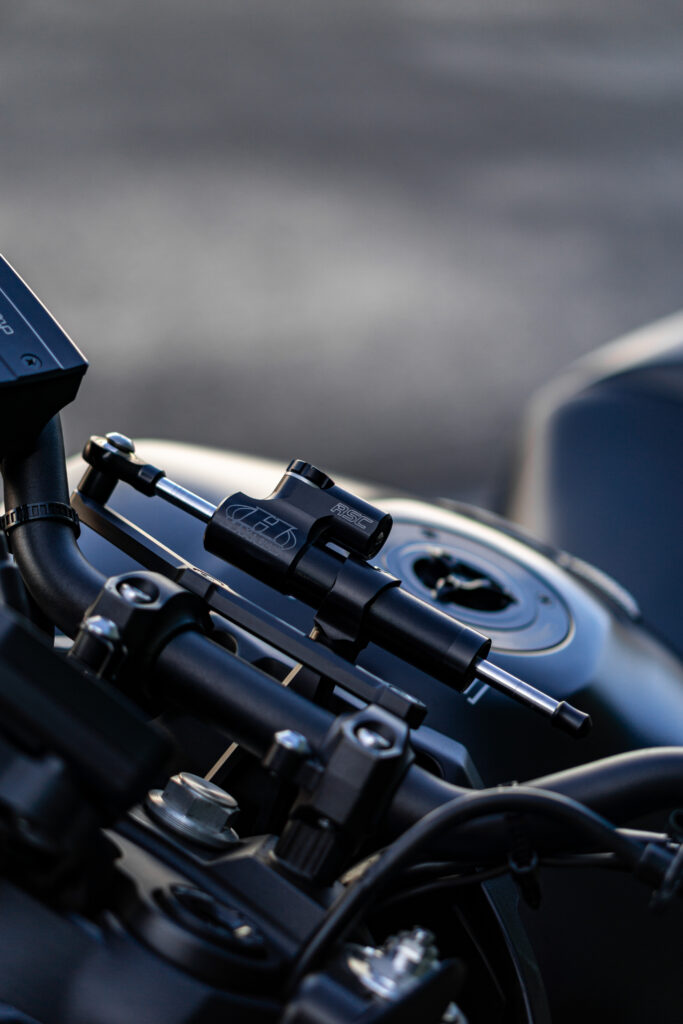
Yes, removing a steering damper can be dangerous, particularly at higher speeds or on motorcycles that are prone to instability. Without a steering damper, the front wheel has no resistance against rapid, unwanted oscillations, which can cause the handlebars to shake violently and result in a loss of control. The risk level depends on your bike, your riding style, and the conditions you ride in.
Below, we answer the most common questions riders have about steering damper removal, tank slappers, and when a damper genuinely needs to be replaced rather than taken off altogether.
What happens to a motorcycle when you remove the steering damper?
When you remove the steering damper, the front wheel loses its primary protection against rapid oscillations. Without this resistance, small disturbances to the front wheel such as road imperfections, bumps, or braking forces can set off a chain reaction where the handlebars begin to shake uncontrollably from side to side. At speed, this can escalate quickly into a tank slapper, one of the most dangerous situations a rider can face.
The steering damper works by absorbing and slowing down these lateral movements before they can amplify. It does not affect your normal steering input at low to moderate speeds, but it acts as a buffer when the front end is disturbed. Without it, the geometry of the bike, the weight distribution, and the tyre contact patch are all that stand between you and an oscillation that the rider physically cannot correct fast enough.
Modern sport and adventure motorcycles are often engineered with the assumption that a steering damper is part of the system. Removing it changes the handling dynamics in ways the manufacturer did not intend.
Hyperpro
Ride with confidence
Find the nearest Hyperpro dealer and start your motorcycle upgrade.
What is a tank slapper and why does it matter?
A tank slapper is a rapid, violent oscillation of the handlebars where the front wheel flicks from side to side fast enough to slam the rider’s hands against the fuel tank. It typically occurs at higher speeds when the front wheel loses traction momentarily, hits a bump, or is disturbed during hard acceleration. Without a steering damper, the oscillation has nothing to slow it down and can become uncontrollable within fractions of a second.
Tank slappers matter because they happen faster than most riders can react. Even experienced riders with excellent reflexes often cannot physically counteract the forces involved once a slapper begins to escalate. The handlebars can hit the tank with enough force to break the rider’s grip entirely, leading to a crash at speed.
The steering damper is the single most direct defence against a tank slapper. It does not prevent the initial disturbance, but it slows the oscillation down enough that the tyre can regain traction and the rider can recover. This is why removing a steering damper on a high-powered or sport-oriented motorcycle is a meaningful safety risk, not just a theoretical one.
Are some motorcycles safer without a steering damper than others?
Yes, some motorcycles are less affected by removing a steering damper than others. Low-powered commuter bikes, cruisers with relaxed steering geometry, and lightweight machines ridden primarily at urban speeds are generally less vulnerable to tank slappers. These bikes are less likely to generate the speed and front-end disturbance that make a steering damper important. That said, no motorcycle is completely immune to oscillation under the right conditions.
High-powered sport motorcycles, naked bikes with aggressive geometry, and adventure bikes ridden at highway speeds carry significantly more risk without a steering damper. These machines produce more front-end lift under acceleration, are more sensitive to road imperfections at speed, and have steering geometry that can amplify oscillations rather than dampen them naturally.
Motorcycles that were factory-fitted with a steering damper are a clear indicator from the manufacturer that the bike needs one. Removing it from these models is not recommended under normal riding conditions. If the original damper is worn or underperforming, replacing it with a higher-quality unit is a better solution than removing it entirely.
Should you remove a steering damper for low-speed or off-road riding?
For low-speed urban riding, removing a steering damper rarely makes a meaningful difference to handling, but it also offers no real benefit. At speeds where tank slappers are unlikely to occur, the damper has minimal effect on steering feel. Removing it is unnecessary rather than helpful. For off-road riding, the answer is more nuanced and depends heavily on the type of terrain and the damper in use.
On technical off-road terrain, some riders find that a steering damper set too stiff can reduce the natural feedback and responsiveness needed to navigate rocks, roots, and uneven ground. However, this is a tuning issue rather than a reason to remove the damper entirely. A well-adjusted or progressive-rate damper can be set to provide very light resistance at slow speeds while still offering protection if the front wheel is suddenly deflected.
Removing a steering damper entirely for off-road use is generally not recommended unless the bike is being used at very low speeds in highly controlled conditions. At the moment the terrain sends a sharp deflection through the front wheel, even off-road, the absence of a damper leaves the rider without a safety buffer.
What are the signs that a steering damper needs replacing rather than removing?
A steering damper that needs replacing will show specific symptoms that are different from a damper that is simply unwanted. If the damper is the problem rather than the solution, replacing it restores both safety and handling quality. The most common signs of a worn or failing steering damper include:
- Visible oil leaks around the damper body or rod, indicating the internal seals have failed
- Inconsistent resistance when moving the handlebars, with some positions feeling stiff and others feeling loose or free
- Clunking or knocking from the steering area, particularly at low speeds or over bumps
- Persistent wobble or instability at speed that was not present when the bike was new or the damper was fresh
- Physical damage to the damper body, mounting brackets, or rod from a fall or impact
Any of these signs point to a damper that has worn out rather than one that is unnecessary. Removing a failed damper leaves the bike without protection. Replacing it restores the safety margin the manufacturer built into the design. If you are unsure whether your damper is still functional, a dealer or suspension specialist can assess it quickly.
How Hyperpro helps you ride with better steering control
If your steering damper is worn, underperforming, or simply not matched to your riding style, we offer a direct solution. Our steering damper range is designed to give you genuine control without compromising steering feel. Here is what we offer:
- CSC (Constant Safety Control) linear damping model with 22 adjustable positions, suited to riders who want consistent, predictable resistance
- RSC (Reactive Safety Control) progressive damping model with 22 adjustable positions, which provides lighter resistance during normal steering and stronger resistance when a tank slapper or wobble begins to develop
- Model-specific CNC-milled mounting kits in Hyperpro Gold or Black, designed as plug-and-play fitments that require no drilling or cutting in 98% of applications
- A full product catalogue covering a wide range of motorcycle makes and models, so you can find the right fit for your specific bike
Replacing a worn damper with the right unit is always a better decision than removing it. You can browse our full product range to find the right steering damper for your motorcycle, or contact us if you have questions about fitment or compatibility. Purchases are made through our authorised distributor network.