


A tank slapper is genuinely dangerous and can become fatal within seconds, especially at high speed. The handlebar oscillates violently from side to side, and if the rider cannot regain control, the motorcycle can crash with little warning. The risk increases sharply above 100 km/h, where the forces involved can overwhelm even experienced riders. Below, we break down exactly what happens, what triggers it, and how to reduce your exposure to this threat.
What actually happens to a motorcycle during a tank slapper?
During a tank slapper, the front wheel loses traction momentarily and then snaps back, setting off a rapid, self-reinforcing oscillation of the handlebars. The wheel swings left, then right, then left again in increasingly violent arcs. If nothing interrupts this cycle, the amplitude grows until the rider loses control or the bike crashes. The name comes from the handlebars literally slapping against the fuel tank at the extremes of each swing.
The physics behind it are straightforward. When the front wheel lifts off the ground, even briefly, the gyroscopic stabilization that normally keeps the steering centered disappears. When the wheel lands again, it touches down at a slight angle. The geometry of the front end then corrects itself, but overshoots, triggering the opposite swing. Each correction adds energy to the oscillation rather than removing it, which is why a tank slapper escalates so quickly.
The rider’s grip on the handlebars can actually make things worse. Holding on tightly transmits the oscillation through the arms and upper body, making it harder to absorb or dampen the movement. Experienced riders are often told to loosen their grip and let the bars move, which is counterintuitive but physically correct.
How fast does a tank slapper become fatal?
A tank slapper becomes potentially fatal at speeds above roughly 80 to 100 km/h. At those speeds, the oscillation cycle is fast enough that the rider has almost no time to react between swings, and the forces involved are large enough to throw the bike off course completely. Below that threshold, the same instability can still cause a crash, but the rider has a marginally better chance of riding it out.
Speed amplifies the danger in two ways. First, it increases the energy stored in each swing, meaning the handlebars hit harder and the correction forces grow larger. Second, it compresses the time available to respond. At 150 km/h, a full oscillation cycle can complete in under half a second. No human reaction time is fast enough to intervene mechanically at that point.
High-speed tank slappers on tracks and open roads have caused fatalities among professional and amateur riders alike. The outcome depends on how quickly the oscillation is damped, whether the rider can hold on, and what the road surface or surroundings look like at the moment control is lost.
Hyperpro
Ride with confidence
Find the nearest Hyperpro dealer and start your motorcycle upgrade.
What causes a tank slapper at high speed?
A tank slapper at high speed is most commonly triggered by a sudden loss and recovery of front-wheel traction, often after a jump, a large bump, or aggressive acceleration over an uneven surface. The front wheel lifts, loses its stabilizing contact with the road, and then touches down misaligned. Other common triggers include hitting a pothole or expansion joint at speed, a sudden weight transfer to the rear, or a tank slapper originating from a wobble that was not caught early enough.
Several factors increase the likelihood of a tank slapper developing:
- Worn or mismatched tyres that reduce grip and predictable traction recovery
- Incorrect tyre pressure, which changes how the contact patch responds to sudden loads
- Loose or worn steering-head bearings, which introduce play into the steering geometry
- Uneven or damaged road surfaces that interrupt front-wheel contact unpredictably
- Aggressive throttle application out of a corner that shifts weight rearward and unloads the front
- Poorly set-up suspension that does not control wheel movement effectively at speed
Motorcycles with longer wheelbases and more relaxed steering geometry are generally more resistant to tank slappers than short, aggressively steered sport bikes. However, no geometry makes a motorcycle immune if the underlying trigger is strong enough.
Can a steering damper prevent a tank slapper?
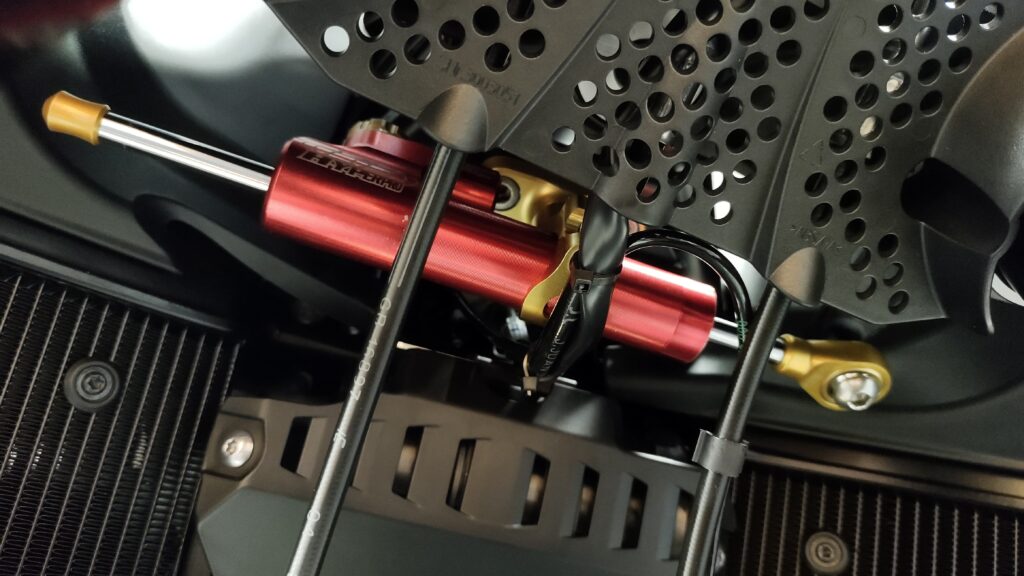
Yes, a steering damper significantly reduces the risk of a tank slapper and can prevent one from escalating into a crash. A steering damper adds resistance to rapid handlebar movement, absorbing the energy of each oscillation swing before it can build into a dangerous cycle. It does not eliminate the initial trigger, but it interrupts the feedback loop that makes a tank slapper self-reinforcing.
The effectiveness of a steering damper depends on its design and how well it is matched to your riding style and motorcycle. A linear damper applies consistent resistance across all steering speeds, which works well for steady-state riding. A progressive damper applies lighter resistance during normal slow steering inputs and increases resistance sharply as the speed of handlebar movement rises, which is more effective at catching the sudden, fast oscillations characteristic of a tank slapper without making low-speed manoeuvring feel heavy.
Our steering damper systems are available in two versions: the CSC (Constant Safety Control) linear model and the RSC (Reactive Safety Control) progressive model. Both offer 22 positions of adjustment, and both come with model-specific mounting kits that fit without drilling or cutting in 98% of applications. A correctly fitted and adjusted steering damper is one of the most direct mechanical steps a rider can take to reduce tank slapper risk.
What should you do if a tank slapper starts while riding?
If a tank slapper starts while you are riding, the most important actions are to loosen your grip on the handlebars, keep your body weight centered and low, and avoid braking sharply or adding throttle abruptly. Loosening your grip allows the bars to move without your arms feeding additional energy into the oscillation. Staying centered keeps the weight distribution stable and gives the front wheel the best chance of recovering traction evenly.
Here is the sequence to follow:
- Relax your grip immediately. Tense arms amplify the oscillation through your body.
- Keep your body upright and centered over the bike. Do not lean to one side.
- Avoid sudden braking. Hard front brake input during a tank slapper can cause an immediate crash.
- Ease off the throttle smoothly to gradually reduce speed without a sharp weight transfer.
- Let the bike stabilize itself. Many tank slappers self-correct within a second or two if the rider does not interfere destructively.
The instinct to grip harder and brake is natural but counterproductive. Practising relaxed, loose-arm riding technique in normal conditions builds the muscle memory that makes the correct response more likely under stress.
Does suspension setup affect tank slapper risk?
Yes, suspension setup has a direct effect on tank slapper risk. A front suspension that is too soft allows the front wheel to unload and lift too easily over bumps, increasing the chance of the instability starting. A suspension that is too stiff transmits sharp impacts to the frame without absorbing them, which can also trigger a sudden loss of traction. Correct spring rate, damping, and preload settings keep the front wheel in consistent contact with the road, which is the foundation of stability.
Worn fork springs are a particularly common contributor. As springs lose their progressive resistance over time, the fork dives more aggressively under braking and recovers more slowly after a bump. Both of these conditions make the front end more vulnerable to the kind of sudden traction loss that starts a tank slapper. Upgrading to correctly rated progressive fork springs restores the front end’s ability to manage rapid load changes without losing contact.
Rear suspension also plays a role. A rear shock that is set too soft allows the bike to squat excessively under acceleration, transferring weight away from the front wheel and making it easier for a wobble to start. Balanced front and rear suspension setup, matched to the rider’s weight and riding style, reduces the overall instability of the motorcycle at speed. You can browse the full range of suspension upgrade options to find components matched to your specific model.
How Hyperpro helps reduce tank slapper risk
A tank slapper is not just an uncomfortable moment on a motorcycle. At speed, it is a genuine safety threat that can escalate faster than a rider can react. The good news is that the mechanical factors that make a tank slapper more likely are all addressable with the right components and setup.
We develop suspension and steering control products specifically designed to reduce this kind of instability:
- RSC Steering Damper with progressive damping that responds harder as handlebar speed increases, catching oscillations before they build
- CSC Steering Damper with consistent linear damping across all 22 adjustment positions for riders who prefer predictable resistance
- Model-specific mounting kits in Hyperpro Gold or Black, engineered as plug-and-play fitments with no drilling required in 98% of cases
- Progressive fork springs and shock absorbers that keep the front wheel loaded and in contact with the road through bumps and weight transfers
Every product we make is designed for a specific motorcycle model, so fitment and performance are predictable rather than approximate. If you have questions about which setup is right for your bike, contact us directly. To purchase, visit an authorized Hyperpro distributor in your region.