


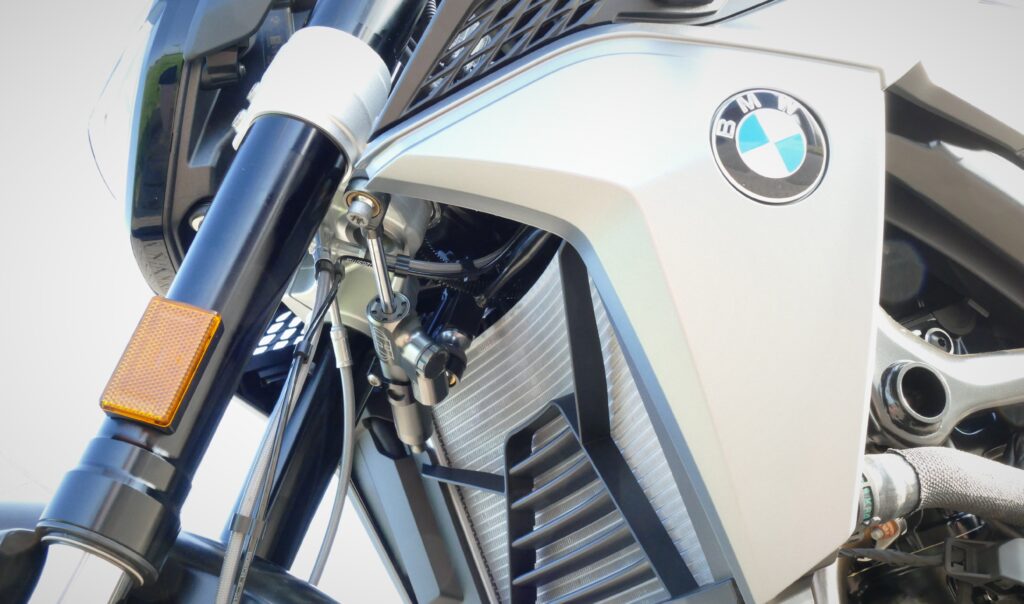
Some brands only offer CSC steering dampers because the CSC (Constant Safety Control) design covers the vast majority of real-world riding scenarios with a single, reliable linear damping mechanism. It is a proven, cost-effective technology that suits most street, sport, and adventure riders, making it the logical choice for brands that prioritize broad compatibility over a tiered product range. Below, we break down exactly what sets CSC apart, why brands make that choice, and when a wider selection actually matters to you as a rider.
What makes CSC steering damper technology different from standard designs?
A CSC steering damper uses linear damping to deliver a consistent level of resistance across the full range of handlebar movement. Unlike more complex progressive systems, the damping force does not change relative to input speed or steering angle. This makes CSC dampers predictable, easy to set up, and effective at neutralizing tank-slappers, wobbles, and high-frequency vibrations in everyday riding conditions.
The “Constant Safety Control” label reflects exactly that behavior: the damper applies the same calibrated resistance whether you are making a slow parking maneuver or recovering from a sudden wobble at speed. Most steering dampers in the CSC category are adjustable, allowing riders to dial in the resistance level to match their riding style and road surface. The result is a straightforward, durable component that requires minimal maintenance and delivers consistent performance across a wide range of conditions.
Where CSC differs most clearly from progressive designs is in how it responds to sudden, high-speed inputs. A progressive damper increases resistance as steering speed rises, offering lighter handling at low speeds and firmer control during a wobble. A CSC damper keeps resistance constant, which some riders find more intuitive and others find slightly limiting in extreme conditions. For the majority of street and adventure riders, however, that difference is rarely noticeable in practice.
Hyperpro
Ride with confidence
Find the nearest Hyperpro dealer and start your motorcycle upgrade.
Why do some motorcycle brands spec only one damper type?
Brands that offer only CSC steering dampers typically do so because one well-engineered damper type covers the needs of their target market without unnecessary complexity. Developing, testing, and stocking multiple damper technologies requires significant investment in engineering, tooling, and inventory. If the CSC design already handles the riding conditions their customers face, adding a second technology tier adds cost without a proportional benefit.
There are also practical reasons tied to fitment. Each motorcycle model requires a specific mounting kit to attach a steering damper to the frame and steering head without drilling or cutting. Designing and manufacturing those kits for two separate damper platforms doubles the development workload. Brands that focus on broad model coverage often find it more efficient to perfect one damper design and build a wide range of compatible mounting solutions around it.
Finally, customer simplicity plays a role. A single, well-explained product is easier to sell, install, and support than a choice between two technologies that many riders do not fully understand. For a brand targeting the general aftermarket rider rather than the track-focused specialist, a single high-quality CSC option is often the right commercial decision.
What are the performance trade-offs between CSC and other steering damper types?
The primary trade-off between a CSC and a progressive RSC steering damper comes down to how the damper responds to different input speeds. A CSC damper delivers the same resistance at all times, which means the rider sets one level of damping and the system holds it. An RSC (Reactive Safety Control) damper increases resistance automatically as steering speed rises, offering a lighter feel during normal cornering and stronger intervention during a sudden wobble.
In practical terms, this creates the following differences:
- Low-speed handling: A CSC damper set to a firm level can feel slightly heavy during slow maneuvers. An RSC damper stays light at low speeds and only firms up when needed.
- High-speed stability: Both types control wobbles effectively, but an RSC damper responds proportionally to the severity of the input, which some riders find more natural.
- Setup simplicity: A CSC damper is straightforward to adjust. You set your preferred resistance and ride. An RSC damper requires understanding how progressive curves work to get the most from it.
- Riding style fit: For street and adventure riders, the CSC is typically sufficient. For sport riders pushing hard on the track or fast roads, the RSC’s reactive behavior can feel more transparent.
Neither type is objectively superior. The right choice depends on your riding style, the roads you use most, and how much you want to tune your setup.
Does a CSC-only catalog limit fitment options for your bike?
A CSC-only catalog does not necessarily limit fitment options for your bike. Fitment is determined by the mounting kit, not the damper technology itself. If a brand has developed a model-specific mounting kit for your motorcycle, a CSC damper can be fitted to it regardless of whether an RSC option also exists. The damper type and the fitment range are two separate considerations.
What can limit fitment is the breadth of a brand’s mounting kit catalog. A brand that only offers CSC dampers but has engineered kits for hundreds of models gives you more fitment options than a brand with two damper types but a narrow kit range. When evaluating whether a brand covers your bike, check the mounting kit compatibility first, then consider which damper technology suits your riding.
You can browse available motorcycle suspension products to check fitment for your specific model before making a decision.
When should a rider choose a brand that offers multiple damper technologies?
A rider should choose a brand offering multiple steering damper technologies when their riding demands more nuanced control than a constant-rate damper provides. This is most relevant for sport riders who spend time on the track, riders who frequently switch between slow technical roads and fast open highways, or anyone who wants the damper to adapt automatically rather than requiring manual adjustment between different conditions.
It also makes sense to seek out a multi-technology brand when you have already tried a CSC damper and found it either too firm at low speeds or not reactive enough during high-speed instability events. That feedback tells you that a progressive, speed-sensitive design would better match your expectations.
On the other hand, if you ride primarily on public roads, tour on an adventure bike, or simply want a reliable upgrade that removes wobbles and vibrations without a complex setup process, a well-engineered CSC damper from a brand with strong model coverage is likely all you need. The technology choice matters less than the quality of the damper and the precision of the mounting solution.
How Hyperpro helps you choose the right steering damper
We design and manufacture two steering damper systems to cover the full range of rider needs: the CSC (Constant Safety Control) for consistent, predictable linear damping, and the RSC (Reactive Safety Control) for progressive damping that responds to steering speed. Both are adjustable across 22 positions, giving you precise control over your setup.
- CSC damper: Constant resistance across all steering inputs. Ideal for street, touring, and adventure riders who want reliable wobble control and a straightforward setup.
- RSC damper: Progressive resistance that increases with steering speed. Better suited to sport riders and those who want the damper to adapt automatically to conditions.
- Model-specific mounting kits: CNC-milled in Hyperpro Gold or Black, designed as plug-and-play fitments for your exact motorcycle. No drilling or cutting required in 98% of applications.
- Broad model coverage: We develop mounting kits across a wide range of street, sport, and adventure motorcycles so you can find a solution that fits your bike correctly.
If you want to find out which damper and kit combination suits your motorcycle, contact us directly or visit one of our authorized distributors. Purchases are always made through our distributor network to ensure you receive the correct product and proper support for your installation.